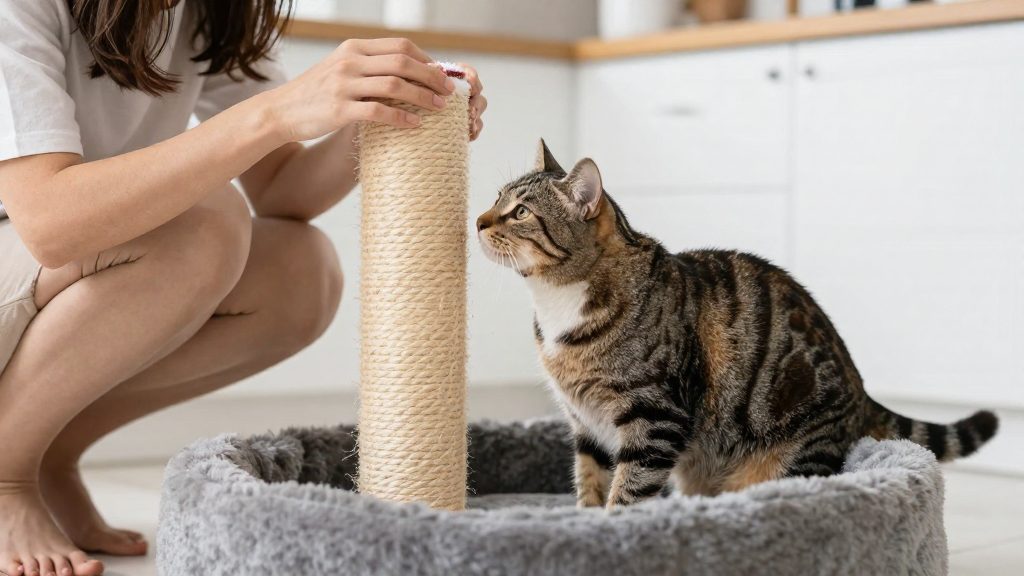
Before bringing a shelter cat home, check that the space can meet its basic needs for litter, food, rest and safety. A cat needs a dedicated litter area, a home free of accessible hazards, and a clear decision on whether it will live indoors, outdoors, or move between the two. The official sources consulted do not specify minimum numbers of litter trays, room sizes or plant lists, so this section focuses on the checks and methods that apply to any home.
Is my home ready for a cat?
Litter tray number and placement
Plan for litter trays before the cat arrives, not after. Shelters often send a cat home with limited information about its previous toilet habits, so the setup needs to work from day one.
- Place trays in quiet, accessible spots, away from the feeding area.
- If the home has several floors or rooms the cat will use, position trays so the cat does not have to cross open space or pass a noisy appliance to reach one.
- Choose a tray size and litter type the cat can step into comfortably. Ask the shelter which litter the cat has used, since a sudden change can cause it to avoid the tray.
- Clean trays regularly and watch for toilet use outside the tray, which can signal stress or a health problem that needs a vet.
Household hazards and toxic plants
Walk through the home at cat height and identify anything the cat could chew, swallow, climb or knock over. Cats investigate with their mouths and paws, so items on low surfaces matter most.
- Store medicines, cleaning products, and human food securely.
- Check houseplants and cut flowers against a current veterinary toxicity resource for your country before bringing them in. Plant toxicity varies by species, so a general online list is not enough.
- Secure loose cables, small objects and open windows or balcony gaps.
Indoor versus outdoor access
Decide the access arrangement before adoption and make sure the home supports it.
- Indoor-only living requires window and balcony screening, enrichment such as climbing furniture and toys, and a tray system that works without outdoor access.
- Outdoor access requires a secure perimeter, a plan for supervision, and confirmation that local rules allow it.
- A cat that has never been outside may be happy as an indoor-only cat. A cat used to outdoor life may need a different plan to adjust to indoor living, so discuss the options with the shelter and your vet.
What does the shelter know about the cat’s history?
Shelters rarely hold a complete life story, but they usually know more than a private seller or a classified-ad listing. According to the Montreal SPCA, quoted by MTL Blog (2022-11-28), shelters can describe each animal’s personality, behavioural needs and health issues. Your job is to turn that general description into specific answers about the cat’s past, its known triggers and how it behaves in a home. Ask staff what they have directly observed, and ask separately what was reported at intake.
Previous owner, origin and surrender reason
Ask whether the cat came from a household, was surrendered by an owner, or was found as a stray. The official sources consulted do not specify what intake records typically contain, so ask staff what they actually have on file and what they do not know. A clear “we don’t know” is more useful than an invented story.
Known behaviour, wariness and triggers
Royal Canin Canada recommends asking about the cat’s usual behaviour, what it is wary of, whether it is comfortable alone, and how it reacts to children and to other animals. These answers shape daily life more than any other part of the history. Record the triggers staff have seen, such as loud noises, handling or new people, and ask what the cat does when it is stressed.
Previous home and lifestyle history
Ask what kind of life the cat has led, how it handles different environments, and whether it is used to going outside. A cat that has lived with children or in a busy household may adapt differently from one raised in a quiet home.
Judging reliability
Compare how much usable information each source gives:
| Source | Behaviour and personality | Health issues described | History reliability |
|---|---|---|---|
| Shelter | Described by staff, including behavioural needs | Described, per the Montreal SPCA | Based on what staff have observed and what they know |
| Classified-ad sale (e.g. Kijiji) | Usually not described in a verifiable way | Not reliably documented | Little reliable history, per the Montreal SPCA |
The SPCA also warns that classified-ad sales can involve kitten mills, so a seller who avoids questions about the cat’s background is a warning sign. Treat detailed, consistent answers from staff as a positive signal, and vague answers as a reason to ask more questions.
What health care has the cat already had?
According to Royal Canin Canada, shelter cats are usually treated for parasites, examined by a vet, and often sterilised and vaccinated before adoption. “Usually” and “often” are not guarantees, so ask for the written records instead of relying on a verbal assurance. Three records matter most: the parasite treatment record, the vaccination status, and the sterilisation record. The official sources consulted do not specify one deworming or vaccination schedule that applies to every shelter, so the dates and products written on each record are what you need to check.
Parasite treatment and deworming records
Ask for the date of each treatment, the product name as written on the record, and the name of the clinic or person who gave it. A treatment with no date cannot tell you when the next one is due. Treatments given shortly before adoption show when the cat was last covered, so note them on your own file.
Vaccination status and booster dates
Request a dated vaccination history listing each vaccine given, its date, and the date the next booster is due. Boosters are scheduled at set intervals, so an undated entry is not enough to plan the next visit. Confirm with the shelter that the record will travel with the cat, so the new vet can continue the schedule without repeating doses unnecessarily.
Sterilisation records
Ask whether the surgery was performed, the date, and whether a vet signed the entry. Keep this record with the others, because it affects future planning and the vet will want it on file.
After adoption
Bring all three records to the first appointment with your own vet. Ask the clinic to note the dates of the last treatments and vaccines in its system, so the next due dates are tracked from the start.
How will the cat get along with kids and pets?
Social compatibility is the part of a shelter cat’s profile that paperwork rarely settles. Shelters also assess the adopter’s lifestyle, so the same conversation can cover whether your home has young children, frequent visitors or other pets.
Reactions to children and noise
During a meeting, watch how the cat responds to children’s voices, quick movements and everyday household sounds such as a vacuum cleaner, a doorbell or a running tap. Note whether it hides, stays still, or approaches. The official sources consulted do not give a noise threshold or tolerance scale, so judge the cat by its observed behaviour rather than by a measurement.
Behaviour with dogs, cats and other pets
Ask how the cat has behaved with other animals and whether it has shared a space with them. If your household already has a pet, a supervised first contact in a separate room, with both animals able to leave the encounter, is a practical way to observe the cat’s response before any shared living. Watch for behaviour with other animals that signals stress, such as persistent hiding, fixed staring or hissing, and treat those signs as a reason to ask more questions rather than to proceed.
Trial meetings before the final decision
Royal Canin Canada advises visiting the cat several times before adopting so it can get to know you. Use each visit to test one variable:
| Visit focus | What to observe |
|---|---|
| Quiet visit, adults only | Approach, hiding, posture |
| Children present | Reaction to voices and sudden movement |
| Household pet present | Hiding, chasing, staring |
| Typical household noise | Startle, withdrawal, or settling |
What does adoption really cost?
Adopters are usually asked for a financial contribution (Royal Canin Canada). A cat can live about 15 years and needs vet care throughout its life, according to the Montreal SPCA (2022-11-28, quoted by MTL Blog). The official sources consulted do not specify the contribution amount, which is set by each shelter, so ask for the figure directly and compare it with other options.
What the adoption contribution usually covers
The Montreal SPCA states that adoption is often cheaper than buying a cat once vaccination, spay/neuter, microchipping and insurance are counted.
| Stage | What the sources say | Source |
|---|---|---|
| Recurring | Annual checkups and vaccines | MTL Blog, quoting the Montreal SPCA (2022-11-28) |
| Long term | Vet care throughout the cat’s life | MTL Blog, quoting the Montreal SPCA (2022-11-28) |
Insurance and recurring vet spending
The official sources consulted do not specify premium levels, deductibles or coverage limits. Request written quotes from insurers and compare what each policy excludes before you commit.
Planning for a long-term commitment
To estimate total spending, list the yearly costs (vet checkups, vaccines, insurance, food and litter) and multiply them across the cat’s expected lifespan. Add an allowance for unplanned treatment, because a cat’s health can change at any age. A written plan based on this horizon shows whether the household can sustain the cost over the full life of the animal.
How long does a cat take to settle in?
A newly adopted cat typically needs one to three months to adjust to a new home, according to the Montreal SPCA as relayed by MTL Blog (2022-11-28). This is a range, not a deadline. Settling-in speed depends on the cat’s past experiences, its temperament, and how gradually it is exposed to the home.
Stress signs and hiding
Hiding can be part of adjustment, but it can also signal stress or illness, so watch the cat closely. Signs that a cat is stressed rather than simply cautious include:
- Staying under furniture or in a closet for most of the day
- Eating noticeably less, or not eating at all
- Excessive grooming, sometimes to the point of bald patches
- Flattened ears, dilated pupils, or a low, tucked tail when approached
- Hissing or swatting when someone comes near
If a cat shows difficulty breathing, go to a veterinarian or emergency clinic immediately. If it stops eating, or shows vomiting, diarrhoea or lethargy, contact a veterinarian the same day. Do not wait for the adjustment window to pass. The sources consulted do not give a fixed number of days after which hiding should be considered abnormal.
Introducing the cat to rooms gradually
Opening the whole home at once can overwhelm a cat that is still adjusting. A staged approach gives it a secure base to return to:
| Stage | What to do | Why it helps |
|---|---|---|
| 1. Single room | Keep the cat in one quiet room with its food, water, bed, and a hiding place | Limits new sights, sounds, and smells at the start |
| 2. Adjacent room | Open the door for short periods while you stay nearby | Lets the cat explore at its own pace with you as a reference point |
| 3. Wider home | Extend access room by room as the cat moves around confidently | Avoids sudden exposure to unfamiliar areas |
Move to the next stage only when the cat is eating, moving about, and approaching you on its own terms. Going back a stage is normal if it begins hiding again after a change.
What do lease and local rules say?
Before you adopt a shelter cat, confirm in writing that your housing and your municipality allow it. The Montreal SPCA advises checking whether your lease allows cats and whether you can commit to the animal long term (MTL Blog, quoting the Montreal SPCA, 2022-11-28). Whether a no-pet clause can be enforced depends on your province, so check your lease and your provincial tenancy rules before any visit to a shelter.
Lease clauses on cats and pet deposits
Read the full lease rather than relying on a verbal agreement. Look for:
- Pet clauses: whether cats are allowed outright, allowed with written consent, or excluded by building or breed rules.
- Pet deposits or pet rent: whether an extra payment is requested. Provincial law may restrict or prohibit such payments, so verify with your provincial tenancy authority before paying.
- Damage and cleaning terms: any responsibility for scratching, odours or litter-related damage.
The official sources consulted do not specify typical deposit amounts or standard clause wording, so these details must come from your own lease and your landlord.
Landlord consent and written approval
If the lease does not clearly permit cats, request written approval before adopting. A practical sequence:
- Send the landlord a short message describing the animal’s species, age and whether it is neutered.
- Keep the reply in writing, including any conditions attached.
- Bring that approval to the shelter.
Local licensing and microchip registration
Municipal licensing and microchip registration rules vary by city and province, and the sources consulted do not specify the requirements for every area. Check with your municipality or animal services department. For lease disputes, such as a no-pet clause or a refused consent, contact your provincial tenancy authority or seek legal advice. Check with your local municipal office or animal services department before bringing the cat home, and ask the shelter what identification records it will provide at adoption.
Frequently asked questions
What should I ask a shelter about a cat before adopting it?
Ask about the cat’s age, its past life, whether it copes well when left alone, what startles or worries it, and how it reacts to children and other animals. Also ask whether it has lived outdoors, because that history affects which access arrangement will suit it (Royal Canin Canada, undated).
What health care does a shelter usually handle before adoption?
Shelter cats are usually treated for parasites, examined by a vet, and often sterilised and vaccinated before they leave, and the shelter typically assesses your lifestyle first (Royal Canin Canada, undated). Adopters are usually asked for a financial contribution, but the official sources consulted do not specify the amount or what it covers, so ask the shelter directly.
What health signs should I watch for during the first weeks at home?
A newly adopted cat typically needs one to three months to adjust, according to the Montreal SPCA as relayed by MTL Blog (2022-11-28). Do not wait for that period to pass if the cat stops eating, vomits, has diarrhoea or seems lethargic: contact a veterinarian the same day. If it has difficulty breathing, go to a veterinarian or an emergency clinic immediately.