Suitable guinea pig bedding is absorbent, controls odour and resists mould, and contains no chemicals that a guinea pig could ingest while nibbling. The official sources consulted do not give numeric thresholds for absorbency or odour, so these criteria are qualitative. Each one can be checked by observing the cage and the material itself. Choosing bedding means testing a material against these properties before comparing brands or types.
What makes bedding safe for guinea pigs?
Guinea pigs urinate often and nibble their environment, so bedding has to do two jobs at once: keep the floor dry and clean, and stay harmless if it is chewed. The table below summarises the properties to check and what the sources say about each.
| Property | What to check | What the sources say |
|---|---|---|
| Absorbency | Takes up urine and keeps the surface dry | Good bedding should be absorbent (The Vet Desk, 2025) |
| Odour control | Limits smell between full cleanings | Paper-based bedding has good odour control; aspen has little (Purdue University College of Veterinary Medicine, 2026) |
| Mould and mildew resistance | Does not grow mould when damp | Good bedding resists mould and mildew (The Vet Desk, 2025); corncob moulds easily (Purdue, 2026) |
| Chemical-free | No added chemicals or inks | Bedding should be free of chemicals because guinea pigs may nibble it (The Vet Desk, 2025) |
| Digestibility | Low risk of blockage if eaten | Corncob is poorly digestible and can cause impaction if eaten (Purdue, 2026) |
Absorbency and moisture control during daily use
Absorbency is the first property to test. Bedding that takes up urine keeps the surface dry between spot-cleans. Fleece liners work as an alternative, but they need frequent washing (The Vet Desk, 2025).
Odour control between full cleanings
Odour control determines how often the cage must be fully cleaned. Paper-based bedding and paper pellets have good odour control.
Safety when a guinea pig nibbles or eats it
Because guinea pigs chew their bedding, the material must be free of chemicals and must not block the digestive tract. Corncob is poorly digestible and can cause impaction if eaten (Purdue, 2026). Torn cardboard with labels removed is an alternative for guinea pigs that chew, provided the cardboard is torn rather than cut (The Vet Desk, 2025).
Paper-based bedding and pellets
Paper-based bedding and paper pellets are the options in this group with good odour control, according to Purdue University College of Veterinary Medicine (2026). That makes them a practical choice when the cage cannot be cleaned as often as you would like. Their handling limits are different, though: pellets feel rough underfoot, and printed materials carry a risk that plain paper does not.
Purdue notes that pellets can feel rough when used alone, and recommends topping them with timothy hay. Purdue also states that water should be changed daily (Purdue University College of Veterinary Medicine, 2026).
Two alternatives appear in The Vet Desk’s guidance (2025):
- Torn cardboard: use torn, not cut, cardboard with the labels removed before it goes into the cage.
- Printed newspaper: the guidance treats it as an emergency-only option because of its inks. It should not be used as routine bedding.
| Option | Odour control | Handling limit | Source |
|---|---|---|---|
| Paper-based bedding | Good | Not stated in the consulted sources | Purdue (2026) |
| Paper pellets | Good | Feel rough alone; top with timothy hay | Purdue (2026) |
| Torn cardboard | Not stated in the consulted sources | Labels must be removed; tear rather than cut | The Vet Desk (2025) |
| Printed newspaper | Not stated in the consulted sources | Emergency use only, because of inks | The Vet Desk (2025) |
Is aspen a good choice, given its little odour control?
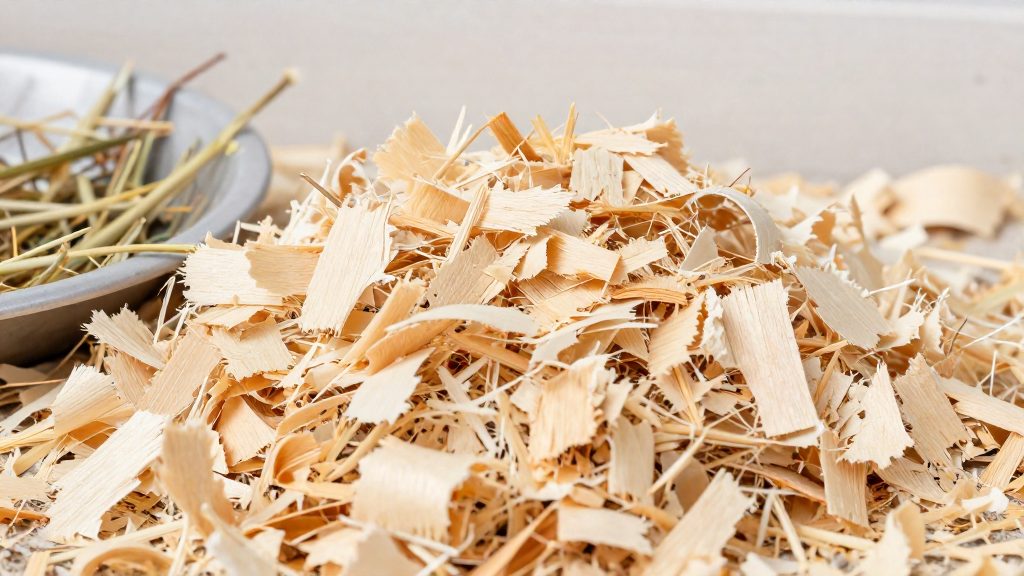
Purdue names aspen shavings as a safe bedding, but they have little odour control and the consulted sources do not cover their absorbency. Purdue University College of Veterinary Medicine (2026-06-25) names aspen explicitly as safe bedding in its veterinary guidance. The main drawback is odour. Purdue notes that aspen has little odour control, so the bedding itself will not keep smells down, and the cage needs regular, thorough cleaning to stay fresh.
Aspen compared with paper-based bedding
Odour is the clearest point of difference between aspen and the paper-based options Purdue covers. If smell is your main concern, paper-based bedding performs better on this measure than aspen. Aspen remains a recognised safe choice, but it asks more of the owner in terms of cage hygiene.
What the sources do not cover
The official sources consulted do not specify aspen’s absorbency or its resistance to mould and mildew, so you cannot confirm from these sources how aspen performs on them. Check the product’s own information on absorbency before relying on it for a cage with a heavy urine load.
Fleece liners as a reusable option
Fleece liners are the reusable alternative to disposable bedding. According to The Vet Desk (2025), fleece liners are an economical option that can replace other bedding entirely, so the cage floor does not need a separate loose layer beneath them. The cost of that saving is upkeep: liners need frequent washing, and the practical way to manage this is to keep several in use.
Rotation keeps the cage usable at all times. When the cage is soiled, remove the used liner, place a clean one in its position, and wash the used one. The next time the cage needs changing, the cycle repeats. The official sources consulted do not specify washing temperatures, detergents, drying times or how many liners a cage needs, so follow the manufacturer’s care instructions for the specific product.
Which bedding should you avoid?
Cedar shavings, pine, corncob, straw and cat litter are the bedding materials to keep out of a guinea pig cage. Purdue University College of Veterinary Medicine (2026) says cedar should be avoided at all costs, and the Vet Desk, reviewed by Dr. Marta Vidal-Abarca (2025), lists softwood shavings, cat litter and corn cob among materials to avoid. Each material carries a different hazard, so knowing the reason helps you judge products that are not on these lists.
Cedar and pine: respiratory and liver risks
Cedar shavings are linked to respiratory problems and liver changes in guinea pigs, according to Purdue (2026). Pine is also a problem because its aromatic oils can irritate guinea pigs. Purdue adds that even kiln-dried pine is probably best avoided, so heat treatment does not make pine a safe choice in this source’s view. The Vet Desk groups cedar and pine together as softwood shavings to avoid.
Corncob: impaction and mould
Purdue (2026) does not recommend corncob bedding because it is poorly digestible and can cause impaction if eaten. It also moulds easily, which adds a hygiene risk.
Straw and cat litter
Purdue (2026) describes straw and cat litter as unsuitable for guinea pigs. The official sources consulted do not specify the exact hazard posed by straw. The Vet Desk lists cat litter among materials to avoid.
Is hay bedding or a top layer?
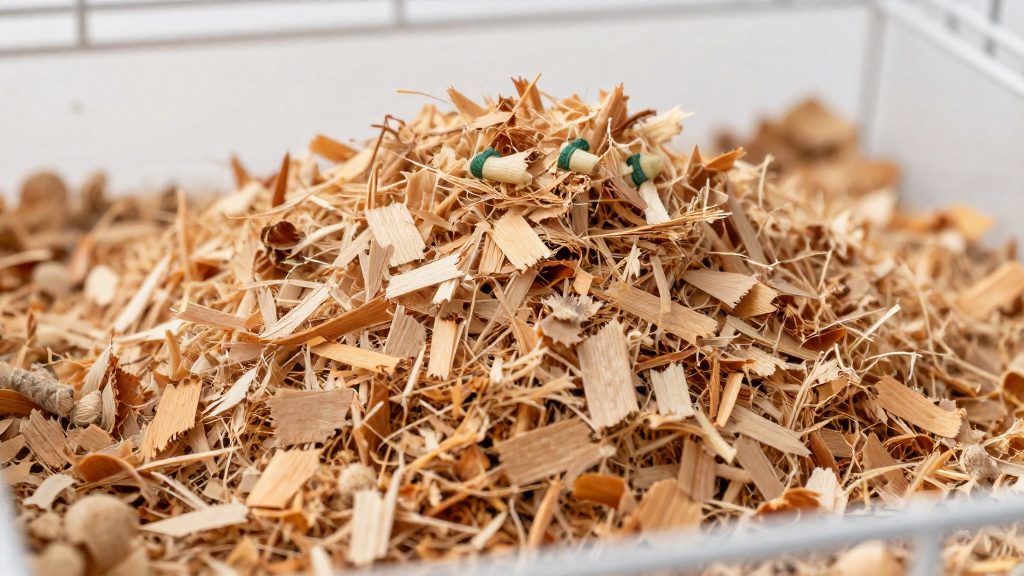
Timothy hay works as a top layer, not as a complete bedding. According to Purdue University College of Veterinary Medicine (2026), it supports tunnelling and nesting and absorbs some urine, but it does not control odour and moulds when wet. It therefore covers a behavioural need and adds partial absorbency, so it works best alongside a base material that handles moisture and smell.
Tunnelling and nesting
Guinea pigs dig into loose material and build nests from it. A layer of timothy hay gives them the material for both behaviours, which is the function Purdue (2026) attributes to it in the cage. The official sources consulted do not specify a minimum depth for this layer.
Partial urine absorption without odour control
Timothy hay takes up some of the urine that reaches it, but it does not neutralise smell. Purdue (2026) states that hay offers no odour control, so a hay top layer cannot be relied on to keep the enclosure smelling clean. Once wet, it moulds, which is why soiled hay cannot simply stay in place.
Replacement interval
As a top layer, timothy hay can be changed every one to two days (Purdue University College of Veterinary Medicine, 2026). This top-layer interval is shorter than the replacement cycle described for paper-based bedding, which Purdue says may last a week or more.
| Property | Timothy hay as a top layer |
|---|---|
| Tunnelling and nesting | Supported |
| Urine absorption | Partial |
| Odour control | Not provided |
| When wet | Moulds |
| Replacement interval | Every one to two days |
How often should you change bedding?
Replacement frequency depends on the bedding material and how well it controls odour and moisture. According to Purdue University College of Veterinary Medicine (2026), paper-based bedding may last a week or more. The official sources consulted do not give a fixed number of days for aspen, so the interval should be set by smell and by the condition of the bedding.
Replacement intervals by bedding type
| Bedding | Odour control | Replacement guidance |
|---|---|---|
| Paper-based bedding | Good (Purdue, 2026) | May last a week or more before a full change |
| Paper pellets | Good (Purdue, 2026) | No fixed interval given in the consulted source |
| Aspen shavings | Little (Purdue, 2026) | Strict cleaning required; no fixed interval given in the consulted source |
Odour-driven cleaning frequency
With aspen, odour is the signal to act, not the calendar. Because aspen does little to control smell, check the cage regularly and clean it as soon as a smell develops. Bedding that is wet or shows mould should also be replaced early.
Spot cleaning versus full cage changes
Spot cleaning removes only the soiled or wet areas and leaves the clean bedding in place. It suits cages where the bedding is still dry and free of smell. A full cage change empties the enclosure, cleans it, and refills it with fresh bedding. Use a full change when odour or dampness is spread across the whole floor, or when the bedding is already due for replacement under the intervals above.
The consulted sources do not specify how often spot cleaning should be done between full changes.
When to see a vet
Some bedding choices, such as cedar or corncob, are linked to health problems, and some reactions to a new material are signs that a veterinarian should assess the animal. The signs below are grouped by what they may indicate, with the bedding link stated only where the sources consulted support it. Any of these signs should be checked by a vet promptly, without waiting to see whether a bedding change helps.
Respiratory signs
Laboured breathing that begins after a bedding change, and any new sneezing or nasal discharge, are the signs to act on first. If a guinea pig breathes with visible effort, treat it as an emergency and contact a veterinarian or an emergency clinic immediately. Do not wait to see whether the signs pass.
Changes in appetite or droppings
After new bedding is introduced, reduced appetite, fewer droppings, or droppings that become noticeably smaller or different in appearance need prompt veterinary attention, whatever the bedding. A guinea pig that has been chewing corncob and then passes fewer droppings needs prompt veterinary attention.
Lethargy, weight loss or refusal to eat
A guinea pig that stops eating or becomes markedly less active needs urgent veterinary care the same day, whatever its bedding. Weight loss also needs a prompt veterinary examination. The sources consulted do not tie these signs to a particular bedding type, so they should not be attributed to the bedding without a vet’s examination. Do not delay contacting a vet while trying bedding changes.
| Sign | Bedding link stated in the sources | Action |
|---|---|---|
| Sneezing, nasal discharge, laboured breathing | Cedar linked to respiratory problems (Purdue University College of Veterinary Medicine, 2026) | Contact a vet promptly |
| Reduced appetite, fewer or changed droppings | Corncob poorly digestible, can cause impaction if eaten (Purdue University College of Veterinary Medicine, 2026) | Contact a vet promptly |
| Lethargy, weight loss, refusal to eat | No bedding-specific link in the sources consulted | Contact a vet; the cause is not assumed to be bedding |
The official sources consulted do not specify a time window for acting. The practical rule is to contact a vet as soon as a sign appears, not after a waiting period.
Frequently asked questions
Which bedding should a beginner avoid?
Avoid cedar and pine shavings, which Purdue University College of Veterinary Medicine (2026) links to respiratory problems and liver changes in the case of cedar, and to irritation from aromatic oils in the case of pine. Also avoid corncob, which is poorly digestible and moulds easily, and straw or cat litter, which the same source describes as unsuitable.
Can I use hay as bedding?
Hay works as a top layer for tunnelling and nesting, and it absorbs some urine. It does not control odour and moulds when wet, so Purdue University College of Veterinary Medicine (2026) advises changing the top layer every one to two days.
When should I call a vet after changing bedding?
Visible breathing effort is an emergency: contact a veterinarian or an emergency clinic immediately rather than waiting to see whether the signs pass. A guinea pig that stops eating, becomes markedly less active, or produces noticeably fewer droppings needs same-day veterinary care, whatever bedding it lives on.