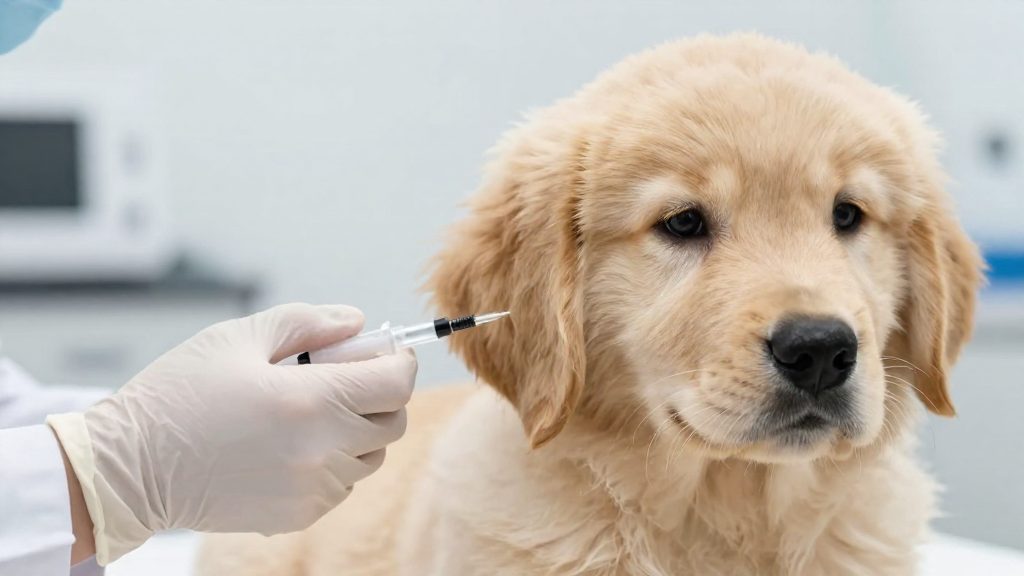
Core vaccines are the vaccines the AAHA recommends for every dog, regardless of lifestyle or environment, because they protect against diseases that spread easily and cause serious or fatal illness. The 2022 AAHA Canine Vaccination Guidelines name four core vaccines: canine distemper virus (CDV), canine adenovirus type 2 (CAV-2), canine parvovirus type 2 (CPV-2) and rabies. In the 2022 version, every other vaccine covered by the guidelines is non-core, and its recommendation depends on the individual dog (see the leptospirosis section for the reported 2024 change).
What counts as a core vaccine for dogs?
The classification rests on two linked criteria. A core vaccine protects against a disease that is easily spread and serious or fatal. Because that risk applies to any dog, the recommendation does not change with lifestyle or environment. The only exception named in the guidelines is a medical reason that prevents vaccination.
A non-core vaccine is recommended according to the dog’s lifestyle and risk. Its need is assessed case by case rather than set for all dogs. The 2022 guidelines list five non-core vaccines that may be essential based on risk: Leptospira, Lyme disease, Bordetella (with or without parainfluenza), canine influenza and Western diamondback rattlesnake venom toxoid.
| Feature | Core vaccine | Non-core vaccine |
|---|---|---|
| Who it is recommended for | Every dog, regardless of lifestyle or environment | Dogs whose lifestyle and risk make it essential |
| Medical exception | Yes, if a medical reason prevents vaccination | Not specified in the source summary |
| Vaccines named in the 2022 guidelines | CDV, CAV-2, CPV-2, rabies | Leptospira, Lyme disease, Bordetella, canine influenza, Western diamondback rattlesnake venom toxoid |
The distinction matters for decisions at the clinic. A core vaccine is not a choice made from a list of options; it is the baseline. Non-core vaccines are the part of the schedule that a veterinarian reviews with the owner, using the dog’s actual exposure rather than a universal rule.
Source: Veterinary Practice News, 2023-05-31, summarising the 2022 AAHA Canine Vaccination Guidelines.
The core vaccines in the AAHA guidelines
The 2022 AAHA Canine Vaccination Guidelines, as summarised by Veterinary Practice News on 2023-05-31, recommend four core vaccines for every dog unless a medical reason prevents vaccination.
| Core vaccine | Abbreviation | Target |
|---|---|---|
| Canine distemper | CDV | Canine distemper virus |
| Canine adenovirus type 2 | CAV-2 | Canine adenovirus type 2 |
| Canine parvovirus type 2 | CPV-2 | Canine parvovirus type 2 |
| Rabies | (none listed in source) | Rabies virus |
CDV, CAV-2 and CPV-2 are the three non-rabies core vaccines. Rabies is the fourth core vaccine, and rabies can pass from animals to people.
Medical contraindications that override the core recommendation
The guidelines make one exception: a dog with a medical reason that prevents vaccination does not need the core vaccine. The source summary does not list the specific conditions that qualify, so this decision belongs to the veterinarian who examines the dog. Owners should share the full health history, including any previous vaccine reactions, serious illness or current treatment, before each appointment.
Checking the current guideline version
The four-vaccine list above comes from the 2022 guidelines.
Is leptospirosis core or non-core now?
Leptospirosis was classed as non-core in the 2022 guidelines as summarised on 2023-05-31. AAHA’s own page reports a 2024 update listing it as core for all dogs. The four-vaccine list below is therefore the 2022 list, and your vet should confirm the current AAHA classification. The 2011 AAHA guidelines and the 2022 AAHA Canine Vaccination Guidelines (as summarised on 2023-05-31) both place it outside the core set, to be given according to risk. An AAHA web page reports a 2024 update that lists leptospirosis as core for all dogs, but that claim could not be confirmed in the guideline text. Until the primary document is checked, the 2022 classification is the one to cite.
Classification by source
| Source | Date | Leptospirosis classification | Status |
|---|---|---|---|
| AAHA guidelines, as reported by dvm360 | 2011-11-01 | Non-core | Superseded by 2022 guidelines |
| 2022 AAHA Canine Vaccination Guidelines, as summarised by Veterinary Practice News | 2023-05-31 | Non-core, may be essential based on risk | Verified summary |
| AAHA guideline page, reporting a 2024 update | 2024 (date not confirmed) | Core for all dogs (reported) | Unconfirmed |
What “non-core, risk-based” means in the 2022 guidelines
Both the 2011 guidelines and the 2022 guidelines (as summarised on 2023-05-31) classed leptospirosis as non-core, to be given according to the dog’s risk.
Checking the unconfirmed 2024 claim
AAHA’s web page reports a 2024 update, but it sits on the 2022 guideline page. Before relying on either classification, check the current AAHA guideline text itself. Before stating a current classification, verify it in the following order:
- Open the AAHA canine vaccination guideline document itself, not a summary or news article.
- Note the publication or revision date printed in the document and whether the core vaccine list changed in an official revision.
- Check whether the 2024 change is described in AAHA’s published guideline text or only on a web page.
- Record the document version and the date you accessed it.
AAHA guidelines are American recommendations.
Why does rabies vaccination depend on your state?
The core recommendation for rabies is clinical. It tells a veterinarian what to advise, but it does not by itself create a legal duty. The obligation to vaccinate a dog against rabies comes from rabies law, which is written and enforced at the level of the jurisdiction where the dog lives. The same dog can therefore be subject to different rules a short drive away.
Clinical recommendation versus legal mandate
Two questions are often confused:
- Clinical question: Is rabies vaccination recommended for this dog? For a core vaccine, the guidelines answer yes for all dogs.
- Legal question: Must this dog be vaccinated and its vaccination documented? The answer depends on the statute or ordinance in force where the dog is kept.
A veterinarian’s recommendation and a legal requirement can coincide, but the guideline cannot serve as proof of compliance. Only the applicable local rule defines what an owner must hold.
How requirements vary across levels of government
Rabies rules can be set at several levels, and these layers can overlap:
- State level: statutes that make rabies vaccination a duty for dogs, often with rules on who must vaccinate and how proof is recorded.
- County level: local orders that may add licensing, registration or tagging conditions.
- Municipal level: city ordinances that may impose their own licence or vaccination-record requirements.
Where these layers differ, confirm with your state animal health authority or local animal control office which rule applies to you. Do not assume that a state rule covers everything. Check each layer that applies to the exact address.
How to verify the requirement that applies to you
- Identify the exact address where the dog lives, including city and county.
- Locate the state rabies statute and any administrative code published by the state’s animal health authority.
- Check the county and city websites for licensing or ordinance pages.
- Note the date each source was last updated and confirm it is still current before relying on it.
- Ask your veterinarian which vaccine, booster interval and certificate format your local authority accepts.
Which non-core vaccines might your dog need?
Non-core vaccines are not given to every dog. This section covers three non-core vaccines that are matched to everyday lifestyle exposures. Leptospirosis is addressed above, and the rattlesnake venom toxoid is a risk-based option to discuss with your vet if your dog may meet Western diamondback rattlesnakes.
Bordetella, with or without parainfluenza
Bordetella is the non-core vaccine most closely linked to contact with other dogs. The relevant question is whether your dog regularly shares space with unfamiliar dogs, for example during kennel boarding, grooming, or training classes. A dog that stays only within one household has a different exposure profile from a dog that is boarded each year. The guidelines list Bordetella “with or without parainfluenza,” so ask your vet whether the combined option fits your dog’s situation.
Lyme disease in tick-endemic regions
Lyme disease is relevant when a dog lives in, or regularly visits, areas where ticks that carry the disease are present. Exposure depends on location and activity, such as walks in long grass, woodland hiking, or rural property. Because the risk is regional, the same dog may need the vaccine in one area and not in another. Discuss tick control with your vet alongside any vaccination decision.
Canine influenza and group settings
Canine influenza is assessed through the same lens: contact with many dogs from many households. Dog shows, multi-dog gatherings, and boarding facilities are the typical situations to review. The decision is individual and should be revisited when your dog’s routine changes.
Lifestyle exposure is the starting point. Before the visit, write down each situation your dog encounters (boarding, grooming, outdoor areas, travel, and group events) and bring the list to your vet. This gives the vet the information needed to match each non-core vaccine to a specific risk.
| Lifestyle exposure | Non-core vaccine to discuss |
|---|---|
| Kennel boarding, grooming, training classes | Bordetella (with or without parainfluenza) |
| Walks or stays in tick-endemic areas | Lyme disease |
| Dog shows and multi-dog gatherings | Canine influenza |
How do puppies and adult dogs differ in vaccine timing?
Puppies receive core vaccines as a dose series spaced over several weeks, while adult dogs are scheduled from their known vaccine history. The most specific puppy timing in the available sources comes from the 2011 AAHA guidelines, which set doses every 3 to 4 weeks between 6 and 16 weeks of age, with the final dose at 14 to 16 weeks (dvm360, 2011-11-01). That version has been superseded by the 2022 AAHA Canine Vaccination Guidelines, and the reference data for this article does not include the 2022 puppy intervals, so the 2011 figures should not be treated as a current schedule.
| Schedule element | 2011 AAHA guidance (superseded) |
|---|---|
| First puppy dose | From 6 weeks of age |
| Interval between doses | Every 3 to 4 weeks |
| Final puppy dose | 14 to 16 weeks of age |
Booster timing after the initial series
A booster is a dose given after the puppy series to extend protection. The reference data for this article does not specify booster intervals under the 2022 guidelines, so no interval is stated here. Ask the veterinarian to set the booster date at the end of the series.
Adult dogs with undocumented vaccine history
For an adult dog with no usable records, the first step is to gather whatever exists:
- Records from the previous owner, breeder, shelter or rescue.
- Previous clinic names and approximate dates, so the vet can request files.
- Any microchip registry or local licence entry that shows a rabies vaccination.
If nothing is found, the veterinarian treats the vaccination status as unknown and decides on the schedule after a physical examination.
What if your dog’s vaccines are overdue?
A lapsed vaccination record does not automatically mean the series must start over. Your vet decides how to proceed after reviewing the dog’s history, the time since the last dose, and the vaccine involved. The starting point is a complete, dated record of what your dog has received.
Restarting a series is the vet’s decision. Intervals for restarting depend on the vaccine and the dog’s history, so ask your vet to confirm, for each vaccine, whether the series continues from the last dose or restarts. Ask your vet to confirm, for each vaccine, whether the series continues from the last dose or restarts.
Titer testing is an alternative way to assess protection. A titer test measures antibody levels in a blood sample. It is an assessment tool, not a vaccine, and the vet interprets the result against the disease in question. The fiche does not give titer thresholds, so ask the clinic which result it would accept for each core disease.
Records needed for boarding and licensing vary by facility and by local authority. The fiche does not list what either requires, so confirm with the boarding kennel and your local licensing office before you travel or book.
When to talk to your vet
A vaccination visit is not a formality. Your vet decides whether your dog is fit to be vaccinated and whether your dog’s exposure calls for additional vaccines. The points below cover situations where the conversation should happen before the appointment.
Individual risk questions to ask
Core vaccines are the baseline for all dogs, so the useful discussion is about what else applies to your dog. Bring these questions to the appointment:
- Will my dog travel within the country or abroad? Entry requirements differ by destination, so ask your vet which requirements apply.
Reactions that need same-day veterinary care
Some signs after vaccination need prompt action. Use this table to decide how quickly to act.
| Sign after vaccination | Action |
|---|---|
| Swelling of the face, muzzle or eyelids | Contact your vet or an emergency clinic immediately |
| Hives or widespread itching | Contact your vet or an emergency clinic immediately |
| Vomiting or diarrhea that continues | Call your vet the same day |
| Pale or grey gums, weakness or collapse | Go to an emergency clinic now |
| Difficulty breathing | Go to an emergency clinic now |
Mild, brief soreness at the injection site is not the same as these signs. Tell your vet which vaccines were given and at what visit, so the reaction can be recorded accurately.
Medical conditions that may delay vaccination
Raise these points before the visit:
- Whether the dog is pregnant or may be.
- Any medication the dog receives, since some can affect the immune response. Do not adjust doses yourself.
Frequently asked questions
Which vaccines does AAHA consider core for every dog?
The 2022 AAHA Canine Vaccination Guidelines name four core vaccines: canine distemper virus, canine adenovirus type 2, canine parvovirus type 2 and rabies. These apply to every dog unless a medical reason prevents vaccination.
If my dog stays indoors, can I skip the non-core vaccines?
Non-core vaccines are chosen according to the dog’s lifestyle and risk, so a dog with little contact with other dogs, boarding facilities or wildlife may need fewer of them than a dog that travels or socialises often. Your veterinarian should assess exposure for your dog’s specific situation rather than leaving the decision to a general rule.
Is leptospirosis core or non-core in the current AAHA guidelines?
The 2022 guidelines, as summarised by Veterinary Practice News (2023-05-31), classed leptospirosis as non-core. AAHA’s guideline page reports a 2024 update that lists it as core for all dogs, but this could not be confirmed from the guideline text, so check the current AAHA document directly before applying either classification.