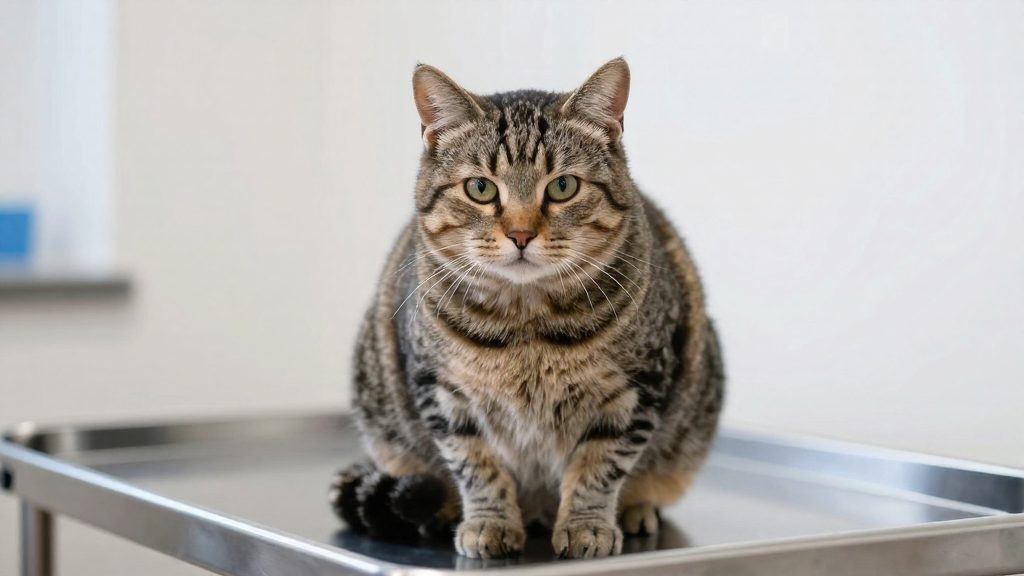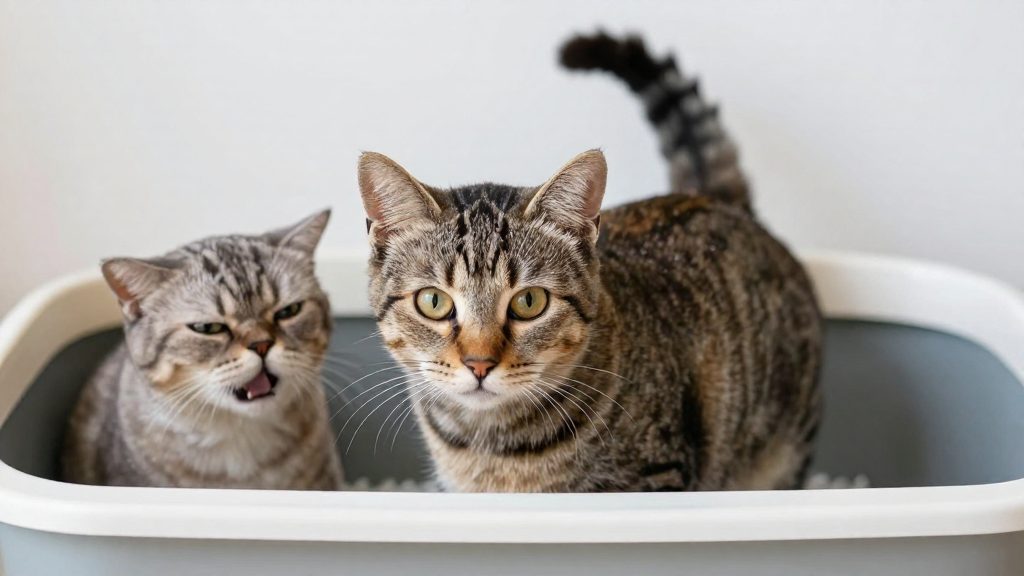
A cat that cannot pass urine is a medical emergency because the blockage stops the body from removing waste, and the harm spreads beyond the bladder. The danger comes from what happens to the urine and waste that stay inside the body.
Why a cat that can’t pee is an emergency
How retained urine builds up toxins
Urine normally carries waste products and electrolytes such as potassium out of the body. When the urethra is blocked, that exit closes while the kidneys keep working. Waste and potassium then accumulate in the blood instead of leaving through urine. Abnormal potassium levels are especially dangerous because they affect the heart’s electrical rhythm, so this is the most time-sensitive part of the problem.
Why the kidneys stop filtering
The kidneys filter blood and send urine down to the bladder. A urethral obstruction creates back-pressure: urine that cannot drain from the bladder raises pressure in the urinary tract, and that pressure travels back toward the kidneys. As pressure rises, filtration slows and can stop, so the kidneys lose their ability to clear waste. The result is a cycle in which less urine leaves the body, more waste stays in the blood, and the rest of the body is increasingly affected.
What the body shows as the bladder fills
Veterinary guidance describes a firm, painful belly, which may indicate an enlarged bladder. Other signs that the body is struggling include vomiting, hiding, and low energy. These signs reflect the wider effects of the blockage, not only the urinary tract.
Why prompt care changes the outcome
The body-wide effects are why a cat that has stopped urinating needs veterinary assessment without delay. PetMD (2025-08-08) reports survival of around 90% when treatment is prompt. That figure applies to cats treated promptly and is not a reason to wait. Delay raises the risk of life-threatening complications, so a cat that has stopped urinating needs emergency veterinary care without delay.
Emergency signs to watch for
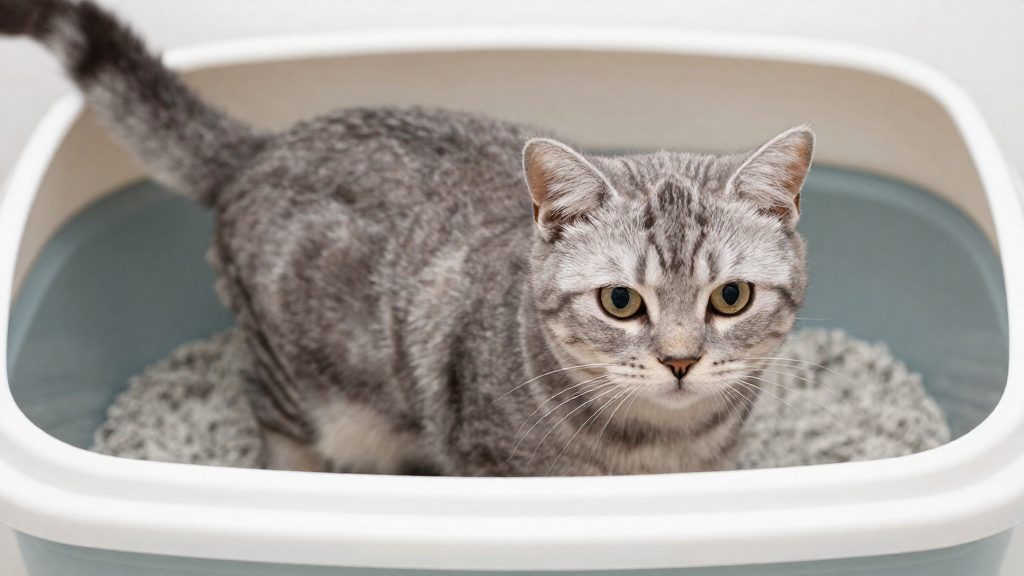
A cat that cannot pass urine often shows changes that owners can see at home, sometimes before the cat appears obviously ill. The signs below are grouped by where they appear, starting with the litter box and moving to the cat’s general behaviour. PetMD describes a cat that cannot pass urine as a medical emergency (PetMD, 2025-08-08).
Litter box behaviour
- Repeated litter box visits with little or no urine. The cat returns to the tray often and produces little or nothing (Garden State Veterinary Specialists, 2025-05-30).
- Crying while trying to urinate. Vocalising during an attempt to pass urine is listed as a warning sign by Garden State Veterinary Specialists (2025-05-30) and PetMD (2025-08-08).
- Urinating outside the box. This appears in the same veterinary guidance as a sign to report (Garden State Veterinary Specialists, 2025-05-30).
Genital area and litter contents
- Frequent or excessive licking of the genital area. PetMD (2025-08-08) and Garden State Veterinary Specialists (2025-05-30) both list this sign.
- Blood in the litter box. PetMD (2025-08-08) and Garden State Veterinary Specialists (2025-05-30) both list this sign.
General body signs
- Restlessness and crying out. Both appear in PetMD’s list of signs (2025-08-08).
- Hiding or low energy. Garden State Veterinary Specialists (2025-05-30) lists hiding and reduced energy together, and PetMD (2025-08-08) lists lethargy.
- Vomiting. Listed by both PetMD and Garden State Veterinary Specialists.
- Panting. PetMD (2025-08-08) includes panting among the signs.
- Firm, painful belly. Garden State Veterinary Specialists (2025-05-30) links this to a possibly enlarged bladder, which a veterinarian can assess.
How long can a cat go without urinating?
A cat that cannot pass urine has no safe waiting period. The time limits below show how quickly a urinary blockage can move from a concern to a life-threatening condition, so the window for action is measured in hours, not days. The sources give different ranges, and none of them defines an interval that is safe to wait out.
The 24-hour mark is the latest point, not a safe delay. PetMD (2025-08-08) states that a cat that has not peed in 24 hours needs a vet immediately. Garden State Veterinary Specialists (2025-05-30) advises seeking care within hours, so a cat that is straining or producing no urine should be seen as an emergency now, without waiting for 24 hours to pass.
Complications can begin well before that point. Garden State Veterinary Specialists (Eatontown, NJ, 2025-05-30) states that a completely blocked cat can develop life-threatening complications within 24 hours. The same source advises seeking care within hours.
| Time frame | Documented outcome | Source (date) |
|---|---|---|
| Within 24 hours of a complete blockage | Life-threatening complications can develop | Garden State Veterinary Specialists (2025-05-30) |
| No urine for 24 hours | Vet visit needed immediately | PetMD (2025-08-08) |
| Within a couple of days (without treatment) | Kidney failure and death can occur | PetMD (2025-08-08) |
| 24 to 48 hours, untreated | Kidney failure and death | Vetstreet, Dr. Donna Spector (2017-04-03) |
| 24 to 72 hours, untreated | Fatal | Garden State Veterinary Specialists (2025-05-30) |
The Vetstreet figure is older (2017) than the other two sources, and its 24-to-48-hour range sits inside the 24-to-72-hour range given by Garden State. Because the sources do not agree on an exact cutoff, do not wait for any time limit: seek emergency care as soon as you notice that the cat is straining or not producing urine.
Are male cats at higher risk?
Yes. Urinary blockages are most common in male cats, and the main reason is anatomy. A male cat has a long, narrow urethra, the tube that carries urine from the bladder out of the body. Because the passage is narrow, a small mucus plug or a urethral stone can close it completely, so urine can no longer leave the bladder. (PetMD, 2025-08-08)
Female cats can also be affected, but less often. Owners of female cats should still treat any sign of urinary difficulty seriously. (PetMD, 2025-08-08) Owners of female cats should still treat any sign of urinary difficulty seriously, since the risk is lower but not absent. (PetMD, 2025-08-08)
Causes of urinary blockage
PetMD (2025-08-08) lists four causes:
- Mucus plugs: clumps of mucus that can lodge in the urethra.
- Urethral stones: hard mineral deposits that can block the passage.
- Feline lower urinary tract disease: a group of conditions affecting the bladder and urethra.
- Cystitis: inflammation of the bladder.
What should you do right now?
Call an emergency veterinary clinic before you leave the house. A cat that cannot pass urine needs a vet immediately, and a general practice may be closed. Tell the clinic that your cat is straining or not urinating and describe what you have seen. Garden State Veterinary Specialists advises calling an emergency vet right away and following their transport instructions (Garden State Veterinary Specialists, Eatontown, NJ, 2025-05-30). Emergency clinic hours and locations vary by area, so find the nearest one now rather than during an emergency.
Before the call, write down the time of your cat’s last urination. A precise timeline lets the clinician triage the case faster.
During transport, keep the cat quiet and handle it as little as possible. Follow the clinic’s transport instructions. Do not try to express the bladder yourself. Offer water only if a vet approves it.
Do not wait to see whether the problem resolves on its own. Calling the emergency clinic right away is the most controllable step you have.
What will the vet do?
At the clinic, the vet first confirms the blockage through a set of diagnostic tests, then relieves the obstruction and keeps the cat stable while the bladder drains. Hospital care is built from a few standard components, and the exact combination depends on the cat’s condition. The steps below cover the workup and the main treatment components described in veterinary guidance.
Diagnostic workup
Vets diagnose a blockage with a physical exam, bloodwork, urinalysis and imaging by X-ray or ultrasound (PetMD, 2025-08-08). Each test answers a different question: the exam assesses the cat’s overall state and the abdomen, while the lab tests and imaging confirm the obstruction and show its effect on the bladder and urinary tract.
Treatment components
| Component | What it involves | Source |
|---|---|---|
| IV fluids | Fluids given intravenously as part of hospital treatment | PetMD, 2025-08-08; Vetstreet, 2017-04-03 |
| Sedation or anesthesia | Relieving the blockage is done under sedation or anesthesia | Vetstreet, 2017-04-03 |
| Catheterization and bladder drainage | A urinary catheter drains the bladder and can be left in for one to several days | PetMD, 2025-08-08; Vetstreet, 2017-04-03 |
| Pain medication | Given as part of the treatment plan | Vetstreet, 2017-04-03 |
| Monitoring or surgery | Monitoring is part of hospital care; surgery is needed less often | PetMD, 2025-08-08; Vetstreet, 2017-04-03 |
Catheterization drains the bladder, and the catheter can be left in for one to several days (Vetstreet, 2017-04-03). Surgery is needed less often, according to Vetstreet (2017-04-03).
Straining versus blockage: how to tell
The key difference is whether the cat produces any urine. A cat that passes urine, even in small amounts, is not in the same situation as one that repeatedly takes the litter box posture and produces little or nothing. Only a veterinarian can confirm a blockage, so the home observations below are meant to give the vet accurate information.
Posture and effort during an attempt
Watch the cat from a distance, without disturbing it. Note whether it:
- settles into the squat in the box and stays there, or leaves quickly and returns
- strains repeatedly with no visible result
- shows restlessness between attempts, which PetMD lists as a sign
- keeps licking the genital area, which both PetMD and Garden State list as a sign
Straining that produces nothing is the pattern to flag, whatever the posture.
Urine output
Check the box after each attempt. Garden State advises noting whether any urine is produced and whether it is bloody (2025-05-30). Record the result exactly, even when it seems minor.
Litter box log over several visits
A single visit is rarely enough. Keep a short written log for each visit:
| Observation | What to record |
|---|---|
| Visits to the box | Time of each visit and whether the cat stayed in the squat |
| Urine produced | None, a small amount, or a normal amount |
| Blood | Any red or pink tint in the urine or litter |
| Urine outside the box | Location and number of occurrences |
Frequently asked questions
My cat keeps visiting the litter box but produces little or no urine. Is this an emergency?
Yes. Repeated litter box visits with little or no urine, especially with crying or frequent licking of the genital area, are listed warning signs of a urinary blockage. Contact an emergency veterinarian now instead of waiting to see whether the problem resolves. (PetMD, 2025-08-08)
What should I avoid doing before I reach the clinic?
Do not try to squeeze or empty the bladder by hand. Keep the cat calm and handle it as little as possible, and offer water only if a vet has approved it. Note whether any urine was produced and whether it contained blood, since the clinic will ask. (Garden State Veterinary Specialists, 2025-05-30)
Which cats are most likely to get a urinary blockage?
Males are affected most often because of their long, narrow urethra, while females can be affected less often. Common causes include mucus plugs, urethral stones, feline lower urinary tract disease and cystitis. (PetMD, 2025-08-08)