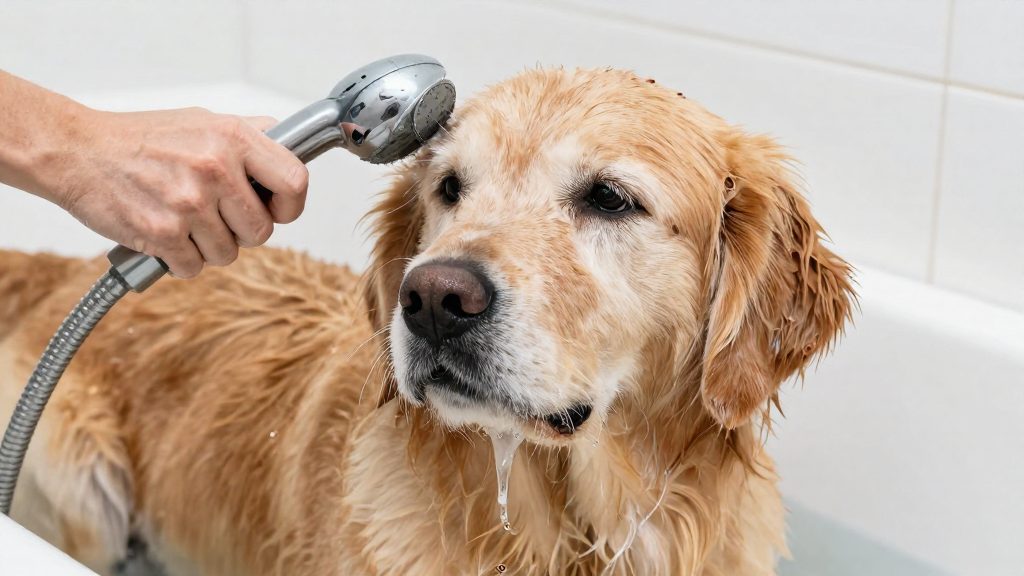
Bath frequency for a double-coated dog has no single fixed answer in the available sources. The American Kennel Club (AKC) quotes a groomer who says medium-to-large coats may need a bath anywhere from weekly to every four to six weeks, provided the coat is maintained between baths. A separate consumer publication, iHeartDogs, gives every 6 to 8 weeks for double-coated breeds such as Huskies and German Shepherds. Neither figure is a veterinary recommendation, so both work best as starting points that you adjust to the dog’s lifestyle.
How often should you bathe a double-coated dog?
Interval guidance by source
| Source (date) | Dogs covered | Stated interval | Source type |
|---|---|---|---|
| AKC (2023-02-23) | Medium-to-large coats in general | Weekly to every 4 to 6 weeks, if the coat is maintained between baths | Groomer quoted by a kennel-club publication |
| iHeartDogs (2024-06-14) | Double-coated breeds, including Huskies and German Shepherds | Every 6 to 8 weeks | Consumer publication, no listed veterinary review |
The AKC range is not specific to double coats. It applies to medium-to-large coats generally. The iHeartDogs figure is the only source in this set that gives an interval for double-coated breeds, and it lacks a listed expert review.
Lifestyle factors (unsourced general reasoning)
The sources do not quantify how lifestyle changes bath frequency, so the points below are general reasoning, not sourced figures.
- Outdoor exposure: A dog that regularly rolls in mud or swims in lakes or the sea will likely need washing sooner than the baseline range.
- Indoor, low-activity lifestyle: A dog that stays clean indoors can usually stay near the longer end of the interval.
- Coat condition between baths: The AKC range assumes the coat is maintained between baths. The source gives no guidance for coats that are not maintained, so ask a groomer or your vet.
- Breed and coat length: Neither source covers smaller double coats or short-coated double-coated breeds, so no interval can be drawn from these sources for them.
- Skin condition: If a veterinarian has prescribed a medicated wash or a specific bathing schedule, follow the vet’s instructions over any general interval.
Why overbathing harms the double coat
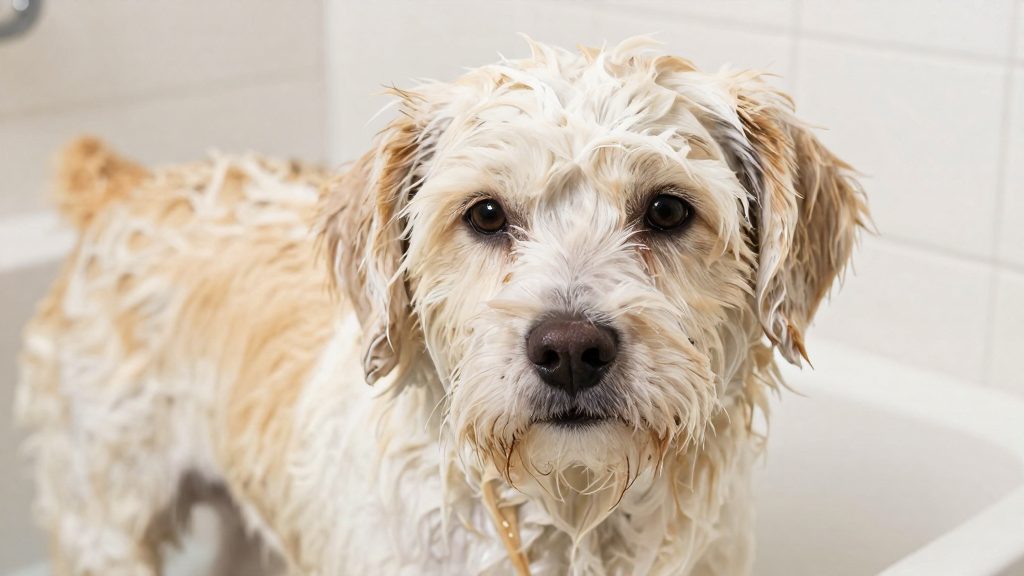
A double coat has two layers: a dense undercoat that traps air, and a longer topcoat that shields it. The American Kennel Club (AKC, article dated 2023-02-23) says thick, naturally insulating coats, such as those of Labradors, Golden Retrievers and Huskies, should not be bathed often. A groomer quoted in that article warns that overbathing can strip too much oil from the skin and disrupt the insulation the coat provides. The link between skin oil and insulation is the core of the problem: the coat’s insulating function depends on the condition of the skin and hair it grows from, and each shampoo removes some of the oil that supports it.
Natural skin oil removal
The AKC-quoted groomer warns that overbathing can strip too much oil from the skin. The source does not give a number of washes or an oil-loss rate (the rest of this section is general reasoning, not sourced), so bathe when the dog actually needs it rather than on a fixed schedule. The source does not give a number of washes or an oil-loss rate, so the sensible approach is to bathe when the dog actually needs it rather than on a fixed schedule.
Effect of lost oils on insulation over time
The AKC material links lost oils to disrupted insulation but does not state how long this takes or what early signs look like. The AKC-quoted groomer warns that overbathing can strip too much oil from the skin and disrupt the coat’s insulation. The source does not say how long this takes or what early signs look like.
Changes in coat texture after repeated washing
None of the reviewed sources describes a measurable texture change after repeated washing. No reviewed source describes a measurable texture change after repeated washing, so there is no sourced check for it. If the coat looks dull, dry or thin, or the skin looks irritated, ask your vet or a groomer.
Brushing: the real maintenance for double coats
For a double coat, brushing is the core of routine coat care, not the bath. A double coat has a soft, dense undercoat beneath a longer topcoat. When loose undercoat hair is not removed, it tangles with the topcoat and forms mats close to the skin. According to AKC (2026-10-06), short, medium and long double coats generally benefit from at least weekly brushing to control loose undercoat and prevent mats. The same minimum applies across coat lengths.
| Routine | Frequency | Purpose |
|---|---|---|
| Brushing | At least once a week, all coat lengths | Remove loose undercoat, reduce matting |
| Combing | Two or three times a week | Prevent mats |
| Extra brushing during seasonal release | Increased while the undercoat is releasing | Control loose hair before it spreads through the coat |
Weekly brushing as the baseline
Brushing lifts loose undercoat out of the coat before it knots. Work through the coat in sections, lifting the topcoat so the brush reaches the layer underneath, rather than only smoothing the surface. Pay attention to areas where hair rubs together, such as behind the ears, under the legs and along the hindquarters.
Combing to prevent mats
Brushing alone does not always reach the base of the coat. AKC says combing two or three times a week helps prevent mats. Comb through to the skin in layers, and check the areas listed above. Catching a small tangle at a combing session is far easier than dealing with a larger mat later.
Seasonal undercoat release
Double-coated dogs release their undercoat in seasonal periods, and the timing varies by individual dog. During these periods, the amount of loose hair increases quickly. Brushing more often during release sessions removes loose undercoat before it mats into the topcoat or ends up on furniture and clothing.
Should you shave a double-coated dog?
Grooming experts generally advise against shaving a double-coated dog. A clipper pass removes both coat layers at once: the dense undercoat and the longer protective topcoat. Because the two layers are removed together, the coat cannot be cut back to the topcoat alone, and the insulating undercoat is lost along with the outer hair.
Regrowth is the second problem. According to AKC (2026-10-06), the undercoat may regrow faster than the topcoat. The two layers can therefore return at different rates, and the coat may grow back with a different balance of undercoat to topcoat than the dog had before.
Two situations are accepted exceptions, according to a groomer quoted by AKC (2026-10-06):
- Before surgery, when the area to be operated on has to be clipped.
- As a last resort, for severe matting that cannot be managed another way.
| Situation | Shaving status | Source |
|---|---|---|
| Routine cooling in warm weather | Not supported: shaving doesn’t cool dogs | AKC, 2026-10-06 |
| Before surgery | Accepted reason | AKC, 2026-10-06 |
| Severe matting, as a last resort | Accepted reason | AKC, 2026-10-06 |
Outside these exceptions, the guidance in the sources points toward keeping the coat intact rather than clipping it.
How do you dry a thick undercoat safely?
According to AKC’s quoted groomer, Arctic-coated breeds should not be dried all the way to the skin. For heavily tangled coats, the same source recommends two steps: a conditioner soak before shampooing, and a high-velocity dryer to help loosen mats. The AKC material gives no further drying technique, so anything beyond these points is unsourced general reasoning. Each sourced step addresses a different problem, so the table below separates them.
| Step | Applies to | Purpose | Source |
|---|---|---|---|
| Stop drying before the skin is reached | Arctic-coated breeds | Limits how far the coat is dried | AKC, 2026-10-06 |
| Soak the coat in conditioner before shampooing | Heavily tangled coats | Helps loosen mats before washing | AKC, 2026-10-06 |
| Use a high-velocity dryer | Heavily tangled coats | Helps loosen mats during drying | AKC, 2026-10-06 |
Stop drying before the skin is reached
The sourced rule for Arctic-coated breeds is a drying limit: the coat should not be dried all the way to the skin. The AKC material gives no timing, temperature or method for reaching that limit. The source gives no figure or method for when the coat counts as dry, so ask a professional groomer how far to dry your dog’s coat.
Loosen tangles before and during drying
For heavy tangles, the AKC groomer’s sequence starts before the bath. Work conditioner through the matted areas and leave it on before shampooing, so the mats are softer when you wash them. During drying, a high-velocity dryer can help separate the loosened mats. The source gives no technique for dryer use, such as distance, heat setting or direction, so those details are unsourced, and a professional groomer is the right person to ask. Shaving is not part of this method, and the source treats it as a separate option.
When is an extra bath worth it?
An extra bath outside the regular schedule is justified when the coat has picked up something that brushing alone cannot remove. The three triggers below are the most common. The source material gives no numeric threshold for any of them, so the decision depends on what the coat looks and smells like, not on a calendar date.
| Trigger | Usual first step | When a full bath is warranted |
|---|---|---|
| Mud or grime after outdoor activity | Brush out debris while it is dry (unsourced general reasoning) | Mud stays matted or greasy after brushing |
| Chlorinated pool or salt water | Rinse with plain fresh water (unsourced general reasoning) | The coat still feels sticky or dull |
| Strong odour from rolling in something unpleasant | Spot-clean the affected area (unsourced general reasoning) | The smell persists or the soiling is widespread |
Visible mud, grime or oily residue
Dried mud is easiest to remove before any water is used. Working a slicker brush or undercoat rake through the legs, belly and chest loosens most of the debris and reduces the amount of shampoo needed later. This brushing approach is unsourced general reasoning. A greasy film that makes the coat clump is a clearer sign for a full wash than surface dirt is.
Swimming in chlorinated pools or salt water
Swimming becomes a trigger when residue stays in the coat after the dog is out of the water. Rinsing with plain fresh water is unsourced general reasoning. The AKC material does not cover pool or sea water, so a fresh-water rinse is a common approach, not sourced guidance, and it may be enough after a single short swim. A full dog-specific shampoo is reserved for when the coat still feels sticky or dull after rinsing. If the skin becomes red, itchy or irritated after swimming, see a veterinarian rather than repeating washes at home.
Strong odour from rolling in something unpleasant
The AKC material gives no technique for odour removal, so the points below are unsourced general reasoning. Odour held in the coat is generally addressed by washing rather than brushing. Rolling in carrion, feces or other decaying matter can leave the smell in the coat. Spot-cleaning the affected area is a first step (unsourced general reasoning). A full wash with a dog-specific shampoo, used as directed on its label, is warranted if the smell persists or the soiling is widespread. If the smell persists, ask a groomer or vet.
When should you see a vet or groomer?
Skin symptoms and coat tangles call for different professionals. Persistent skin changes are a veterinary question, while dense mats that resist home brushing are usually a groomer’s job. Use the table to decide who to contact first.
| What you observe | Who to contact first | Reason |
|---|---|---|
| Itching, redness or flaky skin that continues after the coat has dried, or any open sores, intense scratching, signs of pain, or a change in appetite or energy | Veterinarian, promptly | The cause must be identified by examining the skin, and a groomer cannot diagnose it. Open sores, intense scratching, pain or a change in appetite or energy call for a prompt vet visit, without waiting for the signs to worsen. |
| Sudden hair loss or patchy bald areas | Veterinarian | Localised loss of the coat is a change to report, not a grooming issue. |
| Mats too dense to work through with a brush at home | Professional groomer | Tangles close to the skin are hard to remove safely at home. |
Skin signs that persist after bathing
If itching, redness or flakiness continues after the bath, the bath is not the only possible explanation. Note where the symptoms appear, whether they spread, and whether the dog scratches or licks one spot. Bring these observations to the veterinarian, because they help the examination.
Sudden or patchy hair loss
A patch of missing hair that appears suddenly, or an area where the coat thins, should be reported to a vet rather than groomed around. Record the location and size of each patch and when you first noticed it.
Mats too dense for home brushing
The American Kennel Club (AKC, 2026-10-06) advises brushing double coats at least weekly and combing two or three times a week to prevent mats. Pulling on a dense mat at home can hurt your dog, so a groomer is the safer choice in that case.
Frequently asked questions
How often should I bathe a double-coated dog if I am a first-time owner?
No reviewed source sets one interval for double coats. An AKC-quoted groomer gives weekly to every four to six weeks for medium-to-large coats if the coat is maintained between baths, and iHeartDogs gives every six to eight weeks for breeds such as Huskies and German Shepherds, without a listed veterinary review. Use these as starting points and bathe when your dog actually needs it.
Can brushing replace bathing for my double-coated dog?
The reviewed sources do not say whether brushing can substitute for bathing, and they treat the two as separate tasks. The AKC advises brushing double coats at least weekly and combing two or three times a week to prevent mats. Brushing controls loose undercoat and mats, but it does not clean the skin.
When should I see a vet instead of a groomer about my dog’s coat or skin?
The reviewed sources do not list skin warning signs, so this is general guidance rather than a sourced threshold. Itching, redness or flaky skin that persists after the coat dries, open sores, intense scratching, signs of pain, or a change in appetite or energy call for a prompt vet visit. A groomer cannot identify the cause of these signs.