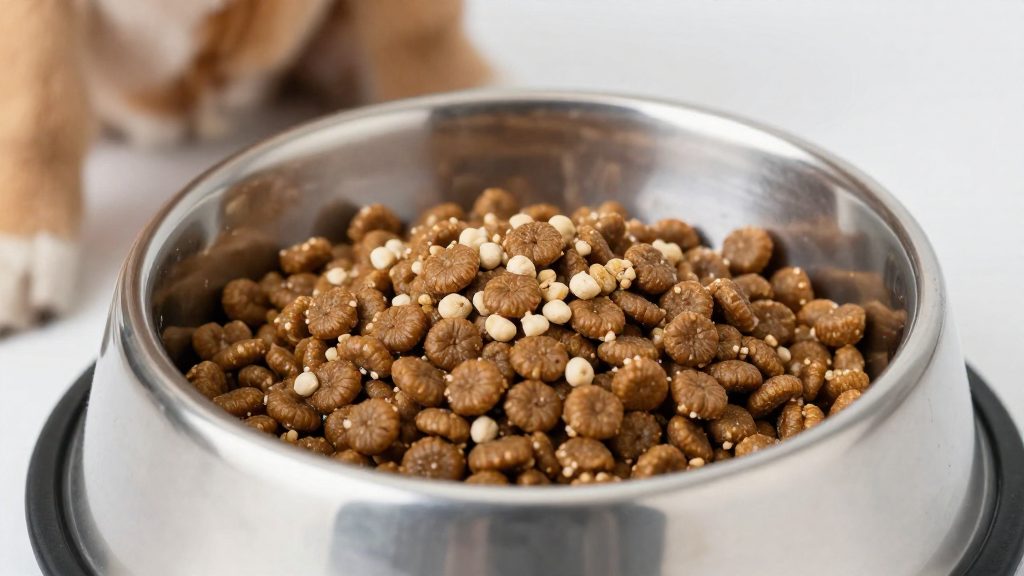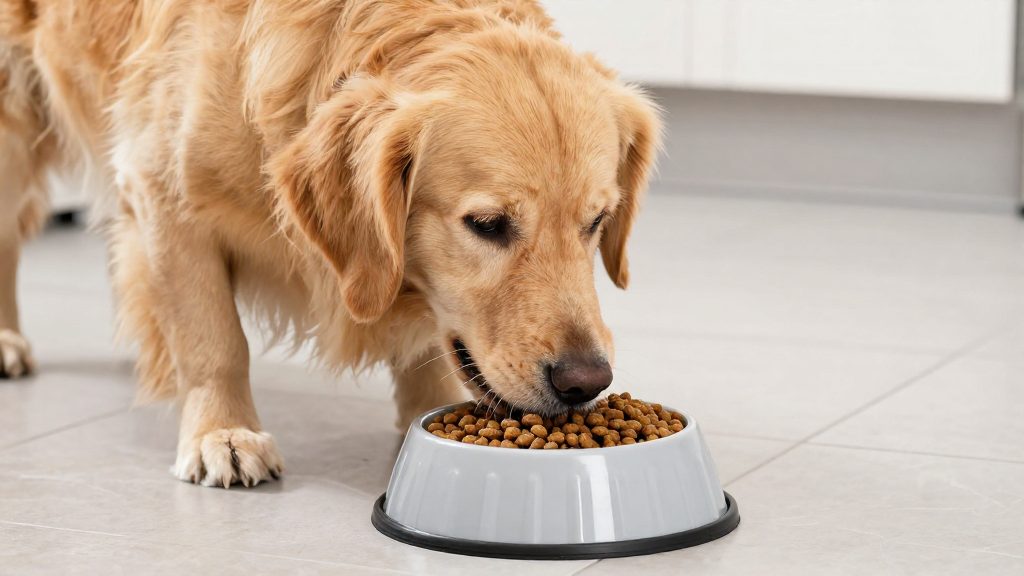
Eating too fast means a pace clearly quicker than the dog’s own normal pace, measured as the time it takes to finish a usual portion. No cut-off in seconds appears in the sources used here, so the useful benchmark is the dog’s baseline pace, established over several meals with the same food and bowl. A single fast meal from a healthy dog is not a warning sign. A pace that is consistently faster than the dog’s own baseline, especially when it changes suddenly, is worth recording and discussing with a vet.
What counts as eating too fast?
Timing a meal to measure eating speed
Use the same portion, bowl and location each time so the results are comparable:
- Measure the usual portion, using the amount the dog normally receives.
- Start a timer when the bowl is placed on the floor.
- Stop the timer when the bowl is empty or the dog walks away with food left in it.
- Record the measured meal time in a log, then repeat for several days and calculate the average.
- Note whether kibble is swallowed largely unchewed and whether the dog gulps water straight after eating.
Breed, size and kibble shape
The sources used here do not establish how breed, body size or kibble shape change eating pace, so no breed or size norm should be assumed. The practical approach is to compare each dog only against its own baseline.
| Variable | What to do when timing | Reason |
|---|---|---|
| Breed or size | Compare the dog with its own log, not with other dogs | No breed or size norm is given in the sources |
| Kibble shape | Keep the same food during the baseline period | A food change alters the pace being measured, so the baseline must be re-established |
| Multiple dogs | Time each dog separately and use separate bowls | Shared bowls prevent a clean reading for either dog |
Why a fast pace alone is not diagnostic
A fast pace is a GDV risk factor, not a diagnosis, which means a dog can eat quickly and show no illness. Diagnosis depends on clinical signs, so pace should be judged alongside them, not in isolation.
Common signs your dog is eating too fast
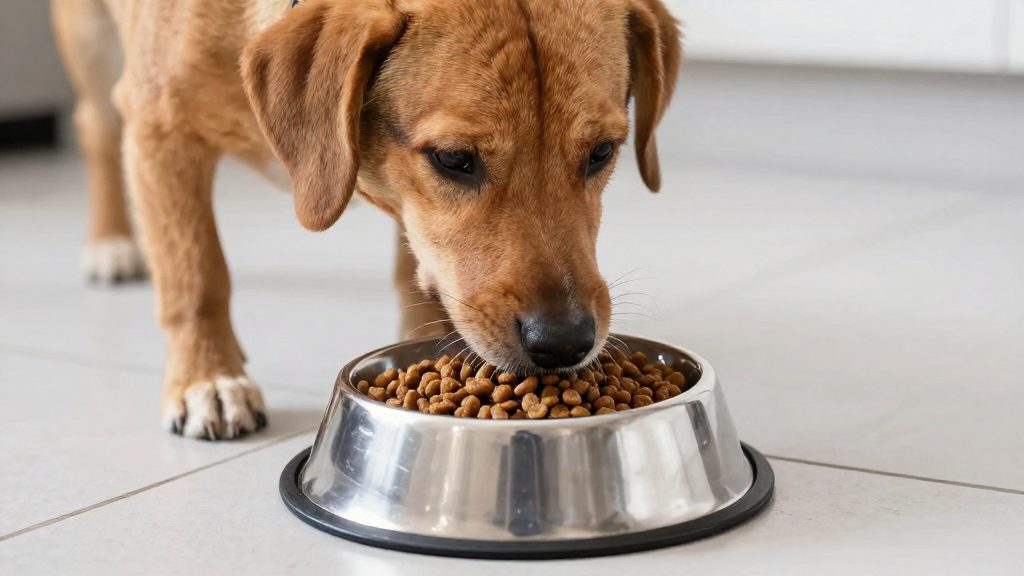
A dog that is bolting its food shows a consistent set of observable habits at mealtime. The clearest sign is a bowl emptied within seconds of being served, often with the dog licking the bowl clean before walking away. A full portion may disappear with little visible chewing.
Swallowing kibble with little or no chewing
Listen to the meal. A dog that swallows kibble whole or crushes it with one or two bites is skipping the chewing stage. Watch for food pieces passing through the mouth without visible breakdown, and for a dog that gulps rather than pausing between bites.
Emptying the bowl within seconds
If the bowl is empty within seconds, the dog is taking in food faster than it can be chewed comfortably. A dog that keeps searching the bowl for crumbs after it looks clean is also eating too quickly, even when the portion appears to be finished.
Frantic posture while eating
Note how the dog stands over the bowl. Typical signs include a head held low and tense, rapid head movements, and a body rigidly positioned over the food. Restlessness during and right after the meal is also common and should be noted alongside the eating pattern.
If the dog adopts a ‘praying’ posture, with the front legs forward and the chest lowered, treat it as a possible sign of bloat, which is an emergency: go to an emergency vet right away (see the bloat warning signs section below).
Guarding the bowl or pawing at it
Watch for a dog that hunches over the bowl, curls its body around it, growls, or moves a paw toward the bowl to keep food close. Pawing at the bowl or scooping food with the front paws can indicate rushed eating or competition for food. A dog that stops eating or stiffens when approached may be showing resource guarding, which is a different behaviour from simple preference for privacy at mealtime.
Is gagging or vomiting after meals normal?
Post-meal sounds and food coming back up do not all mean the same thing. Gagging, retching and regurgitation are distinct events, and the differences depend on where the problem starts and what happens just before food comes up. Owners who can tell them apart can describe the episode more precisely to a vet. The sources do not give a normal frequency for any of these events, so judge by the type of episode and how often it recurs.
| Event | Defining feature |
|---|---|
| Gagging | Happens higher in the throat |
| Retching | Precedes vomiting |
| Regurgitation | Food leaves the esophagus without retching |
Gagging versus regurgitation
Gagging originates higher in the throat. Regurgitation comes from the esophagus, the tube between the throat and the stomach, and food leaves it without a preceding retch. Watching the dog’s posture and listening for the sound can help. Gagging happens higher in the throat, while regurgitation comes from the esophagus without retching. Describe to the vet exactly what you saw and heard.
Retching versus silent regurgitation
Retching is the heaving stage that comes before vomiting. If the dog heaves repeatedly and food then comes up, the episode is retching followed by vomiting. The single most useful observation is whether a heaving phase came first. Note it each time, because that one detail separates the two events.
When recurring gagging needs an immediate appointment
Make an immediate appointment with a vet if gagging comes every few minutes, if the dog claws at its mouth, or if the dog seems unwell (American Kennel Club, 2024-03-15). If the dog is choking or has difficulty breathing, go to an emergency vet right away.
Can fast eating cause bloat?
Fast eating is linked to bloat in the sources reviewed here, and the link is documented with specific figures. The American Kennel Club (AKC) reports that fast eaters have five times the bloat risk of slow eaters, and that dogs fed one meal a day are twice as likely to bloat as dogs fed two meals a day (AKC, 2024-11-15). Cornell University College of Veterinary Medicine lists eating too quickly as a factor that may increase the risk of gastric dilatation-volvulus (GDV).
| Factor | Documented finding | Source |
|---|---|---|
| Eating speed | Fast eaters have five times the bloat risk of slow eaters | AKC, 2024-11-15 |
| Meal frequency | Dogs fed one meal a day are twice as likely to bloat as dogs fed two meals a day | AKC, 2024-11-15 |
| Eating speed (GDV) | Eating too quickly is listed as a factor that may increase GDV risk | Cornell University College of Veterinary Medicine |
What the figures do and do not establish
The AKC figures compare groups of dogs. They show an association, not a measured cause, and the sources do not state how speed works mechanically. Cornell’s wording is hedged (“may increase”), so it should be read the same way.
Speed and meal frequency are listed as separate factors. A dog fed once daily that also eats quickly falls into both categories. The sources do not quantify the combined risk, so no combined figure should be assumed.
Bloat warning signs that need a vet now
Bloat, or gastric dilatation-volvulus (GDV), is an emergency in which the stomach fills with gas and may twist. The signs below are the ones owners are most likely to notice at home. Cornell University’s College of Veterinary Medicine lists them as clinical signs of GDV, and the American Kennel Club (AKC) lists several of them as bloat signs. The sources do not give a timeline for how quickly the condition progresses, so any of these signs should prompt a veterinary visit rather than a wait-and-see approach.
Physical signs to check
| Sign | What the owner observes |
|---|---|
| Enlarged abdomen | The belly looks swollen or bloated. |
| Pain on belly pressure | The dog whines when the belly is pressed. |
| Non-productive retching | Repeated heaving that brings up little or nothing. |
| Excessive drooling | Heavy salivation beyond normal. |
| Panting | Fast breathing while resting. |
| Praying posture | The front legs are stretched forward and the chest is lowered. |
| Pale gums | Gums look whitish or washed out instead of pink. |
| Restlessness or pacing | The dog cannot settle and walks back and forth. |
| Weakness or collapse | The dog struggles to stand or falls over. |
How to check gum colour
To check gum colour, gently lift the lip at the side of the mouth and look at the gum tissue in good light. Compare it with the colour of the dog’s gums when it is well. Pale gums are one of the listed signs, so note the change and report it to the vet.
How can I slow my dog down?
Slowing a dog’s eating comes down to three practical levers: the feeding container, how the daily ration is divided, and where each dog eats when several dogs share a home. Each one limits how much food a dog can take in a single go. None of them replaces a veterinary check if the dog shows signs of distress after eating.
Slow-feeder bowls and puzzle feeders
A slow-feeder bowl has raised ridges, pegs or internal maze shapes. The dog must lick or nudge kibble around the obstacles instead of scooping large mouthfuls. A puzzle feeder works on the same principle but adds a task: the dog pushes, rolls or pulls food out of compartments or a textured surface. Ask your vet which feeder suits your dog.
Splitting the daily food into several meals
Dividing the same daily ration into several smaller portions means less food is taken in at once. Serve the meals at fixed times so the dog learns when food arrives and has less reason to eat in a rush. Follow your vet’s advice on the daily amount and on how many meals to give. The AKC reports that dogs fed one meal a day are twice as likely to bloat as dogs fed two meals a day (American Kennel Club, 2024-11-15), but this is an association, not proof that splitting meals prevents bloat.
Separating dogs during meals in multi-dog homes
Competition for food is a common reason dogs in the same household eat fast. Feed each dog in its own spot, out of sight of the others, using separate rooms, crates or baby gates. Remove each bowl once the dog has finished or after a set period, and supervise until every dog eats calmly. This also stops one dog from taking another’s portion.
| Setup | How it slows intake | Best suited for |
|---|---|---|
| Slow-feeder bowl | Obstacles force the dog to work around each piece | Dogs that gulp dry food |
| Puzzle feeder | Food must be pushed or pulled out through a task | Dogs that need extra engagement at mealtime |
| Split meals | Smaller portions reduce the amount taken at once | Any dog on a fixed daily ration |
| Separate feeding spaces | Removes competition with other dogs | Multi-dog households |
When to see a vet
Several situations call for a veterinarian, and they differ in urgency. Bloat signs, choking and difficulty breathing are emergencies. Gagging every few minutes, clawing at the mouth, or a dog that seems unwell calls for an immediate appointment. Choking on an object that interferes with breathing is an emergency, and the American Kennel Club advises going to an emergency vet right away for choking or difficulty breathing (American Kennel Club, 2024-03-15). A dog that seems unwell needs an immediate appointment (American Kennel Club, 2024-03-15). A change in weight or appetite needs a veterinary examination, and a dog that seems unwell needs an immediate appointment (American Kennel Club, 2024-03-15). A written meal log makes that appointment far more useful.
Choking and breathing difficulty: act now
Choking means an object or food is blocking the airway. Treat any breathing difficulty as an emergency.
- Do not wait to see whether the dog clears the blockage on its own when breathing is affected.
- Go to the nearest emergency veterinary clinic immediately. Call ahead if you can, so staff can prepare.
- Do not confuse choking with gagging. If the dog cannot breathe normally, the distinction does not change the urgency.
Weight loss or appetite change
A dog that is fed normally but loses weight, or whose appetite shifts over several days, needs a veterinary examination. The sources give no numerical thresholds for this. If the dog seems unwell, make an immediate appointment (American Kennel Club, 2024-03-15). Do not assume that eating speed alone explains the change. The vet needs to assess the dog’s weight and condition directly.
Preparing a meal log for the vet visit
Record the following for about one to two weeks before the appointment:
| Item | What to record |
|---|---|
| Meal times | Time each meal is offered and when the bowl is empty |
| Food | Type and brand of food, and the amount you measured |
| Eating behaviour | Estimated speed of eating and any food left uneaten |
| Episodes | Time and context of any gagging, regurgitation, or vomiting relative to meals |
| Appetite and weight | Changes in appetite and any weight changes you have noticed |
| Other products | Any treats, supplements, or medications given |
Frequently asked questions
How can I tell whether my dog eats too fast?
Judge the pace against the dog’s own history, not against other dogs. One unusually quick bowl is not a concern, but a steady shift toward faster eating over several days is worth recording and raising with your vet.
When does a fast-eating dog need a vet right away?
Choking, difficulty breathing and signs of bloat need an emergency vet right away (American Kennel Club, 2024-03-15). Gagging every few minutes, clawing at the mouth or seeming unwell needs an immediate appointment, and a ‘praying’ posture, with the front legs forward and the chest lowered, is a listed sign of GDV (gastric dilatation-volvulus) (Cornell University College of Veterinary Medicine).
Does eating fast cause bloat, and does splitting meals prevent it?
Eating too quickly is listed as a factor that may increase GDV risk (Cornell University College of Veterinary Medicine). The American Kennel Club reports that fast eaters have five times the bloat risk of slow eaters, and that dogs fed one meal a day are twice as likely to bloat as dogs fed two meals a day (American Kennel Club, 2024-11-15). These figures are associations, so they do not show that changing the meal schedule prevents bloat; ask your vet which feeding plan suits your dog.