Pet food sold in the United States is regulated by the U.S. Food and Drug Administration (FDA), which sets federal labeling requirements. Under FDA labeling regulations, pet food labels must show product identification, a net quantity statement, the name and place of business of the manufacturer or distributor, and ingredients listed from most to least by weight.
Who regulates pet food labels in the US?
The federal baseline: FDA mandatory elements
FDA labeling regulations require the following elements on pet food labels (U.S. Food and Drug Administration, source dated 2024-02-15):
| Mandatory element | What the label must provide |
|---|---|
| Product identification | Identifies the product |
| Net quantity statement | Declares the amount contained in the package |
| Manufacturer or distributor | Names the manufacturer or distributor and its place of business |
| Ingredient list | Lists ingredients from most to least by weight |
These are among the elements that FDA labeling regulations require on pet food labels.
State regulators and the AAFCO model
Some states enforce their own pet food labeling rules in addition to the federal requirements. Many of these state rules are based on a model from AAFCO, so a label sold in several states may follow similar wording and structure across those states. Because the state layer sits on top of the FDA baseline, a product can satisfy the federal elements and still be subject to additional state requirements. To find out which rules apply, check the pet food regulator of the state where the product is sold.
Manufacturer name and place of business
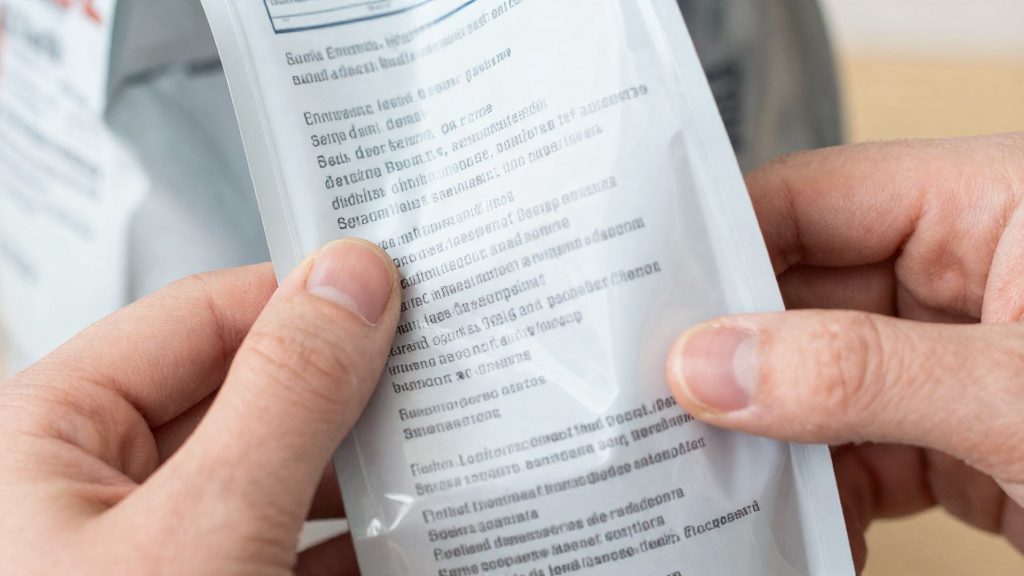
The label must name the manufacturer or distributor and show its place of business. This is the entry point for any question about a product, whether it concerns a complaint, a packaging defect or a labeling query. Note the name and address printed on the bag before contacting the company or the regulator.
Why does ingredient order matter?
The ingredient list shows which ingredients make up the largest share of the formula by weight, from most to least. Under FDA labeling rules, pet food labels must list ingredients in that order (U.S. Food and Drug Administration, 2024-02-15). Ingredients with a lot of water weigh more, so list position does not fully show nutritional value (PetMD, 2026-10-09). It does not measure how much usable nutrition each ingredient provides.
Weight basis: as-formulated, including moisture
The list is based on the as-formulated weight, meaning the weight of each ingredient as it goes into the recipe, water included. Two ingredients of equal nutritional value can therefore rank very differently depending on how much water they contain.
- Ingredients with high water content weigh more and move up the list.
- Dry ingredients weigh less per unit of nutrient and move down.
- The ranking is valid only within a single product. Comparing ranks across products with different moisture levels does not compare the same thing.
PetMD notes that ingredients with a lot of water weigh more, so their position on the list does not fully show nutritional value (PetMD, 2026-10-09).
Why fresh ingredients weigh more than dry
The water content of an ingredient decides how far up the list it lands. Fresh ingredients are mostly water, while dried ingredients have had much of their water removed before they reach the mixer.
| Ingredient form | Water content during formulation | Effect on list position |
|---|---|---|
| Fresh meat or fish | High | Ranks higher than its dry-matter contribution would suggest |
| Dried or processed ingredient | Low | Ranks lower, even if it supplies a comparable amount of nutrients |
The guaranteed analysis reports a product-level moisture percentage (American Kennel Club, 2026-03-10). It does not give the moisture of each ingredient, so it cannot be used to re-rank individual ingredients. Use the dry-matter conversion in the guaranteed analysis section to compare nutrient percentages between products.
Ingredient splitting and combined-weight distortion
Ingredient splitting happens when the same raw material appears in several forms on the list, each under its own name. Each form weighs less than the whole, so each one ranks lower. Read together, however, their combined weight can exceed that of the top-ranked single ingredient.
To check for this:
- Look for the same base ingredient repeated under different names or forms.
- Add the forms together mentally to estimate their combined share.
- Compare that combined share against the first-listed ingredient, not against the individual positions.
The list does not provide the combined weight, so this check is an estimate based on the weight order alone.
Where the ranking stops being informative
The ingredient order is a weight ranking, not a nutrition ranking. It does not show:
- Nutrient density: the amount of protein, fat or other nutrients per ingredient.
- Overall nutritional adequacy: PetMD states that the finished diet matters more than any single ingredient (PetMD, 2026-10-09). The AAFCO nutritional adequacy statement on the label indicates which standards and life stage the food is formulated for (American Kennel Club, 2026-03-10).
- Combined ingredient totals, where splitting has spread one raw material across several entries.
How do name rules like 95%, 25% and ‘with’ work?
In the United States, the percentage rules for named ingredients are set by the Association of American Feed Control Officials (AAFCO) model, which many states adopt. The wording in a product name indicates the minimum share of that ingredient. It does not give the exact content.
The three naming thresholds
| Wording on the label | Minimum share of the product |
|---|---|
| Named ingredient alone (for example, “Chicken”) | 95% |
| Named ingredient plus a qualifier (for example, “Chicken Dinner”) | 25% or more, but less than 95% |
| Ingredient named after “with” (for example, “with Chicken”) | 3% |
Source: American Kennel Club, 2026-03-10.
The 95% rule
The 95% rule applies when the ingredient name stands alone. The named ingredient must make up at least 95% of the product, or at least 70% of the total once added water is counted (American Kennel Club, 2026-03-10).
The 25% rule and qualifier words
The 25% rule applies when the name carries a qualifier. The ingredient must be at least 25% but less than 95% of the product. Qualifier words such as “dinner”, “entrée” or “platter” are examples. A name such as “Chicken Dinner” therefore signals a lower minimum share of chicken than “Chicken” alone.
The ‘with’ rule
The ‘with’ rule allows an ingredient to appear in the name at a low share. An ingredient named after “with” needs only 3% of the product. Such a name confirms the ingredient is present but says little about its quantity.
What do by-products and meals really mean?
Ingredient names on a pet food label describe both the source and the level of processing. Two categories cause the most confusion: by-products and meals. The AAFCO definition of meat by-products says they are “clean, non-rendered parts other than meat.” They can include organs, blood, bone, and emptied stomachs or intestines, but not hair, horns, teeth or hooves (PetMD, 2026-10-09). Because the definition excludes rendered material, a by-product is not the same thing as a meal, even though both can come from the same animal.
Named source is the naming rule that matters most when you read a list. Each ingredient must be named individually with its common or usual name. “Chicken” and “chicken meal” are different labelled items. The word before “meal” tells you which animal the meal came from, and the word “meal” tells you the material has been processed.
Rendering is the process that produces most meals and fats. Animal tissue is cooked and dried so that fat separates from the solid protein. The solids are ground into a dry powder, which is the meal, and the separated fat is sold as a separate ingredient. Meals are processed ingredients; check the current AAFCO definitions for the exact wording.
The fiche does not give AAFCO’s exact definition of “meal,” so check the current AAFCO definitions for the wording used in that category.
| Label term | What it signals | Source |
|---|---|---|
| Meat by-products | AAFCO definition (via PetMD): clean, non-rendered parts other than meat; can include organs, blood, bone, and emptied stomachs or intestines, but not hair, horns, teeth or hooves | PetMD, 2026-10-09 |
| Chicken meal | Named animal source, rendered into a dry protein powder | General process, see Rendering above |
| Animal protein products | Unspecified source | American Kennel Club, 2026-03-10 |
Guaranteed analysis: what the numbers show
The guaranteed analysis is the panel on a pet food label that reports nutrient percentages. According to the American Kennel Club (2026-03-10), it shows crude protein, crude fat, crude fiber and water (moisture). The guaranteed analysis shows percentages of crude protein, crude fat, crude fiber and water (moisture) (American Kennel Club, 2026-03-10). Because moisture varies widely between products, the raw percentages cannot be compared directly.
| Nutrient on label | Label role | What it tells you |
|---|---|---|
| Crude protein | Minimum | The lowest protein level the product is guaranteed to contain |
| Crude fat | Minimum | The lowest fat level the product is guaranteed to contain |
| Crude fiber | Maximum | The highest fiber level the product is guaranteed to contain |
| Moisture (water) | Maximum | The highest water level; it sets the gap between as-fed and dry-matter values |
“Crude” describes the laboratory method, which estimates the total amount of each nutrient. It does not indicate how much of that nutrient the animal can digest.
Moisture effect on as-fed values
The percentages on the label are as-fed values, meaning they are measured on the food as sold, water included. A canned food with high moisture will show a lower protein percentage than a dry kibble, even if the two have similar protein per gram of solid food. PetMD (2026-10-09) notes that ingredients holding a lot of water weigh more, which is the same effect that distorts the nutrient percentages.
Converting to a dry-matter basis
To compare foods fairly, remove the water first. The result is the dry-matter basis.
- Read the moisture maximum (M) and the nutrient value (N) from the guaranteed analysis.
- Calculate the dry matter: 100 − M.
- Divide the nutrient value by the dry matter and multiply by 100.
Formula: dry-matter nutrient % = N ÷ (100 − M) × 100
Repeat the calculation for every product you compare, using each product’s own label. Once every food is expressed on a dry-matter basis, the values can be ranked against one another.
Is the food complete and balanced?
The nutritional adequacy statement in the fine print answers this question. It says whether the food meets Association of American Feed Control Officials (AAFCO) standards and which life stage it is meant for. Reading it takes less than a minute, but it only tells you what the manufacturer claims for a stage of life, not how good the food is.
Life-stage wording
Check which life stage the statement names before you buy. A food is only complete for the stage on its label.
| Statement wording | What it covers |
|---|---|
| Gestation/lactation | Pregnant or nursing females |
| Growth | Young animals still developing |
| Maintenance | Adult animals at a stable weight and condition |
| All life stages | Food formulated for every life stage on the label’s statement |
Senior foods need to meet only the adult maintenance requirements. A “senior” label therefore does not show that the food meets growth or gestation requirements. If you feed a puppy, kitten or pregnant animal, look for growth or gestation/lactation wording, or for all life stages.
Formulation versus feeding trial validation
The adequacy statement is tied to how the food was checked. Labels may indicate whether the recipe was verified by formulation or by an animal feeding trial. The fiche supplied for this article does not describe the two methods, so check the label wording and ask the manufacturer if the basis is unclear. Do not assume one method is better for your animal without the manufacturer’s documentation.
What the statement does not guarantee
- Ingredient quality: The statement does not rate sourcing, freshness or processing.
- Individual fit: A complete and balanced food may still be unsuitable for an animal with a specific medical condition. Diet changes for health reasons should be made with a veterinarian.
- Single-ingredient value: The finished diet matters more than any one ingredient, so a complete label does not mean every listed ingredient is nutritionally strong.
Check the best-by date and when to ask your vet
The best-by date is the manufacturer’s estimate of how long the product will keep its intended quality if it is stored properly. It is a quality marker, not a safety guarantee. Food that is damaged, contaminated or poorly stored can be unsafe before the date or after it (PetMD, 2026-10-09). Read the date as an upper limit on quality, and inspect the bag and its contents each time you open it or refill a container.
What the date does and does not tell you
- The date reflects the manufacturer’s expectation under the storage conditions it specifies.
- It does not reflect how your home has stored the food after purchase.
- A date that has not passed does not confirm that the contents are safe if the bag was torn, wet, or exposed to pests.
Checks for opened and stored food
The source material for this section does not give storage durations or temperatures, so follow the storage instructions printed on the packaging. Use the following checks before each feeding:
| Check | What to look for | Action |
|---|---|---|
| Bag integrity | Tears, holes, or a broken seal | Do not feed. Contact the manufacturer |
| Smell | Rancid, sour, or unusual odor | Do not feed |
| Appearance | Visible mold, clumps, discoloration, or insects | Do not feed |
| Texture | Damp, sticky, or clumped kibble, or moisture inside the bag | Do not feed |
| Best-by date | Date has passed | Check the packaging storage guidance before feeding |
Keep the food in its original bag or a clean, sealed container, away from heat and moisture, as the label directs.
Signs that warrant contacting a veterinarian
Contact a veterinarian promptly if your pet shows vomiting, diarrhea, loss of appetite, lethargy, or signs of abdominal discomfort after eating a food you suspect is spoiled. Do not wait for symptoms to worsen. Call right away if the pet ate a large amount, or if it is very young, very old or medically fragile. Symptoms in very young, very old, or medically fragile animals warrant the same prompt call. Before the appointment, keep the bag or photograph the label, including the lot number and best-by date, and note the time of feeding. This information helps the vet and the manufacturer assess the product.
Frequently asked questions
Does the first ingredient on the list tell me what the food is mostly made of?
Ingredients are listed by weight, but the first one does not have to be a protein, and ingredients with high water content weigh more, so their position does not fully show nutritional value (PetMD, 2026-10-09). Judge the finished diet as a whole rather than relying on the top line alone.
What does the “25% rule” mean when a single ingredient appears in the product name?
Under the 25% rule, a named ingredient must make up at least 25% of the product but less than 95%, and the name must include a qualifier such as “dinner”, “entrée” or “platter” (American Kennel Club, 2026-03-10). An ingredient listed after the word “with” only needs to be 3% of the product.
Where do I check whether a food is complete for my pet’s life stage?
Look for the AAFCO nutritional adequacy statement in the fine print, which states whether the food meets AAFCO standards and for which life stage: gestation/lactation, growth, maintenance, or all life stages (American Kennel Club, 2026-03-10). Foods labeled “senior” only need to meet adult maintenance requirements.