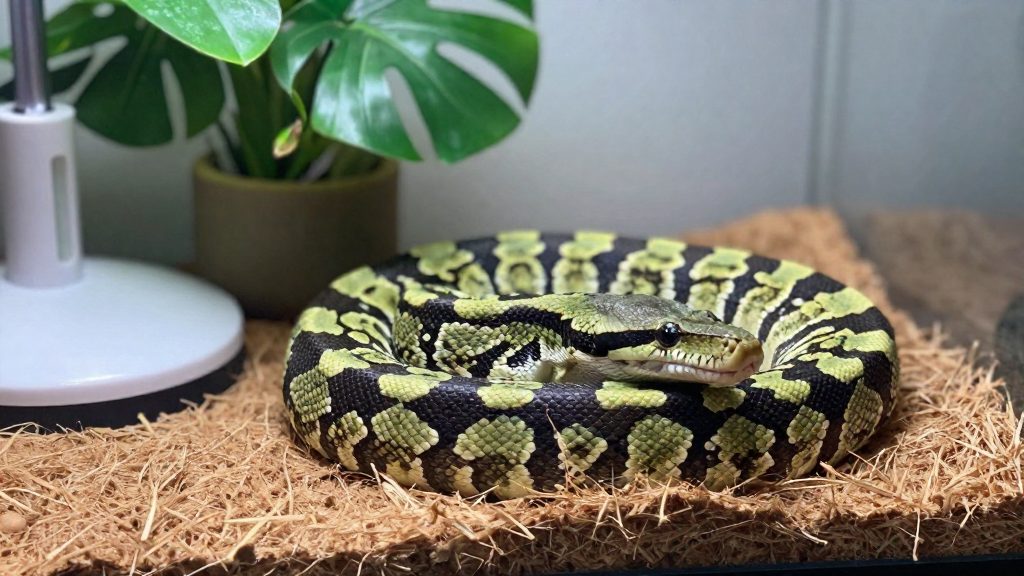
Choosing the species comes before any enclosure purchase, because adult size, lifespan, legal status, handling tolerance and daily care time all depend on it. Check these five points for each candidate species before you buy.
Choose the species before the enclosure
Every later decision about the enclosure, climate and handling follows from the species you select. Review each criterion below for every candidate before you buy equipment.
Adult size and lifespan
Adult size sets the minimum enclosure you need to plan for, and lifespan determines how many years of care you are committing to. Many reptiles grow substantially after the first year. The official sources consulted here do not give adult size or lifespan figures by species, so take these from a veterinary reptile reference or a species care guide that names its author and publication date.
Legal status and permits
Reptile ownership is regulated differently across countries, and within countries across regions and municipalities. A species may be unrestricted, require a permit, or be prohibited. In Canada, rules can differ between federal, provincial or territorial and municipal levels, so check with the authorities in your province or territory and with your municipality before acquiring a species. Keep any permit or proof of lawful acquisition with the animal’s records. Because the legal status of a species can change, recheck it before acquisition rather than relying on an older listing.
Handling tolerance
Handling tolerance varies between species and between individual animals of the same species. Some reptiles tolerate regular handling, while others become stressed when lifted. Watch how a specific animal responds when a breeder or shelter employee picks it up: whether it stays still, tries to flee, or defends itself. An animal that reacts strongly should be considered a low-handling pet, and you should accept that interaction will be limited.
Activity pattern and daily care time
Reptiles are not all active at the same time of day. Some species are most active in daylight, others at dusk or at night. Activity pattern determines when you can observe the animal and when feeding and checks fall in your routine. Estimate the total time you can give each day for feeding, observation and routine checks, and compare that figure with the species’ pattern before committing.
| Criterion | Question to answer before buying | Where to verify |
|---|---|---|
| Adult size | What length does the animal reach as an adult? | Veterinary reptile reference or species care guide with named author and date |
| Lifespan | How many years of care will it need? | Same sources as adult size |
| Legal status | Is the species restricted, permitted or prohibited where I live? | National or local wildlife or animal health authority |
| Handling tolerance | How does this individual react to being picked up? | Observation during a visit with the breeder or shelter |
| Activity pattern | When is the species awake, and how much daily time do I have? | Species care guide, compared with my own daily schedule |
What size terrarium does your reptile need?
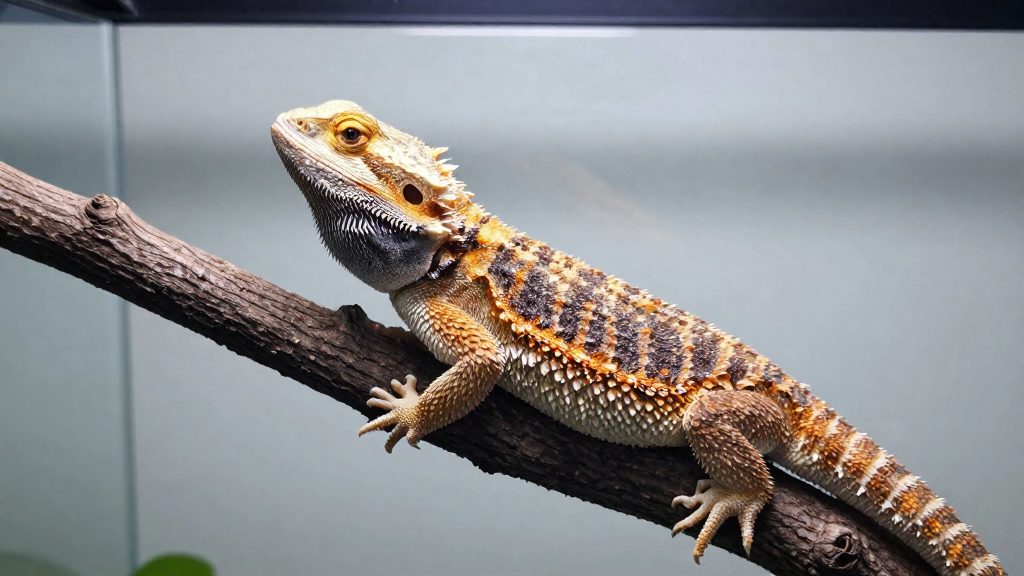
The main sizing rule is shape. According to PetSmart’s retailer learning centre, climbing reptiles need an enclosure that is taller than it is wide, while non-climbing reptiles need one that is wider than it is tall. Before choosing a tank, identify which group your species belongs to, because the same footprint can suit one animal and be unsuitable for another.
| Reptile type | Required proportion | What to prioritise |
|---|---|---|
| Climber (a species that climbs) | Taller than wide | Vertical space for climbing branches and perches |
| Non-climber (for example, a bearded dragon) | Wider than tall | Floor area for movement and separate warm and cool zones |
Floor area should be scaled to the adult body length, not the size the animal has when first acquired. A hatchling may look small in a large tank, but the enclosure must still allow an adult to turn around, stretch its full length and move between zones without touching the glass or walls. The official sources consulted do not give minimum dimensions for individual species.
Planning for growth
Reptiles grow over months and years. If you house a juvenile in a smaller temporary enclosure, set a plan to move it into a larger one as it grows. The sources consulted do not specify growth timelines or the point at which an upgrade becomes necessary.
Where should you place the tank at home?
Choose a stable surface in a low-traffic area that is away from direct sun and drafts, and close enough to a power outlet to run the heating and lighting equipment without long extension cables. PetSmart’s learning centre advises these conditions for any reptile enclosure, and the exact spot matters because the room’s temperature and noise affect the animal every day, not only during setup.
Matching the footprint to the species
The tank’s proportions determine what it needs from its surface. A tall, narrow enclosure has a higher centre of gravity, so it needs a firmer base and a more secure fixing to the wall. A wide, low enclosure needs a larger, level surface.
| Factor | Suitable choice | Avoid |
|---|---|---|
| Support | Sturdy, level furniture rated for the filled weight | Shelves or stands that flex or rock |
| Floor | Solid floor able to carry a filled tank, which weighs far more than the empty one | Upper floors of older buildings without a structural check |
| Wall fixing | Tall units secured to a solid wall | Free-standing tall tanks in areas where people brush past |
| Power | Outlet within easy reach of the tank | Daisy-chained power strips behind furniture |
Distance from windows, heat sources and doors
Direct sunlight through a window can overheat the glass and the enclosure, and the sun’s position changes across the year, so check the spot at different times of day. Doors and windows that open create drafts, which can cause uncontrolled temperature swings inside the tank. Keep the enclosure clear of heating units as well, since they add heat from a direction you cannot regulate with the thermostat in the tank.
Noise, foot traffic and pet access
A hallway, kitchen doorway or television area exposes the animal to constant movement and vibration. A quiet corner with fewer passers-by is the better choice. Keep the tank out of reach of other household pets: cats and dogs can knock the enclosure, and the sudden approach of an animal can stress the reptile.
Heat gradient, lighting and humidity
A reptile enclosure works as a thermal map rather than a single temperature. It needs a warm end and a cool end, with a basking spot under a heat source where the animal can raise its body temperature, then move away from the heat. According to PetSmart’s reptile care guidance, the gradient is read with one thermometer at each end, so you can measure the difference instead of estimating it.
Heat source and basking spot placement
Choose a heat source that warms one area strongly while the rest of the enclosure stays cooler. Position the basking spot at the warm end, directly under the heat source, and keep the cool end far enough away that the animal can leave the heat without leaving the enclosure. Uncontrolled sources of heat or cold will distort the readings. The official sources consulted do not specify target basking temperatures for individual species.
Thermometers and hygrometer
| Instrument | Where it goes | What it tells you |
|---|---|---|
| Thermometer, warm end | Warm side, near the basking spot | Upper limit of the gradient |
| Thermometer, cool end | Opposite side of the enclosure | Lower limit the animal can retreat to |
| Hygrometer | Inside the enclosure, away from the heat source | Relative humidity, to compare against the species’ native habitat |
Check the two thermometers at the same time of day, and compare the readings over several days rather than reacting to a single value. Read the hygrometer the same way.
UVB lighting and photoperiod
The official sources consulted do not specify UVB output, lamp distance or daily day length for any species. As a general principle, the lighting schedule should follow the species’ natural activity pattern. Use a timer to keep the on and off times consistent, and choose lamps matched to the species and replaced on the manufacturer’s schedule.
Humidity targets by species
Humidity is managed separately, and its target depends on the species’ native habitat. Humidity targets are set by the species, not by a universal number. Record the target for your animal’s native habitat before buying equipment, then use the hygrometer to check whether the enclosure stays within that range across the day.
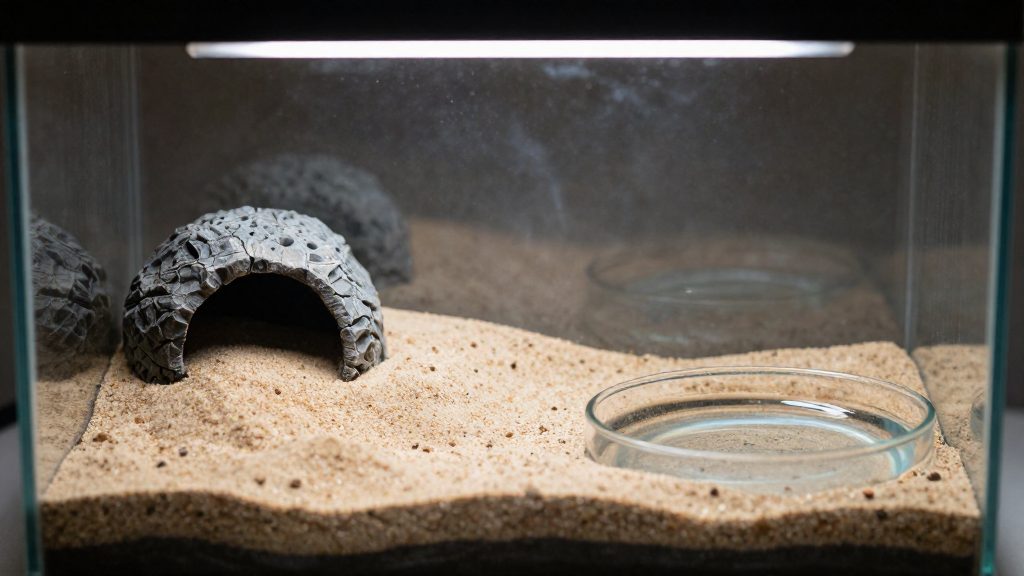
Substrate and safe furnishings
Safe furnishing comes down to three checks at setup: every item should be too large to swallow, free of sharp edges, and removable for cleaning. Loose substrate, untreated wood and rough rock are the main items to assess before a reptile enters its terrarium. Correcting these choices at setup is far easier than fixing them after a reptile has started chewing or digging.
Loose versus solid substrate
Loose substrate (fine particles, chips or small grains) can be swallowed while a reptile feeds, digs or picks up food. Keepers treat swallowed substrate as a recognised concern, but the official sources consulted do not quantify the risk for any species. Solid options, such as tiles or flat stone, cannot be swallowed in the same way and limit digging. If you use loose material, watch for changes in feeding or appetite, and contact a reptile-experienced vet if you notice them.
Hides, branches and rocks: sizing for safety
Each furnishing carries a specific risk:
| Furnishing | Main risk | Check at setup |
|---|---|---|
| Hide | Reptile becomes wedged or trapped inside | Entrance and interior are smooth, with no sharp lip |
| Branch | Splinters, sharp stubs, falling | Ends are smooth and the branch is firmly anchored |
| Rock | Rolling, toppling, flaking | Stacked on a stable base, with no loose flakes |
Stacked rock is the highest-risk structure. Build it on a stable base and check it regularly, because a shifting stack can crush or trap a reptile. Test every piece by running a finger over it and looking for cracks or flakes before placing it inside.
Materials to avoid: treated wood and sharp edges
Avoid treated wood, meaning wood that has been coated, pressure-treated or finished with chemicals, because reptiles chew and lie against surfaces. The official sources consulted do not list which treatments are safe, so use untreated, unfinished wood and check the labels of any ready-made decor.
Remove any item with sharp edges, including cut metal, broken glass, cracked ornaments and plastic with sharp moulded seams. Choose furnishings that can be taken out for cleaning.
How do you reduce Salmonella risk in your household?
Pet reptiles can carry Salmonella without looking ill, so hygiene reduces the risk, but for vulnerable people the safest option, according to PHAC, is not to keep a reptile in the home. The Public Health Agency of Canada (PHAC, guidance dated 27 May 2014) focuses on three points: hand-washing after contact, who lives in or visits the home, and where water from the enclosure ends up. The steps below cover those household habits only.
Hand-washing after feeding and handling
PHAC advises washing hands thoroughly with soap and water right after feeding a reptile, handling it, or cleaning up after it or its living area. A practical sequence is:
- Wet hands with running water.
- Apply soap and rub all surfaces: palms, backs of hands, between the fingers, and under the nails.
- Rinse thoroughly.
- Dry hands with a clean towel.
Children should wash their hands under adult supervision. The official sources consulted do not specify a required washing duration.
Vulnerable groups
PHAC advises keeping reptiles out of homes where the following people live:
- Babies
- Children under five
- Pregnant women
- Older adults
- People with weakened immune systems
PHAC also advises against keeping reptiles in daycares or schools where children under five are present. For a household that includes any of these people, the guidance points toward not keeping a reptile there, rather than relying on hygiene alone.
Kitchen separation
Do not empty tank water into a sink used for food preparation or drinking water. Keep reptile equipment out of the kitchen sink for the same reason. The official sources consulted do not specify which drain or sink is suitable for tank water instead.
Cleaning routine and when to see a vet
The Public Health Agency of Canada (PHAC, 2014-05-27) advises cleaning the tank and its contents outside the home while wearing disposable gloves. Cleaning outdoors keeps contaminated water and debris out of the living space, and disposable gloves can be discarded after each session.
Outdoor deep-clean method
- Move the reptile to a secure temporary enclosure with its heat source.
- Put on disposable gloves before handling the tank, décor or substrate.
- Remove the décor, water dish and substrate, then empty the tank outdoors.
- Scrub the tank and accessories, rinse them, and allow them to dry fully.
- Apply a disinfectant to every surface the reptile touched, following the contact time on the product label.
- Dispose of the substrate and gloves in sealed waste bags.
Routine spot cleaning and waste removal
The official sources consulted do not specify a fixed cleaning interval. The practical approach is to remove droppings and uneaten food as soon as you see them, then carry out a full clean whenever the enclosure becomes soiled. Seal all waste in a bag before putting it in the bin, and change gloves between spot-cleaning and any work on food or water bowls.
| Task | Timing | Method |
|---|---|---|
| Spot cleaning | When waste is visible | Remove droppings and uneaten food with gloves on |
| Waste removal | After each cleaning | Seal in a bag before disposal |
| Full clean | When the enclosure is soiled | Outdoor method above |
Overheating, dehydration and illness signs
The temperature gradient is the main safeguard against overheating. After any cleaning, check that both ends of the gradient are back in range before returning the reptile.
The official sources consulted do not give temperature thresholds or dehydration signs for reptiles. Seek a reptile-experienced vet promptly if your animal stops eating for an extended period, becomes persistently lethargic, shows laboured breathing, or displays signs of heat stress or dehydration that do not improve once the enclosure is corrected.
Frequently asked questions
Is a reptile a safe pet for young children?
The Public Health Agency of Canada (2014) advises keeping reptiles out of homes with children under five, babies, pregnant women, older adults and people with weakened immune systems. If children are in the household, hand hygiene with soap and water after any contact with the animal or its enclosure is essential, and younger children need adult supervision for it.
Where should a reptile terrarium go, and what does a basic heat setup need?
PetSmart’s learning centre recommends a stable surface in a low-traffic area, away from direct sun and drafts, close to an outlet. The enclosure should be taller than it is wide for climbing species and wider than it is tall for non-climbers, and it needs a temperature gradient with a basking spot at the warm end and a thermometer at each end.
How should I clean the tank without spreading germs at home?
The Public Health Agency of Canada (2014) advises cleaning the tank and its contents outside the home while wearing disposable gloves. Never empty tank water into a sink used for food preparation or drinking water, and disinfect any surface the reptile has touched.