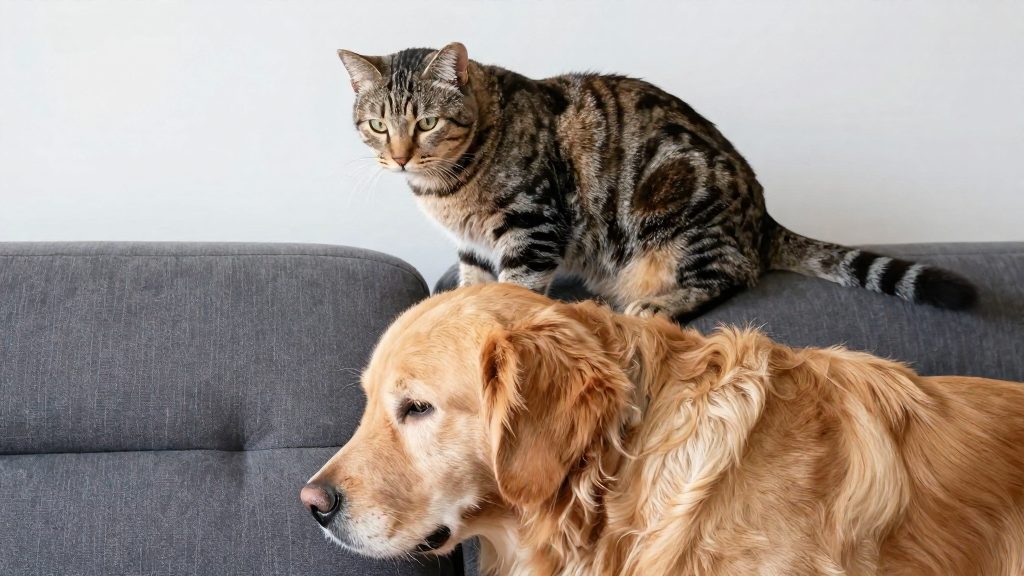
Before a cat enters the home, the resident dog needs three checks: a veterinary health assessment, an honest review of its temperament and history, and an assessment of its impulse control around unfamiliar animals. PetMD advises a veterinary health assessment before introductions begin (PetMD, written by Rebecca Bermingham, CVT, reviewed by Veronica Higgs, DVM, 2023-10-04). A dog that stiffens, fixates, barks, or lunges at a cat is not ready for face-to-face contact, however calm it is at home.
Is your dog ready for a cat?
Veterinary health assessment
Book a vet visit before the first introduction step. PetMD recommends this check before any introduction begins (2023-10-04). Use the appointment to tell the vet about any pain, stiffness, or behaviour change you have noticed, since a dog in discomfort is more likely to react strongly to a new animal. The vet can also advise on any stress-related concerns specific to your dog.
Temperament and history
Write down how the dog has behaved with other animals: dogs it met on walks, cats it has seen, small animals in the house or garden, and any incident in which it barked, lunged, or resisted being handled. Note the dog’s history where known, especially if it came from a shelter or rescue, because past experiences often shape current reactions. Ask the previous owner or rescue staff directly about these points.
Prey drive
Prey drive is the instinct to chase small, fast-moving animals. Cats often trigger it through quick movement. Observe whether the dog fixates on moving objects, stalks toys, or lunges at small animals outdoors. A strong prey response means the dog needs more supervision and slower steps, not a faster timeline. Kittens need particular care, because a large dog may not realise how fragile they are (Baypath Humane Society, Massachusetts, 2021-02-10).
Impulse control and reactions to unfamiliar animals
Test the dog’s self-control at a distance before any contact is planned. Use the signals below from PetMD (2023-10-04) to decide your next step.
| Observed in the dog | Action advised |
|---|---|
| Stiffening, moving slowly, or fixating on the cat | Stay alert, keep the distance and do not progress |
| Barking or lunging | Separate the pets immediately |
| Settling quickly after a brief glance and disengaging on cue | May be ready to progress to the next step, still at a distance |
A dog that settles quickly after a brief glance at a distant animal shows better impulse control than one that stays locked on the cat. Only move forward when the dog can disengage on cue and ignore the cat.
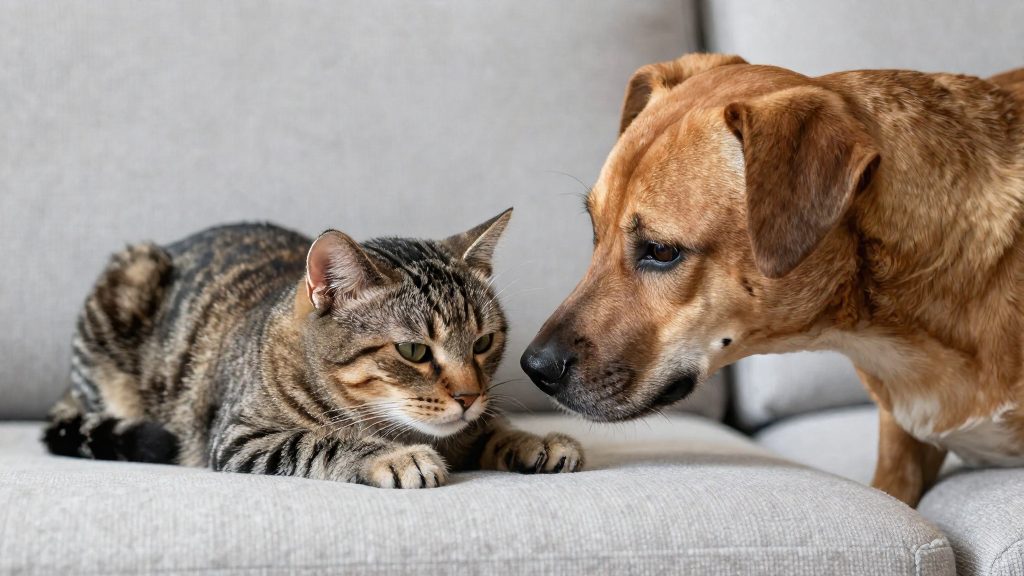
Prepare a safe room before the cat arrives
Set aside one private room that the dog rarely uses and make it the cat’s base during quarantine (at least 3 to 4 days per PetMD), with no face-to-face dog-cat contact for the first week (Baypath Humane Society, 2021-02-10). PetMD advises quarantining any new pet for at least 3 to 4 days and recommends starting the introduction with the new cat in a private room the dog rarely uses. The room is where the cat settles in, eats, and gets used to the household’s sounds and routines before any dog contact is attempted.
Choosing the room
It also needs a door that closes fully, because the separation depends on the door, not on the cat’s own behaviour. The room needs a door that closes fully, because the separation depends on the door, not on the cat’s own behaviour.
Quarantine in practice
For at least the first 3 to 4 days, the cat stays in this room. Alternate roaming then begins only with the dog confined behind a closed door, and there is still no face-to-face contact during the first week. Quarantine serves two purposes: the cat adapts to its new surroundings, and the household can observe its condition and behaviour before any contact with the dog. Keep the cat’s room separate from the dog’s resting areas, so that the dog’s daily routine does not bring it past the door.
Dog-free access rules
| Rule | Source |
|---|---|
| Take the cat straight into its room on arrival | Joybound, 2023 |
| Let the dog sniff at the door without visual contact | Joybound, 2023 |
How do you swap scents and start the introduction?
Scent and sound exchange is the first stage of a dog and cat introduction, and it happens before the animals see each other. The aim is for each pet to learn the other’s presence through smell and noise while they stay physically and visually apart. According to PetMD (2023-10-04), you let one pet roam while the other is confined, then switch, and you swap bedding so each animal becomes familiar with the other’s scent and sounds.
Alternate roaming
Give alternate roaming one animal at a time. The free pet has the home, and the confined pet stays in a separate room with the door closed. When the first animal has had its turn, the roles reverse. Because the two animals do not share space during this stage, make sure the doors stay securely closed so neither can reach the other.
Swapping bedding and toys
The scent swap is the core of this stage. Move bedding, blankets, or toys from each animal’s space into the other’s, so each pet encounters the other’s smell in its own territory. Use the same items for both animals and rotate them regularly, so the scent builds up gradually rather than all at once.
No face-to-face contact in the first first week
Baypath Humane Society (Massachusetts, 2021-02-10) advises allowing no face-to-face dog and cat contact during the first week. Scent and sound exchange continues during this period, and visual contact is not started until the later stages.
| Stage | Dog | Cat | Visual contact |
|---|---|---|---|
| Arrival | Sniffs the closed door | In its safe room | No |
| Alternate roaming | Free or confined, in turns | Confined or free, in turns | No |
| Bedding and toy swap | Uses the cat’s items | Uses the dog’s items | No |
| First week | No face-to-face contact | No face-to-face contact | No |
Step-by-step: gate, leash, then supervised meetings
The introduction moves through three controlled stages: visual contact through a barrier, leashed face-to-face meetings, and finally unleashed time together. Each stage has a fixed setup, and the animals advance only when a stated condition is met. Start the first stage only once the cat is comfortable with the people in the household (Baypath Humane Society, 2021-02-10).
| Stage | Setup | Condition to advance |
|---|---|---|
| 1. Visual contact | Tall gate or barrier, with meals or treats on both sides | Both animals eat and settle while they can see each other (PetMD, 2023-10-04) |
| 2. Leashed meetings | Dog on a loose leash, cat with escape spots available | Meetings are relaxed, so the gate can be removed (Joybound, 2023) |
| 3. Unleashed time | No leash | Leash removed only when both animals ignore each other (Joybound, 2023) |
Stage 1: visual contact through a tall gate
- Place a tall pet gate or barrier between the two animals. PetMD recommends it for visual contact, paired with meals or treats (PetMD, 2023-10-04).
- Serve each animal’s meal on its own side of the barrier so that seeing the other is paired with food.
- Keep the cat’s room or area free of the dog. The gate is the only point of contact at this stage.
Stage 2: leashed first face-to-face meetings
- Make the first face-to-face meetings leashed, with the dog on a loose leash (PetMD, 2023-10-04). A loose leash means the handler holds it without tension, so the dog can move but cannot close the distance quickly.
- Before the meeting, place elevated cat trees or shelves in the room. PetMD names them as escape spots (PetMD, 2023-10-04). The cat can leave the floor level without passing the dog.
- Keep sessions short and end them while both animals are still settled.
Stage 3: removing the gate and the leash
- Remove the gate only when meetings are relaxed. The decision depends on the animals’ behaviour in sessions, not on the calendar (Joybound, 2023).
- Take the leash off only when both animals ignore each other, and keep the cat’s escape spots available (Joybound, 2023; PetMD, 2023-10-04).
What body language means stop?
Body language is the earliest sign that a meeting between a new cat and a resident dog has become too stressful. PetMD (2023-10-04) lists specific postures for each species. On any warning sign, increase the distance or end the session, and separate the pets immediately if the escalated signs below appear. Read the signals together, because a single posture is less informative than a combination, such as a dog that stiffens while staring at the cat.
Dog warning signs
- Stiffening: the dog’s body tenses and loses its loose, relaxed movement.
- Slow movement: the dog moves cautiously or deliberately instead of freely.
- Fixating on the cat: the dog keeps its gaze locked on the cat.
Cat warning signs
- Crouching: the cat lowers its body toward the floor.
- Freezing: the cat stops moving completely.
- Tail flicking: the tail moves in quick, repeated flicks.
- Pinned ears: the ears are flattened back against the head.
- Dilated pupils: the pupils are enlarged.
Signals that require immediate separation
| Behaviour | Species | Required action |
|---|---|---|
| Barking | Dog | Separate the pets immediately |
| Lunging | Dog | Separate the pets immediately |
| Hissing | Cat | Separate the pets immediately |
| Growling | Cat | Separate the pets immediately |
| Raised fur | Cat | Separate the pets immediately |
The difference between the two groups matters. The warning signs above indicate that the animals are stressed, so the session can be shortened or paused. Barking, lunging, hissing, growling, and raised fur indicate a conflict that has already escalated. PetMD notes that progress in these introductions is not linear, so stepping back to an earlier stage is acceptable.

How long does it take for a dog and cat to get along?
Most dog-and-cat introductions take a couple of weeks to a few months, according to PetMD (2023-10-04). The range is wide because each animal adapts at its own pace, so a fixed deadline is unreliable. Plan for a period of weeks or months and let the pets’ behaviour, not the calendar, determine when the next step begins.
The sources then recommend repeating controlled meetings several times before allowing free roaming or any unsupervised time together.
| Phase | Rule from the sources |
|---|---|
| Overall duration | A couple of weeks to a few months (PetMD, 2023-10-04) |
| Before free roaming | Several repeated controlled meetings (Baypath Humane Society, 2021-02-10) |
| Owners absent | Keep the pets separated (PetMD, 2023-10-04) |
Expect non-linear progress
Non-linear progress is normal. A good meeting does not guarantee the next one will go as well, and PetMD notes that it is fine to step back when needed. A step back means returning to a stage the pets handled well, not restarting from zero. Build this into your schedule so that one difficult session does not feel like a failed introduction.
Keep the pets separated when you are away
Separation when you leave home is a rule of its own. PetMD advises keeping the pets apart whenever you are away, even if they appear to get along. This matters because the sources only allow unsupervised time together after several controlled meetings have gone well. Until then, use separate rooms or barriers for every absence.
Keep the cat safe: escape routes, litter, and food
The cat needs a route out of any room the dog can enter, and its litter and food need to stay where the dog cannot reach them. Blocked exits, a dog eating from the litter box, or a dog guarding the cat’s food bowl can each cause the cat stress and push the introduction backward. Set these up before the first meeting, and keep them in place for the whole process. Baypath Humane Society (Massachusetts, 2021-02-10) and Joybound (animal rescue, 2023) both give direct guidance on litter and food placement, and the points below draw on those sources.
Doors, windows, and gates
Check every route the cat could use to leave a room or enter another part of the home, then decide which ones the dog can reach or block:
- Interior doors: Keep them closed or fitted with a barrier the dog cannot push through, so the cat can leave the dog’s area without passing it.
- Windows and balcony doors: Keep windows and balcony doors closed while the cat is roaming so it cannot get outside. Inside, give the cat elevated escape spots such as cat trees or shelves (PetMD, 2023-10-04).
- Cat flaps and gaps: Secure any opening that leads outdoors so the cat cannot slip out.
Litter box placement
Place litter boxes where the dog cannot reach them. Baypath Humane Society (2021-02-10) recommends one box per cat plus one.
| Resource | Requirement | Source |
|---|---|---|
| Litter boxes | Placed where the dog cannot reach them | Baypath Humane Society, 2021-02-10 |
| Litter box count | One per cat, plus one | Baypath Humane Society, 2021-02-10 |
| Litter box access | Keep the dog away from the litter box | Joybound, 2023 |
Keep the dog away from the litter box at all times. Joybound (2023) notes that eating feces, litter, or cat food is stressful for the cat, so a dog that repeatedly reaches the box is a welfare issue, not only a hygiene one.
Feeding stations separated from the dog’s food
Feed the cat in a spot the dog cannot access, and keep the dog’s food out of the cat’s reach as well:
- Feed the two animals in separate rooms or behind a barrier the dog cannot pass.
- Keep the dog away from the cat’s food, including any uneaten food between meals (Joybound, 2023).
- Keep the cat’s food bowl and the dog’s bowl apart, so neither animal approaches the other’s meal.
When should you call a vet or trainer?
Pause the introduction and bring in a professional when a specific trigger appears, rather than trying to manage it alone. Three situations call for this step: resource guarding, persistent aggression or stalled progress, and signs of illness or injury. In each case, separate the pets first. The professional then decides how the work continues.
| Trigger | Immediate action | Who to consult |
|---|---|---|
| Resource guarding (food, bed, toys, litter box) | Pause the introduction | Vet or qualified trainer |
| Persistent aggression or no progress over several weeks | Keep the pets separated | Qualified trainer, with a vet if health is a factor |
| Illness or injury in either animal | Separate the pets and stop the introduction | Vet |
Resource guarding
Resource guarding means one animal defends something it values, such as food, a bed, a toy, or a litter box, from the other. Guarding is a pause signal, not a sign that the introduction has failed.
Persistent aggression or stalled progress
Watch the warning signs on both sides.
Watch for the escalated signs on both sides (barking, lunging, hissing, growling, raised fur). Separate the pets immediately at the first escalated sign. If these signs happen again, or progress stalls, consult a vet or qualified trainer rather than waiting to see whether it settles. Lack of improvement across several weeks of controlled meetings also suggests the current approach is not working. The fact sheet does not set a fixed number of weeks for this threshold, so judge by the pattern. If the pattern does not change, a qualified trainer can assess the household and the meeting setup.
Signs of illness or injury
Separate the pets at once after any injury, such as a bite, scratch, or limping, and contact a vet promptly. The introduction should not continue until a vet has assessed the animal. The same applies to a sudden change in eating, toileting, or behaviour in either animal, because such changes can have a medical cause. Do not assume a behavioural explanation until a vet has ruled out a physical one.
Frequently asked questions
Can the dog and the cat see each other during the first week?
No. Baypath Humane Society (Massachusetts, 2021-02-10) advises no face-to-face dog-cat contact in the first week, so use the scent swap and a closed barrier for contact during that period. The cat should be introduced to the dog only after it is comfortable with the people in the household.
What should I do if the dog barks or lunges at the cat during a session?
Separate the animals straight away, since PetMD (2023-10-04) lists barking or lunging by the dog, and hissing, growling or raised fur by the cat, as signals to stop. If the behaviour happens again, or the animals stop making progress, consult a vet or a qualified trainer. Do not wait to see whether the reaction settles on its own.
How long does it take before the two can share the home unsupervised?
PetMD (2023-10-04) says the process often takes “a couple weeks to a few months,” and progress is rarely straight. Baypath (2021-02-10) advises repeating controlled meetings several times before allowing free roaming or any unsupervised time together. Keep them separated when you leave the house, even if they appear to get along.