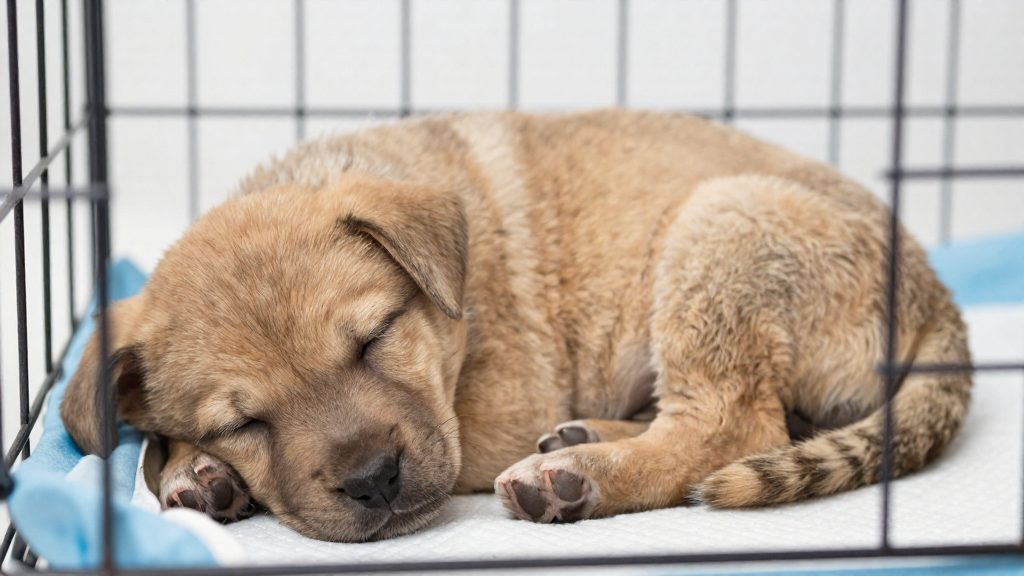
Night crying in a crate usually has one of five documented causes: fear or frustration at confinement, missing littermates, distress at being alone, wanting attention, or needing to go outside to eliminate (PetMD, Dr. Wailani Sung, 2025-04-08). Working out which cause applies comes before any change to the routine, because a puppy that needs to eliminate needs a different response than a puppy that is lonely or trying to get attention.
Why does my puppy cry in the crate at night?
Fear and frustration at confinement
Some puppies react to being enclosed. The crate itself can be the trigger, so the crying may be a response to confinement rather than to darkness, noise, or the time of night. Check whether the puppy settles quickly once it stops reacting, or whether the fussing continues at the same intensity for long periods.
Missing littermates and sudden isolation
A puppy that has spent its early weeks with littermates goes from constant company to being alone in one step. The crying can be a direct response to losing that group, and it may be most noticeable on the first nights after the puppy comes home. This cause is about the change itself, not the crate’s design.
Distress at being alone
Puppies can cry because they are alone in a room they do not recognise as safe. Note whether the crying stops when you speak to the puppy or come close to the crate, and whether it resumes when you move away. A puppy that reacts strongly to being left by itself, and that does not settle, needs a different response from one that quiets quickly.
Elimination
A puppy may whine because it needs to go outside. AKC advises that, for overnight crating of a puppy, letting the puppy out when it whines or fusses is appropriate, since it likely needs to go potty (AKC, 2026-10-13).
Attention-seeking versus genuine distress
Crying that stops as soon as someone responds may suggest the puppy wants attention, but this is only an observation, not a sourced rule. Rule out elimination, hunger, injury and fear first. Use the table below to narrow the cause.
| Likely cause | Question to ask |
|---|---|
| Fear or frustration at confinement | Does the puppy react to the crate itself, for example by pushing at the door or pacing? |
| Missing littermates | Did the crying start on the first night apart from the litter? |
| Distress at being alone | Does the puppy calm when you speak to it, and restart when you leave? |
| Wanting attention | Does the crying stop as soon as someone responds, and resume once they leave? |
| Needing to eliminate | Did the puppy go outside shortly before bed? |

Is it normal for a puppy to cry the first nights?
Yes, some crying during a puppy’s first nights in a crate is common. Some puppies sleep through the night from the start, while others cry for a few nights and some need a middle-of-the-night trip outside (American Kennel Club, 2026-03-10). Crying that continues for hours is a different matter. PetMD (2025-04-08) states that screaming for hours is not normal and may point to fear, injury, hunger, or a need to go to the bathroom.
Typical settling-in crying
Settling-in crying is usually short-lived and tied to the change of environment. During the adjustment period, more than one cause often applies at once, which is why the crying can look alike.
To make the settling-in period easier, the American Kennel Club (2026-03-10) recommends:
- Placing the crate in your bedroom, even right next to your bed, so the puppy feels secure and you can reach in to reassure it.
- Not taking a crying puppy into your bed unless you want it to sleep there.
When crying is not normal
Use the pattern and duration of the crying to tell the two apart:
| Pattern | What the source says |
|---|---|
| Sleeps through from the first night | Within the normal range for puppies (AKC, 2026-03-10) |
| Cries for a few nights, then settles | Within the normal range for puppies (AKC, 2026-03-10) |
| Screams for hours | Not normal; may point to fear, injury, hunger, or needing to go out (PetMD, 2025-04-08) |
| Panicked, or will not stop crying in the crate | May indicate separation anxiety; stop crate training and consult a professional (AKC, 2026-10-13) |
Health checks to rule out hunger or injury
If the crying is prolonged or unusual, work through these checks before the next night:
- Hunger: Confirm the puppy has eaten at a normal time before bed.
- Toileting: Confirm it went to the bathroom right before being crated.
- Injury: Look over the puppy for limping, a reluctance to move, or pain when touched, particularly on the paws, legs, and belly. Check the crate for sharp edges or anything that could have caught a limb or the mouth.
- Veterinary review: If you find any sign of injury, or if the puppy is screaming for hours or will not stop crying despite the checks above, take it out of the crate and contact a veterinarian promptly. If it seems overly scared or distressed and crate training is not progressing, consult a board-certified veterinary behaviorist or a certified applied animal behaviorist (PetMD, 2025-04-08).
Set up the crate for a calm night
Crate placement, size and bedding can affect how settled a puppy feels. The American Kennel Club (AKC, dated 2026-03-10) advises placing the crate in your bedroom, even right next to your bed, so the puppy feels secure and you can reach in to reassure it. A puppy alone in another room has no way to tell whether anyone is nearby, so the crate’s location is the first setup decision.
Placing the crate in the owner’s bedroom
- Put the crate beside your bed, close enough that you can reach inside without getting out of bed.
- Keep the crate in the same spot every night so the puppy learns one sleeping area.
- Keep the puppy in the crate rather than in your bed. Don’t take a crying puppy into your bed unless you want it to sleep there.
Sizing the crate and bedding for comfort
The available data does not specify crate dimensions, so choose a size by checking that the puppy can stand, turn around and lie down comfortably, and confirm the choice with your veterinarian or a professional trainer.
For bedding, a soft blanket or stuffed toy that smells like the puppy’s mother can comfort it, according to the AKC (dated 2026-03-10). Use washable bedding so it can be cleaned if the puppy has an accident.
| Setup element | What to check |
|---|---|
| Location | Bedroom, beside your bed, within reach |
| Crate size | Room to stand, turn and lie down |
| Bedding | Soft, washable item; a blanket or toy with the mother’s scent (AKC) |
Water access and chew items inside the crate
The source data does not address water or chew items inside the crate, so these points rely on general practice rather than sourced figures. Before bedtime, check whether water is available and confirm with your veterinarian how much access is appropriate for your puppy. Remove small or loose objects that the puppy could chew off and swallow, and keep only items that are safe for unsupervised use.
Should I let my puppy cry it out?
Overnight, no: a whining puppy likely needs to go potty, so respond briefly. The American Kennel Club (AKC, dated 2026-10-13) advises letting a puppy out of its crate overnight when it whines or fusses, because it most likely needs to go potty. A night-time whine is therefore treated as a possible toilet signal, not as a behaviour to ignore. Whether to respond depends on the time of day and on why the puppy is being let out.
Overnight whining: respond briefly
For overnight crating, AKC (dated 2026-03-10) recommends carrying the puppy out quietly for a brief, uneventful overnight potty trip, then returning it to the crate. Keep lights low and avoid play, so the puppy learns that night is for sleeping. Make sure it goes to the bathroom right before bed.
Patterns vary. AKC notes that some puppies sleep through the night from the start, others cry for a few nights, and some need a middle-of-the-night trip outside. Overnight potty trips usually end by about 4 to 5 months of age, so this response is temporary.
Daytime whining: no release as a reward
Outside overnight puppy crating, AKC (dated 2026-10-13) advises against letting a dog out as a reward for whining. The purpose of opening the crate should be a genuine need, such as toileting, not a demand for attention.
Comparing the two situations
| Situation | Recommended response | Source |
|---|---|---|
| Overnight whine or fuss | Quiet, brief potty break, then back to the crate | AKC, 2026-03-10 |
| Daytime whine | Do not let the dog out as a reward | AKC, 2026-10-13 |
The source material does not describe a timed or graded ignoring protocol, so this section does not prescribe one. Its guidance is responsive at night and firm about not rewarding noise during the day. A responsive overnight settling approach means checking the puppy’s needs first, then keeping the interaction minimal.

How long can a puppy hold it overnight?
The age-plus-one rule gives a quick estimate of how long a puppy can hold its bladder. According to PetMD (2025-04-08), a puppy’s age in months plus one is roughly the maximum number of hours it can hold its bladder. The figure is an approximation, not a guarantee, and it marks an upper limit on the gap between bathroom breaks, not a target to aim for.
Approximate maximum hours = age in months + 1
| Puppy age | Approximate maximum hours before a bathroom break (PetMD, 2025-04-08) |
|---|---|
| 2 months | about 3 hours |
| 4 months | up to 5 hours |
Applying the figure to the night
- Find the puppy’s age in months and add one.
- Plan the bedtime outing and any middle-of-the-night trip so that no gap in the crate exceeds that number.
- American Kennel Club (2026-10-13) advises that a dog should not stay crated longer than it can hold its bladder.
- American Kennel Club (2026-03-10) notes that overnight potty trips usually end by about 4 to 5 months of age, so the need for a night break typically shrinks as the age-based limit grows.
When accidents change the schedule
Accidents show that the interval is longer than this puppy can currently manage. PetMD advises that if accidents are frequent, the puppy should be taken out more often. Shorten the gaps first, then lengthen them gradually as the puppy stops having accidents.
What not to do during crate training
Two practices are documented as working against crate training: using the crate as punishment, and crating all day, every day. Limiting exercise and company outside the crate is a general-practice concern, not a sourced one. Each one teaches the dog to see the crate as somewhere to avoid, when the goal is a dog that settles inside it at night. The American Kennel Club states that the crate should never be used for punishment and that crating should not be all day, every day (American Kennel Club, 2026-10-13).
| Practice | Why it undermines crate training |
|---|---|
| Sending the dog into the crate as a consequence | The crate becomes linked with being in trouble, so the dog resists entering it. |
| Crating for most of the day, every day | The dog has little time outside confinement, so the crate stops being a rest space and becomes the default state. |
| Cutting back on contact outside the crate | Unmet need for company keeps the dog distressed when left alone, which is one of the reasons PetMD lists for puppy crying. |
Using the crate as a punishment
Closing a dog in the crate after chewing, jumping or an accident pairs the enclosure with a negative event. A dog that links the crate with being in trouble may resist going in, which is why the AKC says never to use it for punishment. Keep the crate neutral to positive: let the dog enter on its own, and place a familiar blanket or a chew inside when it is calm.
Crating all day, every day
A crate used as the main location for the whole day removes the dog’s chance to rest, move and interact, and it makes overnight confinement harder to accept. The sources in this brief do not give a daily time limit. Instead, they say crating should not be a constant routine, so the dog should have stretches outside the crate each day, supervised and with room to move.
Skipping exercise and social time outside the crate
A dog whose needs for movement and company are unmet during the day arrives at the crate already restless. Regular walks, play and time with family members outside the crate reduce the chance that the crate itself becomes the only source of isolation the dog experiences.
When is crying a sign of separation anxiety?
Crying alone does not indicate separation anxiety. The difference lies in the intensity of the distress and whether it persists despite consistent crate training. The American Kennel Club (2026-10-13) notes that a dog that seems panicked or won’t stop crying in the crate may have separation anxiety.
Signs that the crying is not settling
- The dog appears panicked rather than briefly fussing.
- Crying continues for hours (PetMD, 2025-04-08).
- Distress persists over time, and crate training is not progressing (PetMD, 2025-04-08).
Before attributing the behaviour to anxiety, rule out the other causes PetMD lists: fear, injury, hunger, and the need to go potty.
When to stop crate training
The crate must never be used as punishment, and a dog should not stay crated longer than it can hold its bladder (AKC, 2026-10-13).
Choosing a professional
| Option | Guidance in the source |
|---|---|
| Board-certified veterinary behaviorist | Recommended by PetMD (2025-04-08) when a puppy seems overly scared or distressed and crate training is not progressing |
| Certified applied animal behaviorist | Listed by PetMD (2025-04-08) as an alternative to the veterinary behaviorist |
| Professional dog trainer or behavior consultant | Suggested by the AKC (2026-10-13) for a dog that may have separation anxiety |
The sources do not rank these options. A veterinary behaviorist is a veterinarian, so medical causes such as injury can be assessed during the same consultation.