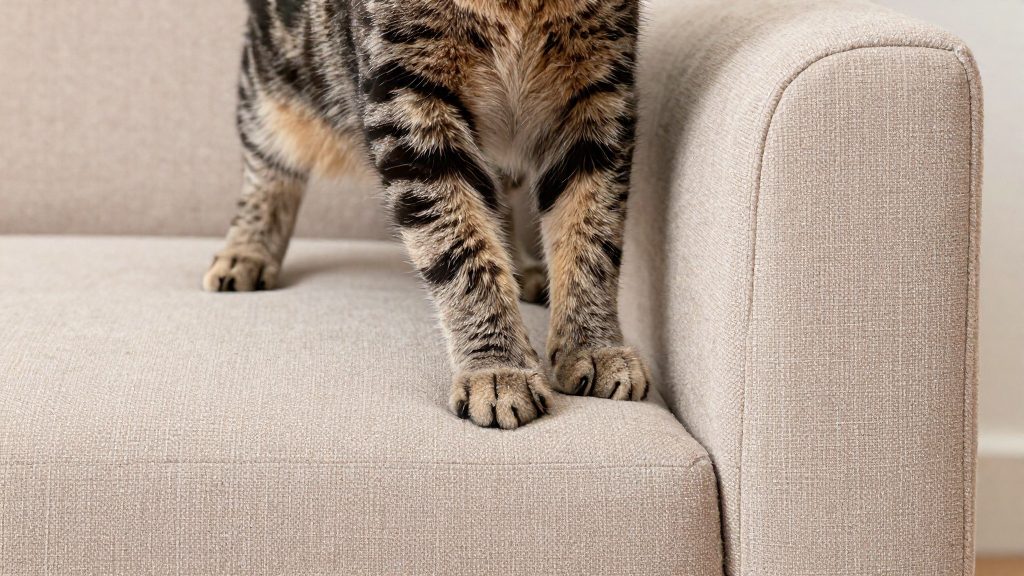
Cats scratch furniture because it is a normal feline behavior, not a sign of disobedience. Scratching serves two main functions: it marks territory and it maintains the claws. The Cornell Feline Health Center describes scratching as a normal need for both, and it advises against punishing a cat for doing it. Stress, boredom and surplus energy can make the behaviour more frequent or more intense, but they do not create the need itself.
Why do cats scratch furniture?
Territory marking through paw scent glands
Cats have scent glands in their paws. When a cat scratches a surface, it leaves a visual mark and a scent signal at the same time. For a cat, a well-scratched object near a doorway, a resting spot or a main walkway works as a message to other cats that the area is occupied. This is why a cat often scratches the sofa arm, a door frame or a piece of furniture near its favourite room rather than in a random corner.
Because the marking function depends on smell, a cat is more likely to return to a surface that already carries its scent. Owners can see this pattern in the places a cat favours, which can guide where a scratching object is most likely to be used.
Claw sheath maintenance
A cat’s claws have an outer sheath that wears down and is shed over time. Scratching helps remove the older outer layers and keeps the claw in working condition. The Cornell Feline Health Center lists claw maintenance alongside territory marking as a core reason for scratching, and it recommends regular nail trimming as a complement to the cat’s own scratching.
Stress, boredom and energy as triggers
Scratching can increase when a cat is under stress, bored or has more energy than its daily routine uses up. In these cases the behaviour may appear in new places, become more frequent, or occur at specific times of day, such as after a period of rest. A change in the household, a new animal or a lack of activity can all shift how often a cat scratches.
Identifying the trigger matters because it changes the response. If the scratching follows a clear change in the environment, the cause is more likely to be stress. If it occurs mainly during long idle periods, boredom or unused energy is more probable.

How to choose the right scratching post
Check three physical features before buying or building a scratching post: height, base stability and covering material. Cornell Feline Health Center advises a post at least as tall as the cat stretched on its hind legs. Humane World for Animals (2026) sets a minimum of 32 inches. Use whichever figure is larger as your target, because a post that meets only the stretch height can still fall short of the 32-inch minimum.
| Feature | Requirement | Source |
|---|---|---|
| Height | At least 32 inches | Humane World for Animals (2026) |
| Height (alternative check) | At least as tall as the cat stretched on its hind legs | Cornell Feline Health Center |
| Base | Sturdy, does not wobble | Humane World for Animals (2026) |
| Main covering | Sisal | Humane World for Animals (2026) |
| Additional coverings | Cardboard, carpet, wood, upholstery | ASPCA (2026) |
Base stability matters as much as height. A tall post that rocks will discourage use, because the cat pulls and stretches against it with its full body weight. Before buying, pull firmly on the post from several directions and check that the base stays in place. Reject or reinforce any post that moves under that pull.
Covering material is the third choice. The ASPCA (2026) lists cardboard, carpet, wood, sisal and upholstery as common options. Humane World for Animals (2026) recommends sisal for the main post. Start with a sisal-covered post that meets the height and stability requirements.
Where should you put the scratching post?
Put the post where your cat already scratches. Humane World for Animals advises placing it beside the spot the cat already uses, such as next to the couch, so the post competes with an existing habit rather than a new one. Once the cat uses the post reliably, its location matters less. Before you choose a spot, observe which furniture the cat targets and how it moves through the home. Placement based on these two observations is more likely to be used than a post placed in a room the cat rarely visits.
Beside the furniture the cat already scratches
Look for the pieces the cat targets, such as sofa arms, chair legs, or door frames. Place the post directly beside that piece, close enough that the cat can reach the post without leaving the spot it has chosen. Placing the post across the room asks the cat to change its habit, which is harder than redirecting an existing one.
Near sleeping spots and main walkways
The sources reviewed for this article do not give a specific rule for sleeping areas or walkways, so treat this as an observation-based approach. Cats often scratch on the routes they use daily, so note the paths between the cat’s favourite resting places, its food, and its windows over several days. A post placed on one of these routes is encountered during normal movement, without the cat needing to seek it out. Avoid quiet dead ends that the cat does not pass through.
Several locations rather than a single post
The ASPCA advises adding more posts of the type your cat prefers in several locations. A single post in one corner gives the cat only one option.
How to protect your furniture in the meantime
While your cat learns to use a scratching post, you can make the furniture less appealing with physical barriers. Humane World for Animals (2026) recommends covering furniture with a tight-fitting sheet, which it calls the easiest and most effective option, or using double-sided sticky tape on small surfaces. Both work by making the scratched surface unpleasant or awkward to grip, so the cat has a reason to choose the post instead. Neither method addresses the cat’s underlying need to scratch, which is why they are temporary and should be paired with a post the cat actually uses.
| Barrier | Where to use it | Source note |
|---|---|---|
| Tight-fitting sheet | Furniture the cat targets | Called the easiest and most effective option (Humane World for Animals, 2026) |
| Double-sided sticky tape | Small surfaces | Recommended for small areas (Humane World for Animals, 2026) |
Cover only the surfaces the cat targets
Protect the specific areas the cat scratches rather than every piece of furniture in the room. Look for the arms, corners, or lower panels that show fresh marks or loose fibres. Covering these spots keeps the rest of the room unchanged and makes it easier to see which surfaces the cat still prefers.
Timing the removal
Humane World for Animals (2026) advises removing these deterrents once the cat uses the post consistently. Consistent use means the cat reliably chooses the post over the furniture, not that it has scratched the post once. Remove the barriers from one surface at a time, and watch whether the cat returns to that spot. If it does, put the barrier back and keep the post in use. Do not leave deterrents on indefinitely, because a cat that never gets a clear, rewarding alternative has no reason to change its habit.
How do you get your cat to use the scratching post?
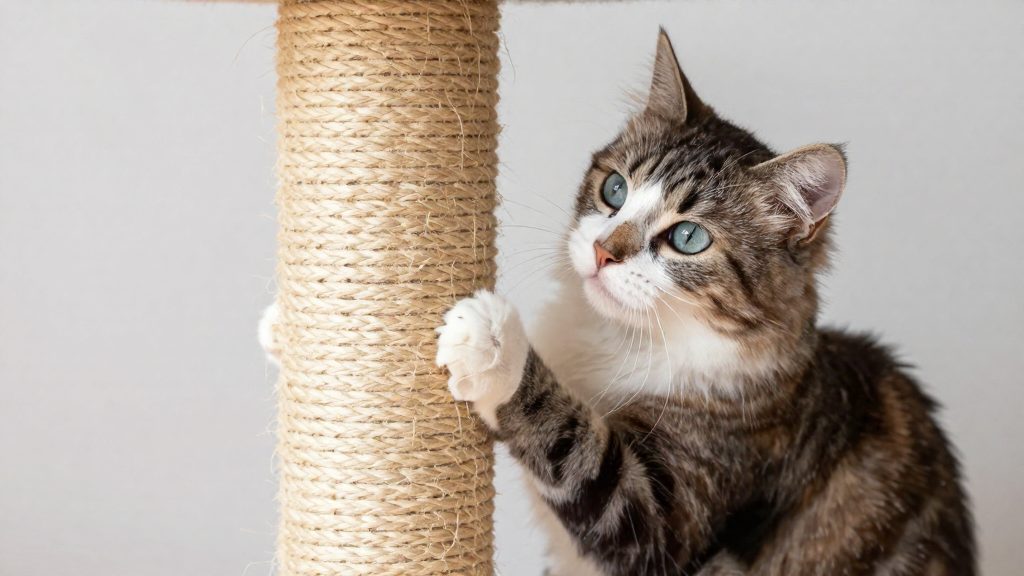
Getting a cat to use a scratching post is a matter of finding out which surface and angle the cat already prefers, then making the post the most rewarding place to scratch. The ASPCA recommends offering several materials and orientations rather than guessing, and Humane World for Animals advises introducing the post through play and catnip. The method has three parts: identify the preferred material and orientation, lure the cat onto the post, and reward scratching on the post immediately.
Step 1: Identify the preferred material and orientation
Set out posts that differ in one variable at a time, then record which one the cat chooses. The ASPCA names these options:
| Variable | Options named by the ASPCA | What to record |
|---|---|---|
| Material | Cardboard, carpet, wood, sisal, upholstery | Which surface the cat scratches most often |
| Orientation | Horizontal, vertical, slanted | Which angle the cat stretches against when it scratches |
Once the preference is clear, the ASPCA suggests adding more posts of that kind. Cats that favour a particular texture or angle are usually easier to redirect when the new post matches what they already use.
Step 2: Lure the cat onto the post
Humane World for Animals recommends introducing the post through play and catnip. Rub a small amount of catnip onto the post, then use an interactive toy to bring the cat close to it, so the cat plays on or beside the post. Let the cat approach at its own pace.
Treats placed on or next to the post can serve the same purpose as catnip: they bring the cat into contact with the post without any handling.
Step 3: Reward scratching on the post immediately
A reward only shapes behaviour if the cat connects it with the action. Give the reward, such as a treat or calm praise, while the cat is still scratching the post or has just finished. Waiting until the cat has walked away weakens the link.
Reward only scratching that happens on the post. If the cat scratches a nearby piece of furniture, do not reward it; the cat should learn that the post is the only place that earns a reward.
If the cat does not use the post
If the cat ignores the post after several attempts, return to Step 1 and test a different material or orientation.
What not to do: punishment and declawing
Punishing a cat for scratching furniture is ineffective, and declawing is a surgical amputation that the main veterinary sources oppose. Cornell Feline Health Center advises against punishment-based correction because cats do not connect a reprimand with the act of scratching. The cat learns only that scratching is risky around you, and it may become fearful or aggressive toward the person who corrects it. Cats do not connect the reprimand with the scratching, so it does not teach them which surfaces are acceptable.
Why clapping and squirting water backfire
Clapping or squirting water is a common reflex, but the ASPCA (2026) says it should be a last resort, for the same reason: the cat may learn to fear you. A physical reaction also depends on the owner catching the cat mid-scratch, so the cat learns the timing of the owner rather than which surfaces are off limits. Redirecting the cat to an appropriate post, as covered in the sections above, does not depend on being there at the right moment.
Declawing is amputation, not a fix
Declawing is not a nail trim. Cornell Feline Health Center describes it as amputation of the bone at the tips of the toes. It carries surgical risks and does not remove the urge to scratch, so a declawed cat still tries to scratch, only without claws. Cornell also states that declawed cats should never go outdoors, because they can no longer defend themselves or climb effectively. The ASPCA (2026) strongly opposes declawing and says it has not been proven to improve behavioural problems.
When declawing is considered at all
Cornell Feline Health Center says declawing should be considered only as an absolute last resort, and only after consulting a veterinarian. A vet can assess whether surgery is appropriate for the individual cat and explain its risks, which is a decision a general owner cannot make from a furniture problem alone.
Are nail trims and nail caps worth it?
Regular trimming and soft adhesive nail caps reduce the damage a cat does to furniture.
Cap lifespan and replacement timing
Caps wear off as the nail grows out. The two sources name different cap types and give different intervals:
| Source | Cap type named | Stated replacement interval |
|---|---|---|
| ASPCA (2026) | soft adhesive caps | about 4–6 weeks |
| Cornell Feline Health Center (undated) | plastic caps | every 6–12 weeks |
Check caps at each interval, and replace any that have loosened or fallen off, since a loose cap no longer covers the claw.
Regular trimming and the claw-length check
Cornell advises trimming nails regularly. Shorter claws catch less on upholstery, so trimming is the base measure that caps build on. Run a claw-length check on a regular schedule: press the pad gently to extend each claw and look for overgrowth or a sharp, hooked tip. Trim only the clear, curved tip, and stop if you see the pink quick inside the nail. If the claws are long or split, have a vet or groomer assess them before you continue.
Who applies caps
The owner, a groomer, or a vet can apply caps. Cornell states that plastic caps only suit cats that tolerate paw handling. A cat that resists should not have its paws forced into the procedure. A groomer or vet can apply caps under controlled conditions, or the owner can continue trimming in short sessions.
When should you call a vet or behaviorist?
Some changes in your cat’s habits can signal pain or illness. Check for a medical cause first, before you adjust posts or deterrents. The ASPCA advises consulting a Certified Applied Animal Behaviorist or a board-certified veterinary behaviorist when a scratching problem persists (ASPCA, 2026). A veterinarian checks for pain or disease, and a behaviorist works on the habit once a medical cause has been ruled out or treated.
Red flags that point to a medical cause
Contact a veterinarian, rather than changing the post or the deterrents, if you notice:
- Sudden change in scratching: the cat stops scratching altogether, scratches much more often, or starts scratching surfaces it previously ignored.
- Change in litter habits: the cat urinates or defecates outside the box, strains, visits the box often with little result, or avoids it. Litter changes can accompany pain or illness, so do not treat them as a furniture problem. Straining to urinate, visiting the box often with little result, or passing no urine is a veterinary emergency: contact a veterinarian or emergency clinic immediately and do not wait to see if it passes.
- Paw or nail pain: the cat flinches when a paw is touched, avoids putting weight on a paw, licks or chews one paw repeatedly, or resists paw handling.
- Swelling, bleeding, or limping: any swelling of a toe or paw, blood on a nail or on the post, or a limp. These need examination even if the cat otherwise seems normal.
When to refer to a specialist
Refer the case to a Certified Applied Animal Behaviorist or a board-certified veterinary behaviorist when:
- scratching continues after a veterinarian has found no medical cause, and you have already offered posts in several materials and orientations, placed where the cat already scratches;
- the cat keeps scratching furniture while the deterrents have been used consistently.
Frequently asked questions
Will scolding my cat stop it from scratching the sofa?
No. Cornell Feline Health Center advises against punishment, because cats don’t link a reprimand to the scratching itself and may learn to fear you instead. Redirecting the cat to an approved post is the more reliable approach.
How many scratching posts does a cat need?
The ASPCA recommends offering posts in several materials and orientations, then adding more of the type your cat favors in several locations. Keep a preferred type post in use rather than replacing it once it shows wear, since cats tend to return to surfaces that smell familiar.
My cat is using the litter box often and straining. Is this a furniture problem?
No. Straining to urinate, or passing no urine, is a veterinary emergency. Contact a veterinarian or an emergency clinic immediately rather than waiting to see whether it resolves.