Delta Air Lines and Alaska Airlines are the two US carriers covered by verified data for this article. Delta allows in-cabin dogs in Comfort/Main (up to 4 pets) and domestic First (up to 2 pets), but not in Business, Delta One, Premium, or any cabin with flat-bed seats. Its minimum age is 8 weeks for domestic travel and 6 months for dogs entering the U.S. from another country (Delta Air Lines, 2026). The verified Alaska Airlines data does not include cabin classes or age limits, so those must be confirmed directly with the carrier.
Which US airlines allow dogs in the cabin?
Delta Air Lines: cabin classes
Delta’s rules depend on the cabin you book. Space is first-come, first-served (Delta Air Lines, 2026).
| Cabin | Pets allowed |
|---|---|
| Comfort/Main | 4 |
| Domestic First | 2 |
| Business | None |
| Delta One | None |
| Premium | None |
| Any cabin with flat-bed seats | None |
Because Business, Delta One, and Premium are excluded, a passenger upgrading to those cabins cannot bring a dog in the cabin on that flight. Check the cabin of each flight segment, since a connecting itinerary may use different cabins.
Delta Air Lines: minimum age
Delta sets two age thresholds (Delta Air Lines, 2026):
- 8 weeks: minimum age for domestic travel.
- 6 months: minimum age for dogs entering the U.S. from another country.
Puppies below these ages are not eligible for in-cabin travel on Delta. Confirm with Delta which documents, if any, are required at check-in.
Alaska Airlines: eligibility
Alaska Airlines’ verified data covers the following eligibility condition (Alaska Airlines, 2026):
- The pet must fit in an under-seat carrier.
Airline pet fees compared
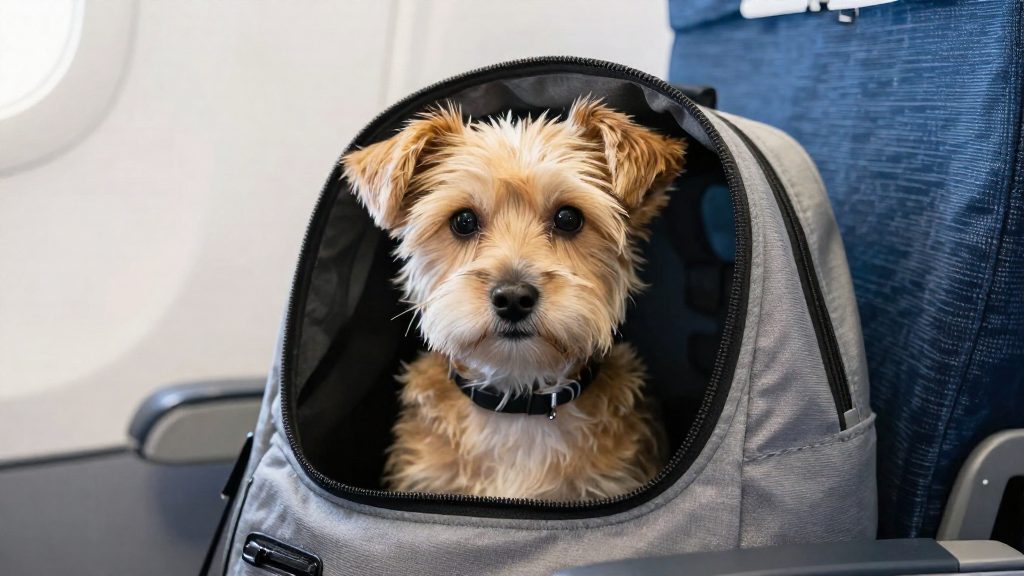
Pet fees on US carriers are charged per one-way segment, so a round trip with a pet usually means paying at least twice. Delta’s in-cabin fee depends on the ticket’s issue date and the type of trip, while Alaska Airlines sets its fee by route and travel type. The figures below come from the carriers’ own pages as of 2026.
Delta Air Lines charges $150 each way for an in-cabin pet on travel within the U.S., Canada, Puerto Rico and the U.S. Virgin Islands, for tickets issued on or after April 8, 2025. Tickets issued before that date carried a $95 fee. International travel costs $200 each way (Delta Air Lines, 2026). Because the fee attaches to the ticket’s issue date, two passengers on the same flight can pay different amounts if one booked before April 8, 2025 and the other after.
Alaska Airlines charges $100 to $200 each way per carrier, depending on the type of travel and the route (Alaska Airlines, 2026). The published range does not map each route to a specific price, so the exact amount has to be confirmed for your itinerary at booking.
| Carrier | Fee per one-way segment | Condition stated by the source |
|---|---|---|
| Delta | $150 | Travel within the U.S., Canada, Puerto Rico and the U.S. Virgin Islands; tickets issued on or after April 8, 2025 |
| Delta | $95 | Tickets issued before April 8, 2025 |
| Delta | $200 | International travel |
| Alaska Airlines | $100 to $200 | Varies by type of travel and route |
Connecting itineraries
Each carrier applies its own fee. Alaska’s page notes that if a trip includes another airline, that airline may charge its own fee (Alaska Airlines, 2026). A connection on two carriers can therefore produce two separate charges per direction. Check each airline’s fee before you book the segments.
What size carrier does your dog need?
For Delta Air Lines, the carrier is the main physical constraint. Delta recommends a soft-sided kennel no larger than 18 x 11 x 11 inches. The kennel must fit fully under the seat in front of you, and it must be leak-proof. A carrier within these dimensions that still does not fit under your seat will not qualify, so check the fit.
| Specification | Delta requirement (Delta Air Lines, 2026) |
|---|---|
| Maximum dimensions | 18 x 11 x 11 inches |
| Carrier type | Soft-sided kennel |
| Placement | Fully under the seat in front of you |
| Construction | Leak-proof |
| Ventilation, domestic travel | Openings on 3 sides |
| Ventilation, international travel | Openings on 4 sides |
| Weight limit | None stated on Delta’s page |
Ventilation and internal space
The ventilation rule depends on the route. Domestic kennels need openings on three sides, and kennels used for international travel need openings on four. Delta also requires that the pet can move around comfortably inside the kennel. The page does not define how much room that means, so confirm with Delta if in doubt.
Measuring for the under-seat fit
Because Delta gives no weight limit, fit is decided by the kennel’s outer size and the space under the seat, not by the dog’s weight. Before you travel:
- Measure the outside of the empty kennel, including any handles, feet or wheels that add height or depth.
- Confirm the total stays at or below 18 x 11 x 11 inches.
- Check that the kennel slides fully under the seat in front of you, not just under the seat edge.
A kennel that meets Delta’s dimensions is a practical starting point for a multi-carrier trip, though each airline sets its own rules.
Can my dog fly on any route?
No. Whether a dog can travel in the cabin depends on the route as well as the airline. On Delta, the restricted-destination list rules out in-cabin pets for flights to or from ten places: Hawaii, the United Kingdom, Australia, New Zealand, Iceland, Jamaica, Hong Kong, South Africa, the United Arab Emirates and Barbados. The restriction applies in both directions. Hawaii is a U.S. state, so a booking that looks domestic can still be ineligible for in-cabin pets. Check the destination before assuming the airline’s domestic rules apply.
How route type changes the options
| Route type | Delta in-cabin status (fact sheet) | What to check |
|---|---|---|
| Domestic U.S. (excluding Hawaii) | Allowed. 4 pets in Comfort/Main, 2 in domestic First | Kennel dimensions |
| Canada, Puerto Rico, U.S. Virgin Islands | Grouped with domestic U.S. travel for the in-cabin pet fee | The fact sheet gives no separate cabin, kennel or age rules for these destinations |
| Hawaii | Not allowed in the cabin | Restricted-destination list |
| UK, Australia, New Zealand, Iceland, Jamaica, Hong Kong, South Africa, UAE, Barbados | Not allowed in the cabin | Restricted-destination list, to and from |
| Other international routes | Not on Delta’s restricted list; the fact sheet does not confirm eligibility | Confirm with the airline and the destination |
Delta’s page does not state equivalent rules for international cabins, so do not assume them.
International routes and destination import rules
Entry requirements are set by the destination country, not by the airline. The fact sheet contains no official government import rules, so this article cannot state them. To check a route:
- Identify the national authority responsible for animal import in the destination country and use its official website.
- Note the publication or update date of each requirement, since rules change.
- Repeat the check for every country on the itinerary, including connection points, because each country’s rules can apply.
How to book a pet spot
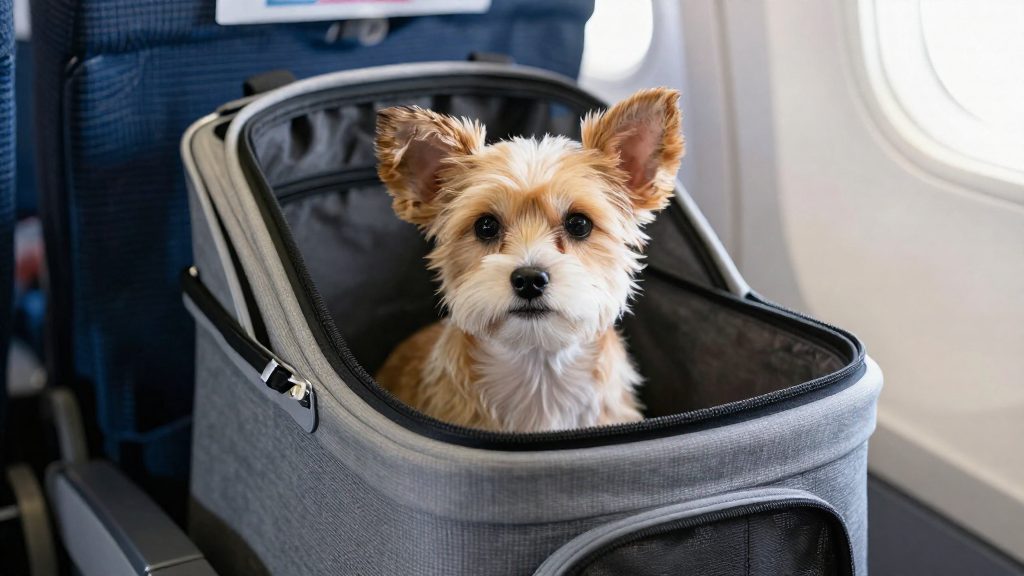
On Delta, cabin space for pets is allocated on a first-come, first-served basis, so the reservation time matters more than the booking date of the ticket. Delta sets a maximum number of pets per cabin: 4 in Comfort/Main and 2 in domestic First. Once the limit is reached, no further pets can be added in that cabin.
Steps for Delta:
- Reserve the pet space early. Since space is first-come, first-served, a later request may find the cabin already full.
- For a trip with connections, confirm the pet reservation on every connecting segment. A booking on the first flight does not confirm the later legs.
Steps for Alaska Airlines:
- Book your ticket first.
- Contact Alaska to reserve space for the pet. Cabin space depends on availability, so the reservation is not automatic.
Rules for the airport and the flight
On Delta, a dog travelling in the cabin stays in its kennel from the terminal to the aircraft and until it leaves the plane. Delta requires the dog to remain in the kennel at all times in the airport and on the aircraft, and the kennel must be placed under the seat in front of you for the whole flight. This means the dog never leaves the kennel during the trip, and the kennel never sits in the aisle or occupies a seat.
Airport and security
The fact sheet does not list check-in counter steps, times or document requirements, so confirm those on the airline’s own pages before you travel. Carry the kennel to the check-in counter and through security.
Boarding and deplaning
- Carrying: Carry the kennel by its handle or straps rather than letting the dog walk in the terminal or the jet bridge.
Behaviour inside the kennel
The kennel is the only space the dog occupies during the flight. A dog that is calm and settled is easier to keep inside the kennel for the full trip.
Is flying right for your dog?
Flying in the cabin suits a dog that is medically fit, has a calm temperament in confined spaces, and has an airline-approved age. Some dogs show signs of stress in confinement before departure. A veterinary check and an honest look at your dog’s behaviour are the two steps that decide whether the trip is a reasonable option.
Veterinary fitness check before booking
Book travel only after your veterinarian confirms that your dog is fit to fly. Ask the vet to:
- Review any chronic condition, heart or respiratory disease, or recent surgery, and say whether air travel is appropriate.
- Ask which vaccinations and treatments the airline and the destination’s official authority require, and check the dates on those requirements.
- Confirm whether the airline or destination requires a health certificate, and when it must be issued.
- Advise on medication for travel. Do not give sedatives without veterinary instruction, as they can affect breathing and balance.
A puppy below Delta’s minimum age cannot travel in the cabin, whatever its health status.
Brachycephalic breeds and age-related risks
Brachycephalic (flat-faced) breeds, such as French Bulldogs, Pugs and English Bulldogs, have shortened airways. This makes breathing harder during stress, heat, or physical exertion. Airport queues, crowding and time in a warm cabin can all add strain. Ask your vet whether your dog’s breathing is adequate at rest before deciding to fly.
Older dogs may tolerate confinement, noise and changes in routine less well than younger adults. Age-related conditions such as arthritis or reduced cardiac or respiratory reserve should be assessed by a vet before travel.
Temperament signs that suggest avoiding air travel
| Observed behaviour | What it may indicate | Practical response |
|---|---|---|
| Panting, trembling or drooling when enclosed | Stress, but also possibly a medical problem or overheating | Talk to your vet before booking, then test with short carrier trips |
| Persistent barking, whining or self-injury in the crate | Severe distress | Consult a vet or certified behaviourist before booking |
| Aggression when handled or restrained | Risk to people and to the dog | Avoid cabin travel and discuss alternatives with a professional |
| Refusal to enter a carrier | Confinement aversion | Crate-train at home over several weeks |
Frequently asked questions
Does Alaska Airlines let me bring my dog in the cabin, and in what order should I book?
Alaska Airlines allows a pet in the cabin only if it fits in a under-seat carrier, and cabin space depends on availability. Book your ticket first, then contact Alaska to reserve a place for the pet. The fee is $100 to $200 each way, depending on the route and travel type (Alaska Airlines, 2026).
How much does Delta charge for an in-cabin dog?
For travel within the U.S., Canada, Puerto Rico and the U.S. Virgin Islands, Delta charges $150 each way on tickets issued on or after April 8, 2025. Tickets issued earlier cost $95 each way, so the ticket issue date matters more than the travel date. International travel costs $200 each way (Delta Air Lines, 2026).
Can my dog fly in the cabin on Delta to every destination?
No. Delta does not accept in-cabin pets to or from Hawaii, the United Kingdom, Australia, New Zealand, Iceland, Jamaica, Hong Kong, South Africa, the UAE or Barbados. This applies to route restrictions, so check the destination on every segment of a connecting itinerary (Delta Air Lines, 2026).