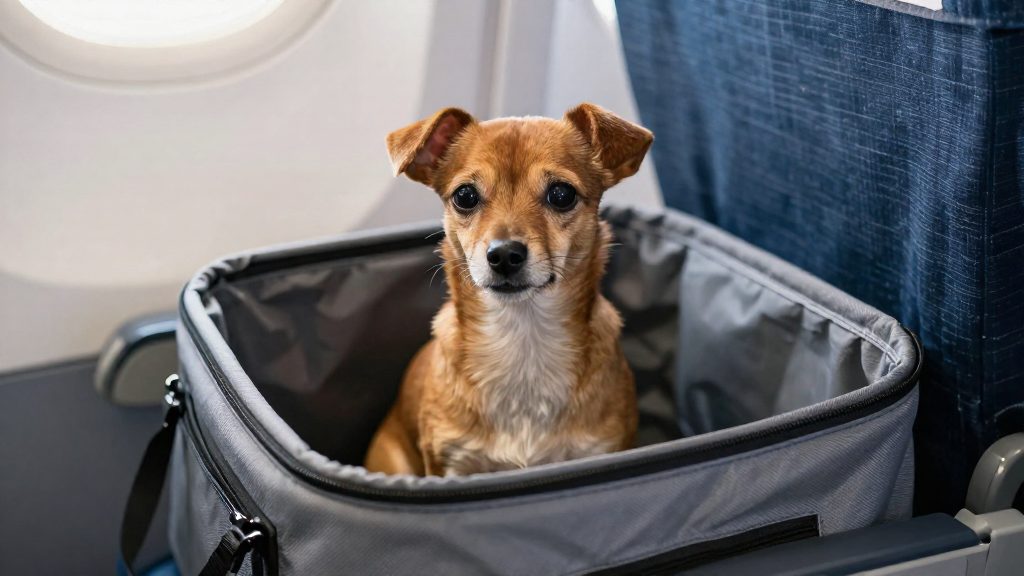
At the TSA security checkpoint, the Transportation Security Administration’s role is limited to checkpoint screening. Under TSA guidance dated 2023-02-14, the pet passes the checkpoint alongside its owner, and the screening steps that involve the pet are carried out with the owner present. TSA’s scope covers the checkpoint only. Cabin acceptance and reservation rules are handled separately from screening, so a pet cleared at the checkpoint still needs to meet the airline’s own conditions for the flight.
What TSA’s role covers at the checkpoint
TSA’s responsibility for a pet begins when you reach the screening lane and ends when you leave the checkpoint area. The pet is not processed as a separate item. It travels through security with its owner.
Pet-related checkpoint steps
| Checkpoint step | What the TSA guidance says (2023-02-14) |
|---|---|
| Hand swab | A TSA officer swabs the owner’s hands for explosive residue. |
| Returning the pet to its carrier | The owner puts the pet back in its carrier at the re-composure area. |
Limits of TSA’s role
- TSA’s pet guidance addresses security screening only.
- The guidance is dated 2023-02-14.
How does a pet go through the security checkpoint?
The screening sequence separates the animal from its carrier: the owner carries the pet through the metal detector if possible (a leashed pet may walk through instead), and only the empty carrier is sent through the X-ray. According to TSA guidance dated 2023-02-14, the steps run in a fixed order, and each one has a specific purpose.
-
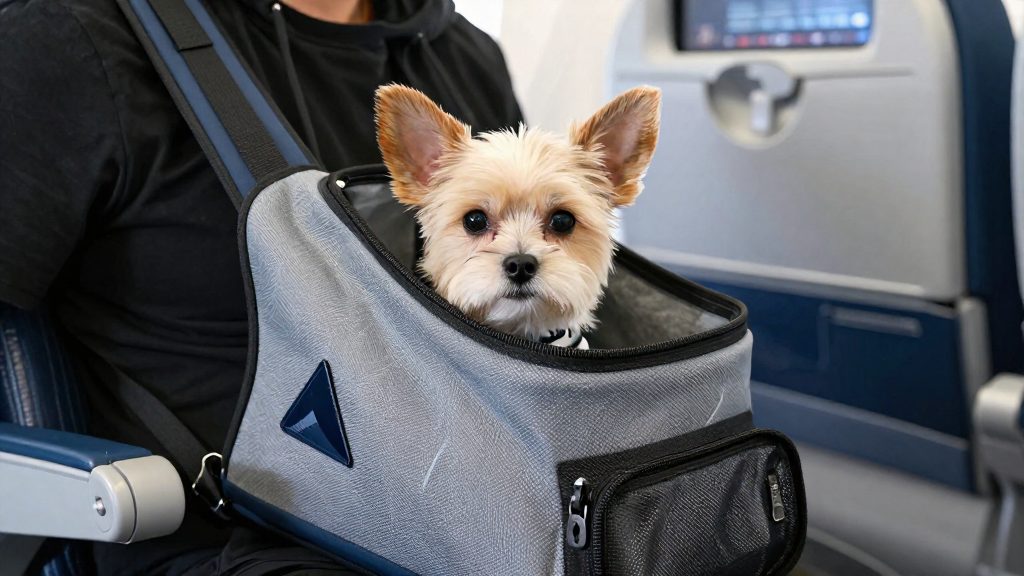
Hand-held carrier stays closed until screening. The pet travels in a hand-held carrier, so the owner can carry the animal and the carrier together up to the checkpoint.
-
Pet is removed just before screening. The owner takes the pet out of the carrier at the last possible moment, not earlier in the queue. Timing matters because the pet should not be left loose in the line.
-
Empty carrier goes on the X-ray belt. The carrier is the only item placed on the belt. The owner should confirm it is fully empty before loading it.
-
Walk-through metal detector. The owner carries the pet through the detector if possible. If the pet is leashed, it may walk through on the leash instead. The owner must follow the officer’s instructions about how to pass through.
-
Hand swab for explosive residue. A TSA officer swabs the owner’s hands. This check is performed on the person, not on the pet.
-
Re-composure area, away from the checkpoint. After screening, the owner moves to a designated area away from the checkpoint lanes and places the pet back in its carrier. The pet should not be put back in its carrier in the lane, where other travelers are waiting.
Why you should never put a pet through the X-ray
The Transportation Security Administration (TSA) states that pets should never be screened through a checkpoint X-ray unit. This is the agency’s official position, dated 14 February 2023. It concerns the animal itself, so it applies whenever a pet is at the security checkpoint. The owner’s task is to keep the pet off the X-ray belt.
The rule applies to the animal, not the container
The guidance separates the pet from its carrier. The pet must never pass through the X-ray unit. The hand-held carrier is the only item that may go on the belt, and only when it is empty. Before screening, the pet is taken out of the carrier, so the carrier moves through the X-ray alone.
| Item | Allowed on the X-ray belt? | Basis (TSA, dated 14 February 2023) |
|---|---|---|
| Pet (dog, cat, bird or other companion animal) | No | Pets should never be screened through a checkpoint X-ray unit |
| Hand-held carrier | Yes, only when empty | Only the empty carrier goes on the X-ray belt |
Why a closed carrier does not change the outcome
A pet inside a carrier is still a pet. The TSA prohibition is written about the animal, and the carrier is treated as a separate item that can be screened only once it is empty. Owners should not assume that a closed carrier, or a pet that looks calm inside it, makes the animal exempt from the prohibition.
Owner responsibility and verification
Because the rule is a prohibition on the pet, the owner carries the responsibility for keeping it out of the X-ray unit. Check the rule before travel on the TSA’s official website, tsa.gov, rather than relying on forum posts or older advice. The guidance on which this section is based is dated 14 February 2023, so confirm that it is the version currently published before you fly.
What if your pet is nervous or skittish?
Owners of anxious or skittish pets can ask TSA for a private screening room at the checkpoint. In that room, the pet stays in its carrier for the whole screening. This option is separate from the standard screening steps, so the owner does not need to take the pet out of the carrier in the open checkpoint area. (TSA, 2023-02-14)
Requesting a private screening room
Tell the officer at the start of the checkpoint that your pet is nervous or skittish and that you would like a private screening room. The TSA guidance does not say when to make the request, so ask a TSA officer at the checkpoint.
| Step | What happens |
|---|---|
| Request | You tell the officer your pet is skittish and ask for a private screening room |
| Screening | The pet stays in its carrier in the private room |
| After screening | The pet stays in its carrier; follow the officer’s instructions on leaving the room |
Keeping the pet in its carrier
Keep your pet inside the carrier throughout the private screening. Do not lift the pet out to calm it, even if it is restless. Keep the carrier closed, and speak to your pet in a calm, steady voice. Leave the carrier in its normal position while you talk to the officer, so the pet is not jostled.
Preparing a skittish pet for crowds and noise
The TSA guidance in this section does not give timings or specific training schedules, so the following is general preparation rather than an official requirement. Before travel, get your pet used to its carrier at home, with the door open and closed and the carrier placed in a quiet room. Put a familiar blanket or item inside so the carrier smells like home.
On the day, plan for extra time at the airport so you are not rushed through crowds, lines, and announcements. If your pet shows signs of severe distress, speak with your veterinarian before the trip about safe calming options. Do not give any sedative without veterinary advice.
Do airline rules differ from TSA rules?
Yes. The Transportation Security Administration (TSA) controls how a pet passes through the security checkpoint. It does not decide whether the animal may travel in the cabin or hold a seat. That decision belongs to the airline, which sets its own cabin pet policy for each flight it operates. A pet can clear security and still be refused at the gate if the airline’s conditions are not met, so the two rule sets must be checked separately.
What the airline decides
- Whether it accepts pets in the cabin on the specific flight and aircraft
- Whether a pet reservation must be made in advance, and by what deadline
- Container requirements for the pet’s carrier
- Fees and the number of pets allowed per cabin
Do not assume that one carrier’s rules apply to another. Each airline publishes its own pet policy, and conditions can vary by airline and by route. On a trip with a connection, each carrier’s policy governs the segment it operates, so every leg needs its own check.
How to check the airline’s pet policy
- Open the pet or special-services section of the airline’s official website, using your exact flight numbers, origin, and destination.
- Note the reservation requirements and the deadline to request them.
- Confirm the container specifications in your booking confirmation or by contacting the airline directly.
- Repeat the same steps for every connecting carrier.
- Check the policy again shortly before departure, since airline terms can change.
Separating the two rule sets
| Question | Governed by | Where to verify |
|---|---|---|
| Can the pet pass the security checkpoint? | TSA | TSA’s current security guidance (the reference guidance used here is dated 2023-02-14) |
| Is the pet accepted in the cabin on this flight? | Airline | The airline’s official pet policy |
| Is a reservation or advance request required? | Airline | The airline’s booking confirmation |
What about service animals at security?
Service animals are handled as a separate category from companion pets at the checkpoint. The reference data used for this article covers companion pets only, and it does not set out screening steps for service animals. The service animal versus emotional support animal distinction therefore matters before you reach the checkpoint, because the category you fall into determines which official guidance applies to you.
For US air travel, the Department of Transportation defines a service animal as a dog individually trained to do work or perform tasks for a person with a disability. An emotional support animal provides comfort through companionship and is not task-trained; airlines generally treat it as a pet. Confirm the current DOT and airline rules before you travel. These two categories are often confused, and they are not treated the same way in travel rules. Confirm which one applies to your animal before you travel, since a companion pet that has not been trained for a task does not fall under the service animal category.
| Category | Screening guidance in the reference data |
|---|---|
| Companion pet | Covered: carrier handling, X-ray exclusion, walk-through procedure, private screening room |
| Service animal | Not covered in the reference data; use official TSA guidance |
| Emotional support animal | Not covered in the reference data; check the rules of your airline and the TSA |
Officer instructions govern the process. Apply the same principle to any animal at a checkpoint: the officer on duty decides the procedure, so ask before you move the animal.
Documentation is not specified in the reference data. Carry whatever paperwork your airline or the TSA requires for your animal type, and keep it in an easily reached pocket, not in checked baggage.
Checklist before you get to the airport
Most of the preparation for a pet’s security screening happens at home, before the trip. A pet that is used to its hand-held carrier and an owner who has confirmed the airline’s requirements in advance will move through the checkpoint with fewer delays. The TSA guidance dated 2023-02-14 sets out how pets are handled at screening, so the home checklist should be built around it.
Documents to confirm before leaving home
- Carrier: Choose the carrier well before the trip and practise opening and closing it, since you will need to take the pet out and return it to the carrier at the checkpoint.
- Identification and records: Gather the pet’s identification and any health records the airline asks for, and keep them in a bag you can reach without unpacking.
- Owner documents: Have your own identification and booking details ready in one place.
Verifying airline policy in writing before departure
Checkpoint guidance does not replace airline rules, and a verbal answer from a booking agent is not enough. Ask the airline to confirm its pet requirements in writing, by email or a saved chat transcript, and keep that record with your travel documents. Check again a few days before departure, because airline policies can change.
Arriving early enough for the checkpoint sequence
Allow extra time for the pet screening steps rather than planning a standard arrival.
At home, decide whether the pet is likely to be distressed by screening.
Frequently asked questions
Do I have to take my pet out of its carrier at airport security?
Yes. According to TSA guidance dated 2023-02-14, you remove the pet from its hand-held carrier just before screening, and only the empty carrier goes through the X-ray. TSA says pets should never be sent through an X-ray unit, and you can walk through the metal detector with the pet if possible, or let a leashed pet walk through instead.
Can I ask for a private screening room if my pet is nervous?
Yes. TSA guidance dated 2023-02-14 says owners of skittish pets can request a private screening room, where the pet stays in its carrier during screening. The guidance does not say when to make the request, so ask a TSA officer at the checkpoint.
Does my emotional support animal count as a service animal on a US domestic flight?
No. The US Department of Transportation rule, effective January 2021, defines a service animal as a dog individually trained to do work or perform tasks for a person with a disability. Airlines generally treat emotional support animals as ordinary pets, so check the current DOT rule and your airline’s policy before you book.