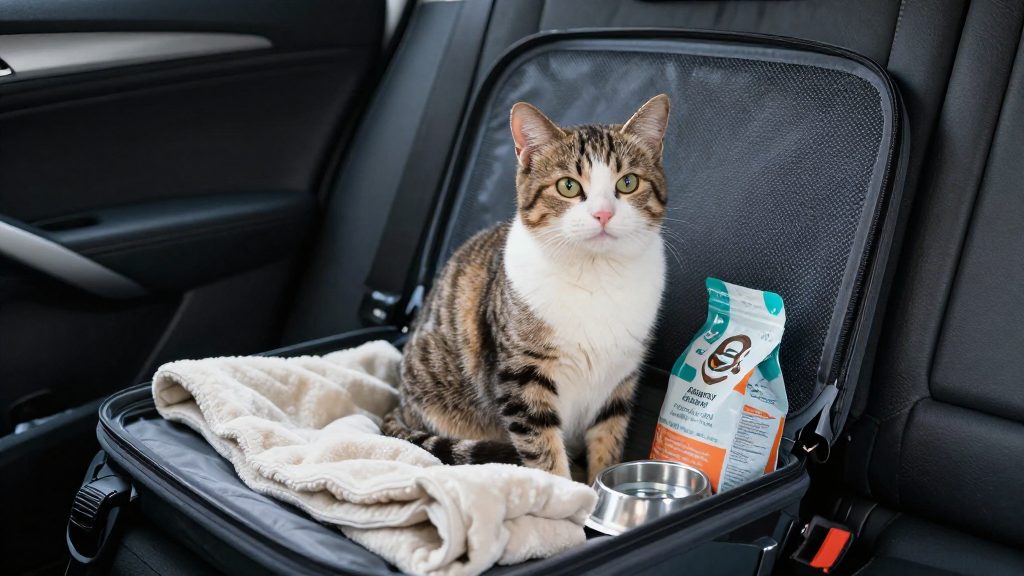
Bring a blanket, a comfort toy, grooming wipes, cleaning supplies and a seat cover in addition to the core travel kit. Chewy’s vet-reviewed packing checklist lists each of these for a car trip (Chewy, vet-reviewed by Dr. Barri J. Morrison, 2026-06-30). The comfort items give the cat something familiar to rest on and hold, the wipes and cleaning supplies deal with accidents and mess, and the seat cover protects the vehicle. Each group serves a different purpose, so pack all three for one cat on one trip.
What should you pack for a cat on a car trip?
| Purpose | Item | Function during the trip |
|---|---|---|
| Comfort | Blanket | Resting surface the cat can recognize |
| Comfort | Comfort toy | Familiar object to keep the cat occupied |
| Hygiene | Grooming wipes | Clean the coat and paws after contact with mess |
| Cleaning | Cleaning supplies | Clean vehicle surfaces after vomiting or accidents |
| Vehicle protection | Seat cover | Protects the vehicle’s upholstery |
Familiar comfort items
Choose a blanket and toy the cat already uses at home. Introducing a new object on the day of travel gives the cat one more unfamiliar element to handle. Keep the blanket available wherever the cat rests during the journey, and check it at each stop. Pack a spare toy as well, because a toy that falls out of reach is one less source of comfort.
Grooming wipes and cleaning supplies
Car sickness in cats can show as drooling, vocalizing and vomiting, according to the same checklist. Keep grooming wipes within reach of the front seat so you can clean the cat’s face and paws during a stop, rather than opening luggage on the road. Pack separate cleaning supplies for the vehicle. Vomit and urine are easier to remove when you act at the first stop, and a dedicated supply means you are not improvising with household products on the road.
Seat cover
A seat cover is the simplest way to protect the vehicle’s upholstery during the trip. Fit it before the cat enters the car, so the surface is protected from the start. Remove and clean it at the end of the journey.
Carrier and car setup
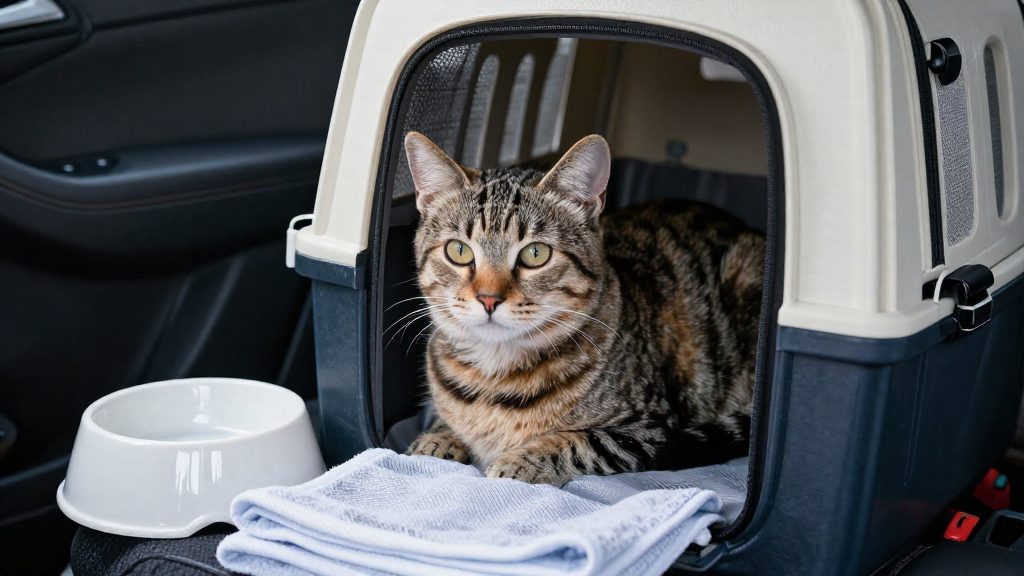
The carrier is the cat’s moving room for the whole trip, so choose it for stability and security first, then for comfort. Many feline behaviorists recommend a hard-sided carrier with openings at the front and top (Vetstreet, 2011-07-14). The top opening lets you lift a cat out without pulling it backward through the door, and the front opening gives access to a cat that is reluctant to come out.
Chewy’s vet-reviewed guidance (2026-06-30) favours a crash-tested carrier where one is available. Check the carrier’s label or the manufacturer’s documentation for any crash-test claim before you buy, because a carrier that is merely sturdy is not the same as one that has been tested.
Placement matters as much as the carrier itself. Chewy’s guidance is to set a regular carrier on the floor behind the front seat, not on a seat, and to secure it so it cannot slide or tip during braking. An unsecured carrier can move in a sudden stop, which is the main reason to fix it in place.
Inside the carrier, use a soft base and a pee pad under the cat’s bedding. The soft base gives the cat secure footing on a moving floor, and the pad absorbs accidents without the cat needing to be moved. Add a familiar blanket or comfort item so the carrier smells like home.
Get the cat used to the carrier before the trip. Leave the carrier open at home, put food or treats inside, and let the cat enter and leave on its own terms. A cat that already rests in the carrier at home may settle more easily on the road. A stable carrier also supports the small meal and calm conditions that Chewy’s guidance lists as helpful for cats prone to car sickness.
Food, water and litter on the road
Pack only what the cat needs for the trip: its regular food, treats, water and litter, sized to the days you will be away. Each item should be sealed, labelled and reachable from the front seat, so you can serve it without unpacking the whole car. Pack the cat’s own routine rather than new products bought for the journey, because unfamiliar items add stress to an already unfamiliar day.
| Item | What to pack | Source |
|---|---|---|
| Regular food | The cat’s usual food, in sealed, labelled portions | Vetstreet, 2011-07-14 |
| Bowls | Collapsible bowls for food and water | Vetstreet, 2011-07-14 |
| Litter | Disposable litter trays with the cat’s usual litter | Vetstreet, 2011-07-14 |
| Travel litter | A travel litter box with litter, listed in the trip checklist | Chewy (vet-reviewed), 2026-06-30 |
Food and treats
Portion the food before departure into separate sealed bags, each labelled with the cat’s name and the contents. Labelling matters when several people handle the car, and portions avoid opening the full bag in a moving vehicle. Keep treats in their own labelled container, separate from the meal portions, so the two are never confused.
Water and bowls
Bring drinking water from home for the cat and use collapsible bowls, which take little room in the car. Keep the bowls in an accessible pocket or bag rather than inside the carrier, so they can be reached without opening the carrier door.
Litter
Use disposable litter trays filled with the cat’s usual litter. Familiar litter keeps the toileting routine recognisable in an unfamiliar place. Pack a sealed bag for used litter so waste does not accumulate in the vehicle between stops.
Medications, records and ID
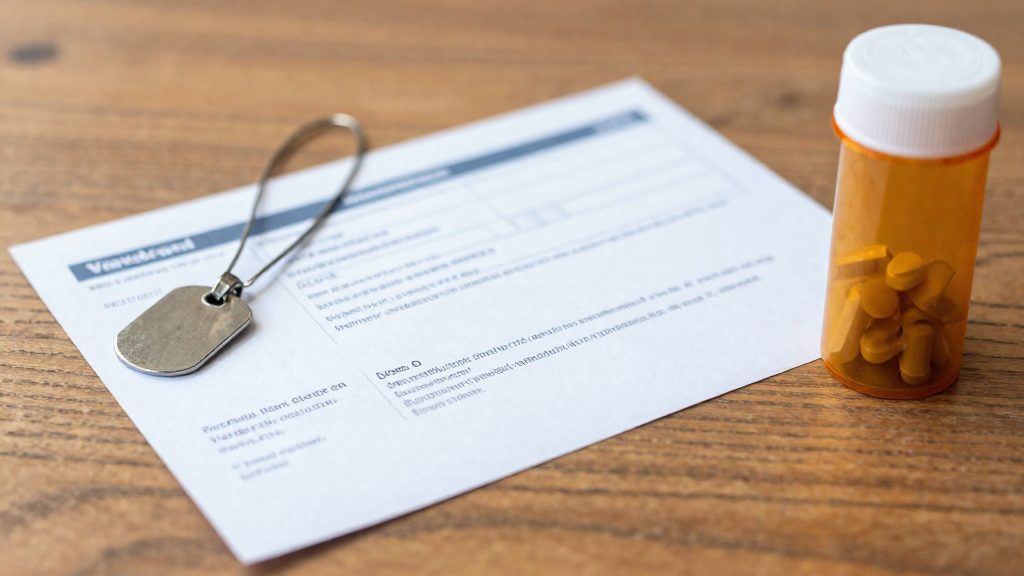
A cat needs its vaccine records, identification and regular medicines before any car trip. These are the items that are hardest to replace on the road. The Chewy packing checklist (vet-reviewed by Dr. Barri J. Morrison, 2026-06-30) lists medical and vaccine records and a collar with updated ID tags as core items, with a tracking device alongside them. Vetstreet (2011-07-14) adds regular medications and a first-aid kit. The Vetstreet guidance dates from 2011, so check its details against current veterinary advice before you travel.
| Item | Category | Source and date |
|---|---|---|
| Medical and vaccine records | Records | Chewy, 2026-06-30 |
| Collar with updated ID tags | Identification | Chewy, 2026-06-30 |
| Tracking device | Identification | Chewy, 2026-06-30 |
| Regular medications | Medicines | Vetstreet, 2011-07-14 |
| First-aid kit | Medicines | Vetstreet, 2011-07-14 |
| Emergency vet numbers (saved in phone) | Contacts | Vetstreet, 2011-07-14 |
Vet records and proof of vaccinations
Keep the cat’s medical records and vaccine records together in one folder that you can reach during stops. Do not rely on a digital copy alone. The sources above do not set legal entry requirements for any country. Before you cross a border with a cat, check the rules of each country on your route with its official authority.
Collar, ID tags and tracking device
Fit a collar with ID tags that show current contact details. “Updated” is the key word in the checklist: an old phone number on a tag defeats the purpose. Chewy lists a tracking device as a separate item, so treat it as an addition to the collar, not a replacement for it. The sources do not name specific tag or tracker models, so choose products on their own merits.
Regular medications and first-aid kit
Pack the cat’s first-aid kit and every regular medication it takes, in their original containers, so that labels and dosing instructions stay with the product. Ask your vet before the trip which medicines to bring and how to store them in the car. Save emergency vet numbers in your phone before you leave.
How do you handle car sickness and stress?
Car sickness in cats has recognisable signs, and most of the preventive work happens before the car leaves. The signs to watch for are drooling, vocalizing and vomiting. Stress and motion sickness can overlap, so note which signs appear and when. That record helps the vet adjust the plan for the next trip.
Preparation has two parts: a conversation with the vet and a few steps on the day of travel.
| Stage | What to do | Source (dated) |
|---|---|---|
| Before the trip | Ask the vet about anti-nausea and anti-anxiety options. Feline pheromone sprays are another option raised for discussion. | Vetstreet (2011-07-14) |
| Before departure | Offer a small meal beforehand. | Chewy, vet-reviewed (2026-06-30) |
| About one hour before travel | Give anti-nausea medication only if the vet prescribed it, and at the prescribed timing. | Chewy, vet-reviewed (2026-06-30) |
| During the ride | Watch for drooling, vocalizing and vomiting. | Chewy, vet-reviewed (2026-06-30) |
Stress is harder to measure than nausea. Vocalizing can signal distress or simply a reaction to the car’s movement, so the signs alone do not separate the two. What the sources support is a plan agreed with the vet in advance, rather than improvised medication on the road.
Is it safe to leave a cat in a parked car?
No. The source guidance is unambiguous: never leave a cat alone in a parked car. This applies even with the windows cracked, because the interior heats up quickly (Chewy, vet-reviewed, 2026-06-30). Cracked windows are not offered as an exception, and a small opening does not make the cabin safe for an unattended animal.
The source does not give a temperature threshold or a time limit before the cabin becomes dangerous, so this section does not quote one. The safe rule is therefore the one the source states without qualification: the cat stays out of an unattended parked vehicle at all times.
Brief fuel and toilet stops
Even a short stop falls under the rule: the cat is never left alone in the parked car. The source sets no duration exception, so a two-minute stop falls under the same rule as a long one. Plan each stop around the cat rather than around the car.
- Before stopping, confirm the carrier is still secured in its position on the floor behind the front seat.
- If you must leave the vehicle, lift the carrier out and take the cat with you.
- Before locking the doors and walking away, check that the cat is out of the cabin.
- Return to the car, place the carrier back in its secure position, and continue.
Why this matters for the trip plan
A cat that is taken out of the car at each stop needs its carrier to be secure and easy to carry. The carrier placement inside the vehicle is covered in a separate section, so the focus here is only the rule that the cat is never left alone in the parked car.
Rest stops and hotel checklist
On trips longer than about five hours, plan a stop so the cat can use its litter box, according to Chewy’s vet-reviewed guidance (2026-06-30). Each stop is also the moment to offer food and water. Overnight stays add a second task: setting up a hotel room that gives the cat a contained, familiar space to rest, eat, drink and use the litter tray.
Routine at each rest stop
- Litter break: on rides longer than about five hours, stop so the cat can use its litter box.
- Food and water: offer both at every stop, not only at the destination.
- Bowls: use collapsible bowls, which Vetstreet (2011-07-14) lists among items to pack for a cat trip.
Hotel room set-up
| Item | Setup | Source |
|---|---|---|
| Carrier | Use a soft base, comfort items and a pee pad inside | Chewy (2026-06-30) |
| Litter tray | Place it in a quiet corner, away from the food and water bowls | Vetstreet (2011-07-14) |
| Bowls | Set out the collapsible food and water bowls at each stop and in the room | Vetstreet (2011-07-14) |
Keeping the carrier in the hotel room gives the cat a familiar space that already smells like its own, which helps it settle overnight.
Frequently asked questions
How often should I stop on a long car trip with my cat?
On rides longer than about five hours, stop so the cat can use a litter box, and offer food and water at each stop (Chewy, vet-reviewed by Dr. Barri J. Morrison, 2026-06-30). Stops also give you a chance to check on the cat’s carrier and comfort.
Can I leave my cat in the car while I run a quick errand?
No. Chewy’s vet-reviewed guidance says never leave a cat alone in a parked car, even with the windows cracked, because the interior heats up quickly (Chewy, 2026-06-30). Bring the carrier with you or take the cat along on errands.
Which carrier works best for a cat in a car?
Chewy recommends a crash-tested carrier with a soft base, comfort items and a pee pad (Chewy, vet-reviewed, 2026-06-30). If you do not have one, a regular carrier placed on the floor behind the front seat is the alternative Chewy mentions.