Why does an unrestrained dog put everyone at risk?
The projectile effect
An unsecured dog has no connection to the car’s structure, so the inertia of its body keeps it moving in the same direction and at the same speed as the car just before a sudden change. When the car decelerates, the dog does not slow with it. It keeps going until it meets a surface or an obstacle. This is why a loose animal can act as a projectile inside the cabin, and why the danger does not depend on how well the driver handles the vehicle.
Likely impact surfaces
The surface a dog strikes depends on the direction of the change in speed:
| Motion of the car | Direction the dog keeps moving | Surfaces it can reach |
|---|---|---|
| Hard braking or frontal impact | Forward | Front-seat backrests, occupants, dashboard area |
| Sharp turn or side impact | Sideways | Side windows, door panels, adjacent passengers |
| Rear impact | Backward relative to the cabin as the car is pushed forward, then possibly forward on rebound | Rear seatbacks and cargo area, then front-seat backs on rebound |
Risk to occupants
A dog of any size that strikes a person can injure the head, neck or face of an adult or child, and a dog in the cargo area can strike occupants during braking. The risk is not limited to the animal’s size: the mass in motion is what transfers force. Drivers who are struck by or must avoid a loose dog can also lose control.
Risk to the dog
The dog itself can be hurt by contact with glass, door hardware or seat frames. In a crash, ejection is a specific danger: a dog can be thrown through a door or window that opens or breaks, after which it is exposed to traffic on the road.

Harness or carrier: load path, attachment and fit
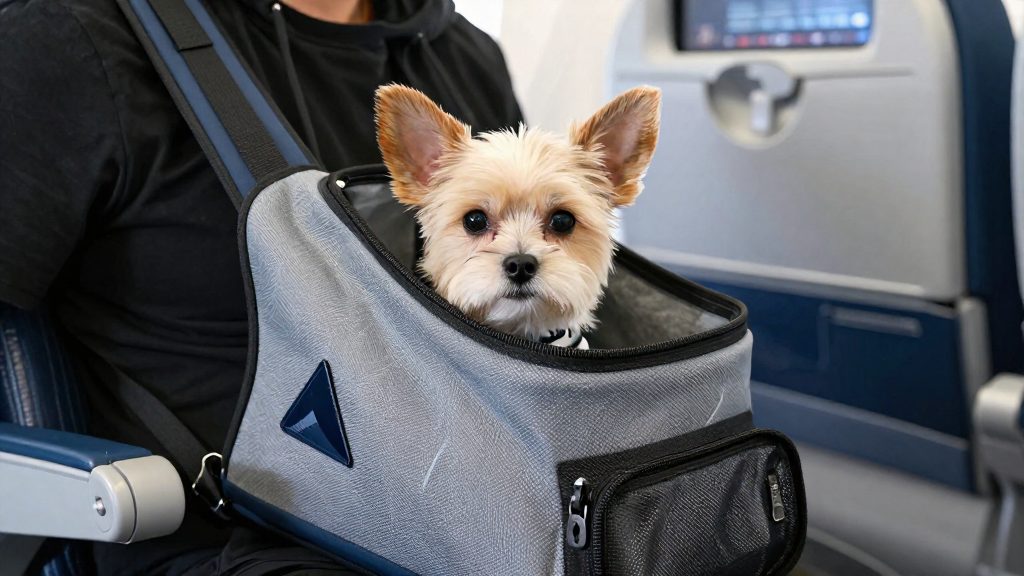
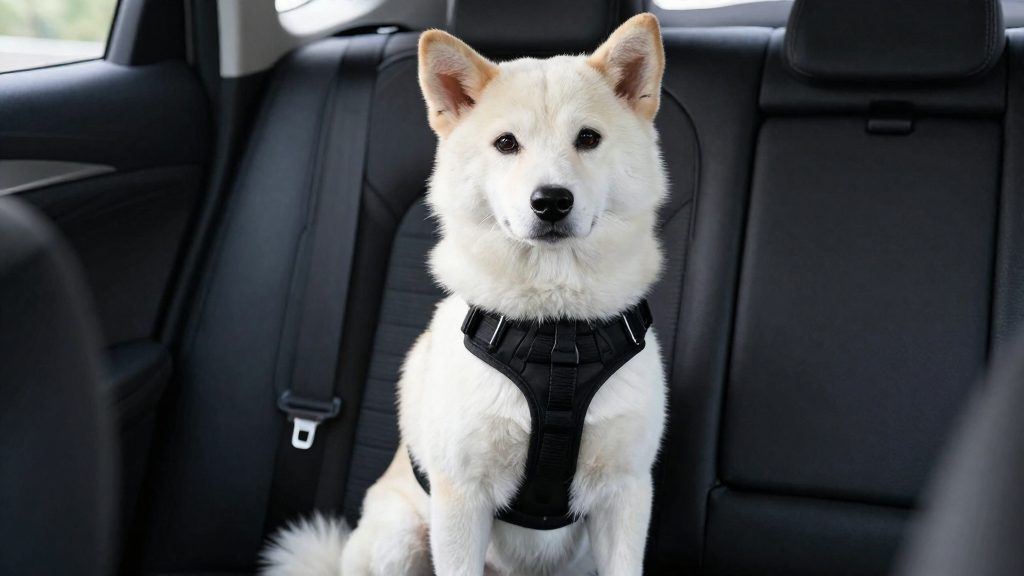
Restraint choice depends on two things: where crash forces travel through the device, and whether the dog stays inside it. A harness spreads load across the dog’s chest and body and transfers it to the vehicle through a tether or seatbelt. A carrier or crate transfers load through its own shell and frame, so the enclosure supports the dog’s body.
Harness versus carrier: load path and attachment points
Each restraint type sends force along a different path:
| Restraint | Load path | Attachment points | Containment |
|---|---|---|---|
| Harness | Chest and body straps, then the tether or belt | Vehicle seatbelt or tether, harness clip points | Depends on fit; a loose harness can allow a dog to slip out |
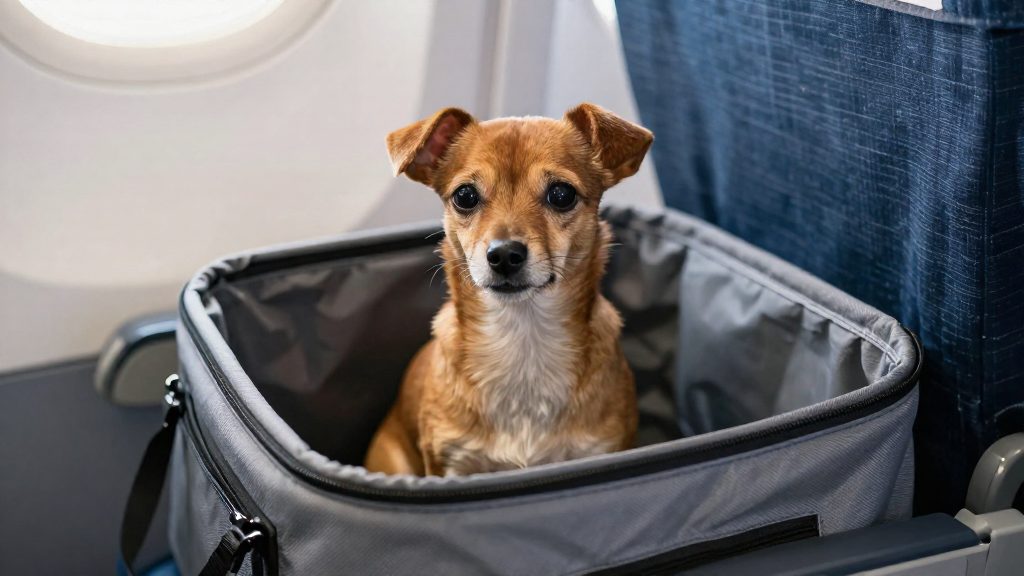
| Soft carrier | Fabric shell and internal frame, then the belt or anchor straps | Belt routing or anchor straps | Depends on zips, mesh panels and the frame |
| Hard crate | Rigid shell, then the belt or anchor points | Belt routing or anchor points on the crate | Rigid walls, door latch and fit |
With a harness, load path depends on the strap geometry and the attachment point. A harness clipped to a point not designed for restraint concentrates force on the attachment and on the strap, not on the dog’s whole torso. Always follow the manufacturer’s attachment instructions and confirm the anchor point is the one the product specifies.
With a carrier or crate, the enclosure’s frame and anchors take the load. Check that the belt or anchor straps pass through the designated routing points and are tightened so the unit does not shift.
Hard crate versus soft carrier: containment and fit
Containment is the main difference between the two enclosure types. A hard crate keeps its shape under load and resists collapse. A soft carrier relies on its frame, seams and closures, so its containment depends on construction details that the product page must describe.
Fit matters for both. The dog should be able to stand, turn around and lie down inside without its head or body pressing against the walls or roof. A tight fit can cause injury, and an oversized enclosure allows movement. Choose a size that suits the dog’s current body dimensions, not its expected adult size.
Named CPS-listed carriers and kennels as reference examples
The fact sheet does not state the construction, dimensions or attachment method of the CPS-listed products, so read each current product page before buying. Compare the load path, closures and fit criteria above against the product’s own documentation.
How do you know a restraint is truly crash-tested?
The most direct check is whether the exact product appears on an independent list. The Center for Pet Safety (CPS) publishes a certified-products page that lists carriers and kennels, including PawsInCar and Away carriers and Gunner and Lucky Duck kennels. According to the page, participants commit to meeting independently developed safety standards, and the CPS describes its testing as rigorous (Center for Pet Safety, 2026). A certified list entry is therefore a stronger signal than any claim printed on packaging.
Step 1: Match the exact model
Search the CPS page by model name, not only by brand. Verify that the listed product is the same model you plan to buy, because a brand name alone does not confirm which product was tested.
Step 2: Look for a certification date
The CPS page gives no certification date for the products it lists. A listing therefore does not show when a product was tested or whether the tested version matches the current one. If the date matters for your decision, ask the manufacturer in writing which version was tested and when.
Step 3: Compare claims with a published standard
Phrases such as “crash-tested” or “meets safety standards” are not verifiable on their own. Ask the manufacturer which published standard it used, which test it ran, and who conducted it. If no standard or test body can be named, the claim cannot be checked against anything.
Step 4: Check the product category
The CPS list reviewed for this article contained carriers and kennels but no harness. A harness marketed as crash-tested cannot be confirmed from that page, so treat such a claim as unverified.
| Verification step | What it establishes | What it leaves open |
|---|---|---|
| Model found on the CPS certified list | The product is listed by an independent body | The page gives no certification date |
| Manufacturer names the standard and test | The claim can be compared with published criteria | A named standard is not proof of certification |
| Product is a carrier or kennel | It falls in a category that appears on the list | Harnesses did not appear on the list reviewed |
Where should your dog ride in the car?
The rear seat is generally the safer place for a dog in a passenger vehicle, provided the dog is contained so it cannot move around the cabin. The front passenger seat should be avoided. The cargo area can work for a dog in a crate or kennel, but only when a physical barrier separates the animal from the cabin. The right position depends on the vehicle layout and how the dog is contained, not on the dog’s size alone.
Rear seat versus cargo area
| Position | Main advantage | Main requirement |
|---|---|---|
| Rear seat | The dog stays in the cabin, where the owner can monitor it | Containment that stops the dog from moving into the driver’s area |
| Cargo area | Keeps the animal out of the passenger space | A barrier between the dog and the cabin, and a crate or kennel that fits the space |
A loose dog in either area is a distraction risk for the driver, so containment is the deciding factor in both positions.
Front passenger airbag hazard
Front passenger airbags deploy rapidly and with considerable force. A dog seated or standing in the front passenger seat can be struck by the deploying airbag, and the dog’s position in that seat is not something the owner can control during a sudden stop. Keep the dog out of the front passenger seat in every trip, including short ones. Check your vehicle owner’s manual for how the front passenger airbag system is described for your model.
Partitions and cargo barriers
A partition is a rigid or mesh barrier that separates the cargo area from the cabin. Where the vehicle has no fitted partition, use a crate or kennel that is secured to fixed points in the cargo area so it cannot slide forward. Keep the dog contained at all times rather than allowing it to roam the cargo space.
Is it legal to drive with a dog loose in the car?
In the United States, rules on unrestrained animals in vehicles are mostly set by individual states and sometimes by local ordinances, so the answer depends on the state you are driving in. Check the current text of that state’s vehicle code or the state motor vehicle agency, and note its date. The answer depends on where you drive, so there is no single legal answer that applies everywhere. The fact sheet for this article covers certified pet carriers and kennels, not traffic codes, so it cannot confirm the rules for any specific country. Check the official source for each market you drive through.
Where to find the national highway code text
Use the government traffic authority or national legislation portal for the country you are in. Each entry should show the text and its effective date.
| Step | What to check | Source type |
|---|---|---|
| 1. Identify the country | Each country sets its own rules, so check the one you are driving in | Your route and itinerary |
| 2. Find the national code | Search for the national highway code or road traffic act with the country name | Government or legislative portal |
| 3. Locate the animal provision | Look for wording on animals, loose loads, or driver distraction | The official code text |
| 4. Confirm the penalty | Find the enforcement section and any stated fine or penalty schedule | Dated official government publication |
| 5. Check the date | Confirm the version is current and note its effective date | Publication or revision date on the page |
Fines and enforcement
Penalties for an unrestrained animal are set in each country’s legislation or enforcement rules. They are not standardised across borders. Do not rely on general travel forums or unofficial summaries to estimate a penalty. Use the official penalty schedule and enforcement text for the country you are in, and confirm it is the current version.
Separately, a carrier or restraint certified by a testing body does not, on its own, confirm legal compliance. Compliance with traffic law is a separate question, and it has to be checked against the national code.
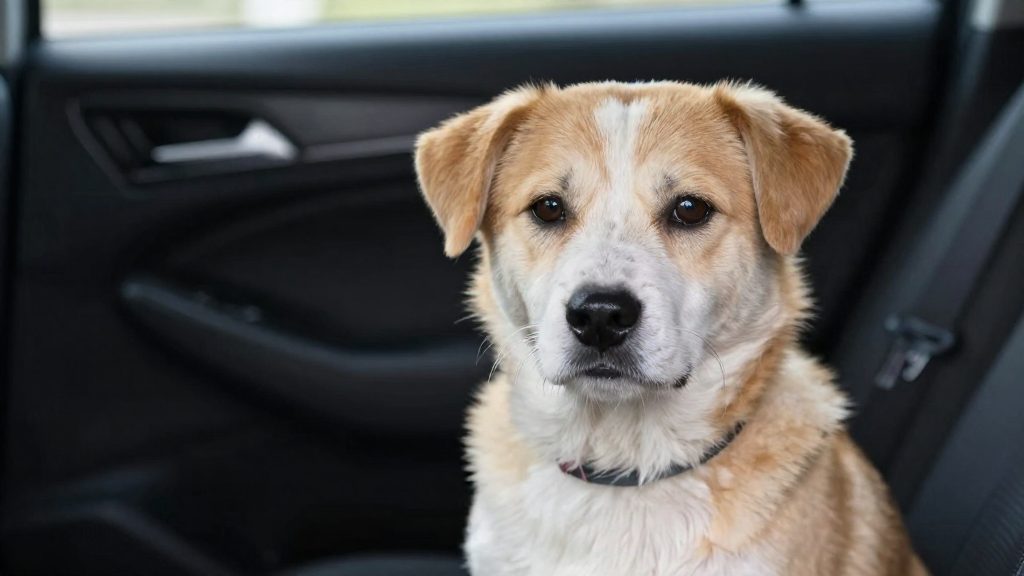
Never leave your dog in a parked car
Leaving a dog alone in a parked car is never a safe option, even for a few minutes and even on a mild day. Sunlight passes through the glass and warms the seats, dashboard and floor, which then release heat into the cabin. With the windows closed, that heat has no way out, so the interior can become far hotter than the air outside. Dogs cool themselves mainly by panting, which works poorly in a small, hot, still space, so the animal has little ability to recover once its temperature starts to climb.
Why parked cars heat quickly
- Trapped heat: Solar energy enters through the glass faster than it escapes through closed windows.
- Still air: A closed cabin has almost no air exchange, so the heat stays concentrated around the dog.
- Surface heat: Dark upholstery and hard plastic surfaces hold warmth and keep radiating it after the sun has moved.
Why shade and cracked windows give limited protection
| Measure | What it changes | Why it does not prevent a dangerous interior |
|---|---|---|
| Parking in shade | Blocks direct sunlight for part of the day | The sun moves, so a shaded spot can become sunny within minutes, and the closed cabin still heats from the surrounding air |
| Window cracked open | Allows a small exchange of air | A narrow gap admits very little air, and the interior still heats well above outside conditions |
Shade and a cracked window reduce some of the load but do not remove the underlying cause, which is the closed, glazed space itself. Neither measure should be treated as a reason to leave a dog in the car.
Short stops and errands have no safe exception
A short errand is unpredictable. Queues, a slow checkout or an unexpected conversation can easily stretch a five-minute stop into a much longer absence, and the car does not cool down while you are away. The safe method is to plan around the stop: take the dog with you where it is allowed, or leave it at home with water and shade indoors. If the dog cannot enter the shop or building, skip that stop or ask for a delivery.
Using certified carriers during travel
No carrier, certified or not, makes it safe to leave a dog in a parked car.
Signs of heatstroke and car sickness: when to call the vet
Heatstroke and car sickness can both cause distress during or after a journey, but they need different responses. Heatstroke means the dog’s body temperature is rising faster than it can cool down. Car sickness is a motion-related upset of the stomach and balance. Suspected heatstroke is an emergency: contact a veterinarian or emergency clinic immediately, even if the dog seems to improve. Car sickness alone is usually milder, but any collapse, repeated vomiting or blood needs urgent veterinary care. The signs below are general observations and do not replace a veterinary assessment.
Heatstroke warning signs
- Heavy, rapid panting that does not slow when the dog rests
- Thick, excessive drooling
- Weakness, unsteady walking, or reluctance to stand
- Collapse or reduced responsiveness
Car sickness warning signs
- Vomiting, often during the journey or at a stop
- Restlessness, pacing, or whining
- Repeated lip-licking, swallowing, or yawning
- Mild drooling that starts with motion
Panting and drooling appear in both lists. The context separates them: a dog left in a warm vehicle or exposed to heat is more likely overheating, while a dog that vomits or becomes restless only while the car is moving is more likely car sick.
When to call a vet immediately
- Collapse, seizure, or unresponsiveness
- Any heatstroke sign after heat exposure (heavy panting, thick drooling, weakness, unsteadiness), even if the dog seems to improve after being moved somewhere cooler
- Repeated vomiting, or vomiting that contains blood
- Pale, grey, or blue-tinged gums
- Any of the above after heat exposure
Contact a veterinarian or an emergency clinic without delay. Say that the dog may have overheated, and give the timing and conditions of the exposure.
Prepare your dog for car trips
Most dogs can learn to settle in a vehicle through gradual exposure before any long journey. The method is to build tolerance in small, controlled steps, then add a travel kit and a feeding plan so that departure day is predictable for both of you.
Gradual habituation
Start with the car parked and switched off. Let your dog sniff the interior, step in and out, and receive a treat or praise for calm behaviour. Once that is relaxed, move to short trips around the neighborhood, then progressively longer drives. Increase duration only when your dog shows calm body language, such as a loose posture, normal breathing, and willingness to take food.
| Stage | Activity | Goal |
|---|---|---|
| 1 | Car parked, engine off | Associate the vehicle with food and calm |
| 2 | Engine on, car still parked | Get used to the sound and vibration |
| 3 | Short trips to a familiar place | Build a positive destination association |
| 4 | Longer trips, then a practice run of the full route | Test tolerance before the real journey |
If your dog shows distress at any stage, return to the previous step and proceed more slowly.
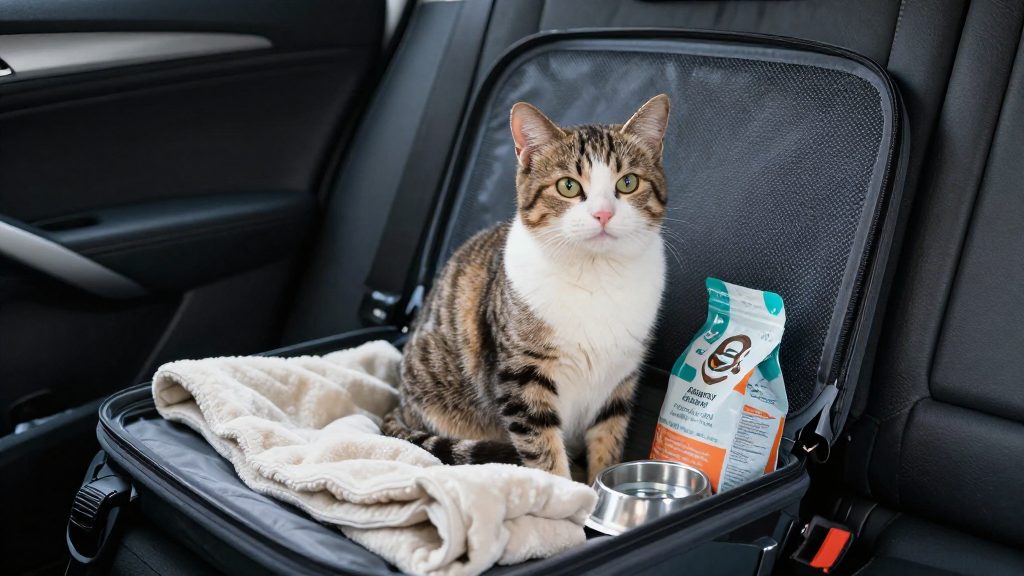
Travel kit
Prepare the kit in advance and keep it within reach of the driver:
- Identification: a collar with an ID tag showing your current phone number, and a microchip whose registered details are up to date.
- Leash and collar or harness: a spare leash for rest stops, since a dog that bolts from an unfamiliar area is hard to recover.
- Water: a supply from home, so that a change of water does not upset your dog’s stomach, plus a collapsible bowl.
- Documents: vaccination records and any health paperwork your vet provides. Check the entry and pet travel rules of your destination country on its official government website before you leave, since requirements vary.
Feeding and water before departure
Avoid a large meal immediately before the trip. Ask your vet to recommend a feeding time that suits your dog’s routine and the length of the journey. Offer water before departure and at each stop, and keep the water bowl accessible during the drive.
Frequently asked questions
Is it legal to let my dog ride loose in the car in the United States?
Rules on unrestrained animals in vehicles are set mainly by individual states and sometimes by local ordinances, so the answer depends on where you drive. Check the current text of your state’s vehicle code or the state motor vehicle agency, and note the date the text was published.
Can I leave my dog in a parked car on a mild day?
No carrier, certified or not, makes a parked car safe for a dog. If your dog shows signs of heatstroke, such as heavy panting, thick drooling, weakness or unsteadiness, contact a veterinarian or emergency clinic immediately, even if the dog seems to recover after being moved somewhere cooler.
Is a certified carrier safer than a harness?
The Center for Pet Safety (CPS) certified-products list I reviewed includes carriers and kennels, and no harness appeared in it, so this guide cannot rank the two by safety. Check each product’s certification status before buying, and confirm that the restraint fits your dog and attaches securely to the vehicle.