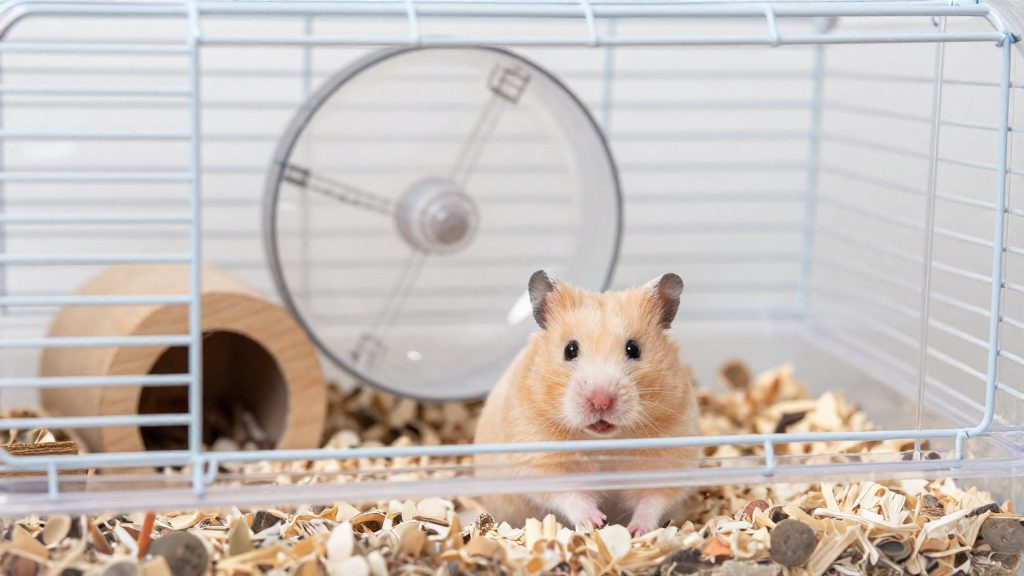
Cage size determines how much room a hamster has to run, dig and forage each day, and these are normal behaviours that a larger enclosure makes easier to carry out. A hamster kept in a small enclosure has fewer chances to move between its nest, food and toilet area, and fewer ways to express normal activity.
Why cage size matters for hamsters
Running, digging and foraging needs
Hamsters are active animals that cover ground, excavate and search for food. Their enclosure needs to support all three:
- Running: continuous floor space lets the animal move in a straight line and not only around a confined loop.
- Digging: the enclosure must hold enough substrate for the animal to tunnel and build a nest.
- Foraging: food scattered or hidden around the enclosure gives the animal something to search for, which a small, bare space cannot offer.
Vet Help Direct notes that, because hamsters have poor eyesight, a larger single-level or low-platform cage is generally better than a tall multi-tier cage, given the fall injury risk. A single level also keeps the floor continuous, which supports the running and foraging described above.
Why enclosure size affects daily welfare
Enclosure size affects how often a hamster can carry out its normal routines. Evidence on whether continuous floor space matters is mostly anecdotal rather than research-based, according to Vet Help Direct. The RSPCA has reportedly stopped citing a fixed cage size and now says only that the cage should be as large as possible. This means the principle is clear, but a precise threshold for welfare is not established.
Stress signs in confined enclosures
Restricted space can show up as repetitive, fixed behaviour, known as stereotypic behaviour. Watch for:
- Pacing along the same walls or path, repeatedly
- Persistent gnawing at bars or the enclosure edge
- Repeated circling in one spot
| Source | What it says about enclosure size and welfare | Date |
|---|---|---|
| The Vet Desk (PangoVet), reviewed by Dr. Marta Vidal-Abarca, BVSc MRCVS | Sets species-specific minimum floor and height figures | 2025-10-29 |
| Vet Help Direct, Laura Waring BVetMed MRCVS | Favours larger single-level cages; floor-space evidence mostly anecdotal | 2022-10-23 |

How big should a hamster cage be?
Judge a cage by its usable floor footprint: the interior length multiplied by the interior width, in the same unit. Convert the interior length and width to inches (1 inch = 2.54 cm) before multiplying, or divide an area in square centimetres by 6.45 to get square inches, so that you can compare it with the veterinary figures. Check every candidate cage in two steps. First, test the floor against the 100 x 50 cm baseline (about 780 sq in) from the UK all-species guidance of Vet Help Direct (Laura Waring BVetMed MRCVS, 2022-10-23). Second, test it against the species target: about 900 sq in for a Syrian hamster and about 700 sq in for a dwarf or Chinese hamster (The Vet Desk (PangoVet), 2025-10-29). Compare lid type, height and other features only after a cage passes the floor check for its species.
Converting dimensions into floor area
- Measure the interior, not the outer frame. Wall thickness, plastic bases and mesh edges reduce the usable area.
- Multiply interior length by interior width, in inches or in centimetres.
- Convert the result to the unit of your reference figure before comparing.
| Floor dimensions | Approximate floor area | Source of reference figure |
|---|---|---|
| 100 x 50 cm (about 39 x 20 in) | about 780 sq in | Vet Help Direct (Laura Waring BVetMed MRCVS), 2022-10-23, UK baseline |
| about 40 x 22.5 in | about 900 sq in | The Vet Desk (PangoVet), 2025-10-29, Syrian target |
| about 40 x 17.5 in | about 700 sq in | The Vet Desk (PangoVet), 2025-10-29, dwarf and Chinese target |
Why total volume misleads
Volume adds height to floor area, so a tall cage can show a large volume while offering a modest floor. Extra height does not give the animal usable space in the way that floor does.
Judging manufacturer size labels critically
- Recalculate the area yourself. Labels may quote only height or volume, or round dimensions.
- Be cautious with older minimums. Some previously quoted figures were smaller, such as 80 x 50 cm for Syrian hamsters, so a cage matching an older figure may fall short of the current targets.
Minimum floor space by species
The Vet Desk (PangoVet) guide, reviewed by Dr. Marta Vidal-Abarca BVSc MRCVS on 2025-10-29, gives a minimum floor of about 900 sq in (roughly 40 x 22.5 in) per Syrian hamster and about 700 sq in (roughly 40 x 17.5 in) per dwarf or Chinese hamster, and advises going larger. The UK all-species guidance from Vet Help Direct (Laura Waring BVetMed MRCVS, 2022-10-23) sets a baseline floor of 100 x 50 cm, about 780 sq in, for every hamster species. Use the baseline as the first check and the species figure as the target for each animal.
| Species or guidance | Minimum floor area | Approximate dimensions | Source (date) |
|---|---|---|---|
| Syrian hamster | about 900 sq in | about 40 x 22.5 in | The Vet Desk (PangoVet), 2025-10-29 |
| Dwarf and Chinese hamsters | about 700 sq in | about 40 x 17.5 in | The Vet Desk (PangoVet), 2025-10-29 |
| UK all-species baseline | about 780 sq in (100 x 50 cm) | about 39 x 20 in | Vet Help Direct, 2022-10-23 |
Syrian target versus the UK baseline
The Vet Help Direct author recommends at least 100 x 50 x 50 cm for every hamster species, and notes that PDSA and Blue Cross have adopted the Veterinary Association for Animal Welfare guideline of a 100 x 50 cm floor. That baseline is about 120 sq in (900 minus 780, calculated from the fact sheet) below the Syrian target. A 100 x 50 cm cage therefore meets the baseline but not the Syrian target. Because the all-species figure is a single size, it does not separate Syrian from smaller species, so the Syrian target should be used for a Syrian hamster.
Dwarf and Chinese hamsters
The 100 x 50 cm baseline (about 780 sq in) exceeds the dwarf and Chinese target of about 700 sq in by about 80 sq in, so a cage at that size meets the species target per hamster.
Older figures
Older commonly quoted minimums were 80 x 50 cm for Syrians and 70 x 40 cm for dwarfs. Use the current figures above, not the older ones.
How deep should the bedding be?
Recommended bedding depth depends on the species. For a Syrian hamster, the Vet Desk (PangoVet) guide recommends bedding about 12 in (roughly 30 cm) deep. For dwarf and Chinese hamsters, the same guide recommends 6 to 8 in (roughly 15 to 20 cm). The UK veterinary guidance from Vet Help Direct sets a single benchmark for all hamster species: 25 cm (about 10 in) or more of substrate.
| Species group | Recommended bedding depth | Source (date) |
|---|---|---|
| Syrian hamster | About 12 in | The Vet Desk (PangoVet), 2025-10-29 |
| Dwarf and Chinese hamsters | 6 to 8 in | The Vet Desk (PangoVet), 2025-10-29 |
| All hamster species (UK guidance) | 25 cm (about 10 in) or more | Vet Help Direct (Laura Waring BVetMed MRCVS), 2022-10-23 |
Why depth matters for digging and nesting
Hamsters dig, and bedding is the material they dig through and build with. The Vet Help Direct guidance ties its 25 cm figure to digging, specifying that depth of substrate for that purpose. Too little bedding leaves the animal with little material to work with, while a deeper layer gives room to excavate and to shape a nest area.
Comparing the figures
The sources do not agree on a single number, so the comparison matters in practice:
- For a Syrian hamster, the 25 cm (about 10 in) UK figure is about 2 in (roughly 5 cm) below the Vet Desk figure of about 12 in.
- For a dwarf or Chinese hamster, the 25 cm UK figure is deeper than the Vet Desk range of 6 to 8 in, which is roughly 15 to 20 cm.
Where the sources differ, treat the species-specific Vet Desk figure as the primary reference and the UK figure as a secondary check.
Is a tall multi-level cage a good idea?
Height can satisfy a height minimum, but the sources do not treat stacked levels as a substitute for floor area. The Vet Desk (PangoVet) guide, reviewed by Dr. Marta Vidal-Abarca, BVSc MRCVS (2025-10-29), sets a height of at least 24 in for Syrian, dwarf and Chinese hamsters. The UK guidance from Vet Help Direct, written by Laura Waring BVetMed MRCVS (2022-10-23), gives a height of 50 cm (about 20 in) for all hamster species, within a floor of 100 x 50 cm. The two sources differ on height, so confirm which figure applies to your situation.
| Source (date) | Height figure | Species covered |
|---|---|---|
| The Vet Desk (PangoVet), 2025-10-29 | At least 24 in | Syrian, dwarf and Chinese |
| Vet Help Direct (Laura Waring BVetMed MRCVS), 2022-10-23 | 50 cm (about 20 in) | All hamster species |
Do platforms count toward floor area?
The fact sheet does not state whether raised platforms add to the floor total. Both sources give their floor figures for the cage floor, so the verified basis for the minimum is the base of the enclosure. Treat any platform as additional enrichment space, not as a replacement for floor area.
Fall risk from height, ramps and open platforms
Practical checks for any raised level:
- Keep platforms low, so a fall from the highest point is not a long drop.
- Confirm that the hamster can climb up and down the route you provide, rather than relying on it to jump.
- Inspect edges and access points regularly for gaps or sharp protrusions that could cause an injury.

Can hamsters share a cage?
The Vet Desk (PangoVet) guide, reviewed by Dr. Marta Vidal-Abarca, BVSc MRCVS on 2025-10-29, says each dwarf or Chinese hamster should live in its own cage, and it gives its space minimums per hamster. The source does not describe a shared setup for Syrian hamsters, so shared housing should not be the default.
Housing rule by species
| Species | Housing rule in the source | Source |
|---|---|---|
| Dwarf hamster | One hamster per cage | The Vet Desk (PangoVet), 2025-10-29 |
| Chinese hamster | One hamster per cage | The Vet Desk (PangoVet), 2025-10-29 |
| Syrian hamster | Minimum floor space set per hamster; no shared setup described | The Vet Desk (PangoVet), 2025-10-29 |
Housing a Syrian hamster
The guide gives the Syrian floor minimum per hamster and describes no shared setup. Plan one enclosure per Syrian hamster, sized to the 900 sq in target.
Signs of aggression in a shared enclosure
Watch for these signs of conflict between cage mates:
- Persistent chasing in which one animal is never allowed to rest, eat, or drink.
- Blocked access to food, water, or a hide, with one hamster guarding the only resource.
- Visible injuries such as bite marks, bald patches, or wounds on the body or ears.
- Cornered behaviour, where one animal stays pressed against the cage edge or hides constantly.
- Fighting on reunion, when the pair starts fighting again after a short separation.
If you see any of these, separate the hamsters immediately into different enclosures. Check each animal for wounds, and contact a veterinarian if a bite wound is present.
What cage sizes should you avoid?
Floor area alone does not make a hamster cage safe. A cage can meet the size guidelines and still fail the animal because of its format or construction. Three features are checked below: airflow in sealed glass tanks, wire-mesh floors that can trap feet, and bar spacing wide enough to allow escape. Check these features after a cage passes the floor check above.
Glass aquariums with limited airflow
Glass tanks are a common hamster enclosure, but a closed glass tank with a solid lid restricts air movement. Limited airflow can allow humidity and urine odour to build up in the bedding. Glass sides do not let air pass through, so ventilation depends on the lid.
Look for a lid with mesh or perforations, and avoid tanks where the only opening is a small gap at the top.
Wire-mesh floors that cause foot injuries
Open wire or grid floors are a poor choice for hamsters. Their small feet and toes can slip into the gaps, and repeated pressure on the wire can injure the feet. A solid base covered with substrate lets the hamster walk and dig normally.
Mesh should not be exposed where the hamster walks, even if it is only part of the floor.
Bar spacing wide enough to escape
Hamsters are small and can squeeze through openings that look too narrow for them. If the head fits through a gap, the rest of the body often follows. Check every opening: the spaces between bars, the lid, the door latch, and the join between the cage and its tray. A gap that appears only at a corner or edge is still an escape route.
| Format or feature | Main welfare or safety risk | What to check |
|---|---|---|
| Sealed glass aquarium with solid lid | Restricted airflow; humidity and odour build-up | Mesh or perforated lid, open sides |
| Wire-mesh or grid floor | Toes and feet slip through gaps; foot injury | Solid floor with no exposed mesh where the hamster walks |
| Wide bar spacing or loose door | Head or body can pass through; escape | Gaps too narrow for the head; secure latch; no gaps at corners or lid |
When should you see a vet?
Some changes in a hamster’s health justify a veterinary visit, and they are separate from problems caused by the enclosure itself. The main warning groups are changes in body weight, drops in energy or appetite, discharge from the eyes or nose, and injuries that need assessment the same day. Hamsters are prey animals and often hide illness, so a change in routine is worth acting on rather than waiting to see whether it passes. Choose a vet who treats small mammals, because experience with rodents varies between practices.
Weight loss is one of the easiest signs to miss, because fur and fat can hide a thinning body. Weigh the animal regularly on the same kitchen scale, at the same time of day, and write down each result. Steady weight loss, or a spine and hips that feel more prominent when the hamster is handled, warrants a prompt vet visit rather than waiting several weeks to see whether it settles.
Lethargy and reduced appetite often appear together. Watch for these signs:
| Sign | What to observe | Action |
|---|---|---|
| Lethargy | Sleeping through normal active periods, reluctance to move, hunched posture | Contact a vet promptly |
| Reduced appetite | Food or water left untouched, less food stored in the cheek pouches | Contact a vet promptly |
| Eye discharge | Wet, crusted or sticky eyes, or persistent squinting | Contact a vet promptly |
| Nasal discharge | Wet nose, repeated sneezing, noisy or laboured breathing | Contact a vet promptly |
Eye or nose problems in a small rodent can progress quickly, so contact a vet promptly rather than waiting to see whether they clear on their own. A hamster that stops eating or drinking, or is very lethargic, also needs prompt veterinary attention.
Some injuries need assessment the same day. These include bleeding, a limb held off the ground or dragging, a visible wound, a fall from height, and an animal that cannot stand or has lost its balance. Contact an emergency or exotic-animal clinic immediately. While travelling, keep the hamster warm, quiet and confined in a secure container.
Frequently asked questions
What is the minimum floor size for a Syrian hamster?
A Syrian hamster needs at least about 900 sq in of usable floor (roughly 40 x 22.5 in), with bedding about 12 in deep and a cage at least 24 in tall, according to The Vet Desk (PangoVet), reviewed by Dr. Marta Vidal-Abarca, BVSc MRCVS, on 2025-10-29. These are minimums, so a larger floor is preferable.
Can two dwarf hamsters share one bigger cage?
No. The Vet Desk (PangoVet) guide, reviewed 2025-10-29, states that dwarf and Chinese hamsters must each have their own individual enclosure, and it sets their floor minimum at about 700 sq in per animal. Plan one cage per dwarf or Chinese hamster, sized to that figure.
Is a tall multi-level cage a good substitute for a wide one?
Not for a hamster’s floor space. Because hamsters have poor eyesight, Vet Help Direct (Laura Waring BVetMed MRCVS, 2022-10-23) favours a low, single-level or low-platform design, since falls from upper levels can cause injury. Choose a cage whose floor area meets the species figure before adding any height.