Pet rabbits kept indoors need regular exercise and behavioral stimulation because movement and mental activity are part of their welfare, not an optional extra. Enrichment guidance adds that the environment should let a rabbit dig, climb, forage, chew, hop and explore.
Why do pet rabbits need indoor enrichment?
Exercise targets and their limits
rabbit.org, an independent site and not the House Rabbit Society, says rabbits should have the opportunity to exercise at least four hours a day or thirty hours a week. The two figures are not exactly equivalent, and the site does not say whether only active time counts toward them.
| Element | What the source states |
|---|---|
| Daily target | At least four hours a day (rabbit.org, undated) |
| Weekly target | At least thirty hours a week (rabbit.org, undated) |
| Daily versus weekly | Four hours a day equals 28 hours a week, so the weekly figure is two hours higher |
| Active time | Not specified: rabbit.org does not say whether only active time counts |
Because the source does not define active time, a rabbit that is awake but sitting still should not be counted toward the target by default. Track opportunities for hopping and exploring rather than hours the rabbit spends in its enclosure.
Matching play to crepuscular activity
Rabbits are generally described as crepuscular, meaning most active around dawn and dusk. No source used in this guide confirms this timing, so treat it as a working assumption and note when your own rabbit is most active. If it holds for your rabbit, schedule the longest supervised play sessions in the early morning and evening, and keep a quieter option, such as a foraging task, available during the day.
Stimulation that targets natural instincts
Rabbit Care Tips (dated 2026-10-10) organises enrichment around the instincts to dig, climb, forage, chew, hop and explore. Its examples include climbing platforms, hiding places, tunnels, paper for shredding and digging boxes. Each instinct calls for a different type of activity, so one toy rarely covers all of them.
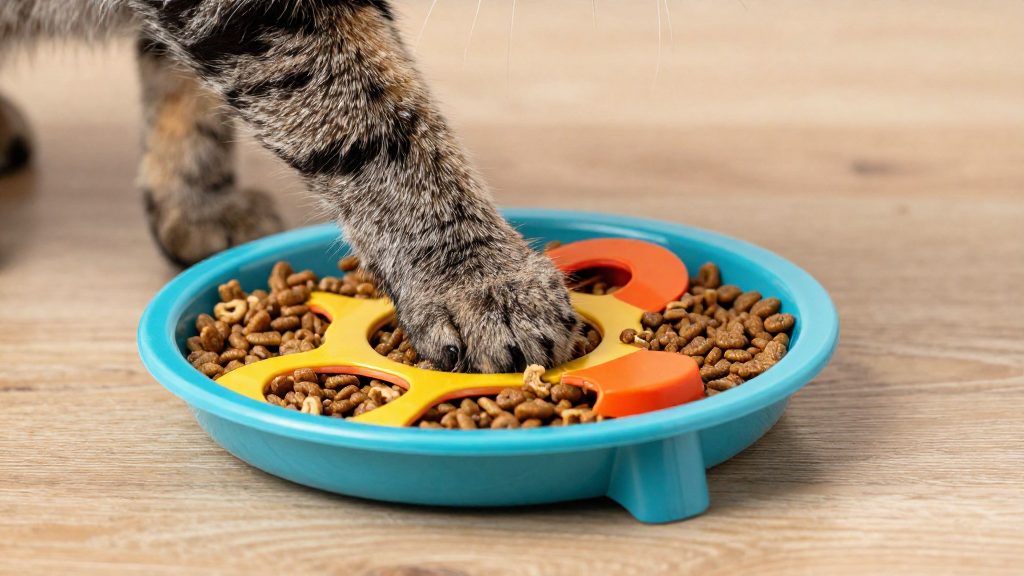
Foraging is a practical way to add stimulation without extra space.
Rotating activities
Swap items in and out instead of offering everything at once, so the rabbit keeps finding the environment interesting.
Set up a safe, rabbit-proofed play space
Before adding any toys or enrichment, check the room itself for physical and chemical hazards. Vet Verified (2024-09-26) lists three core safety points: keep electrical wires out of reach, remove toxic plants, and provide untreated wood for chewing. Those points come first because a rabbit explores by chewing, and a hazard it can reach will eventually be tested with its teeth.
Protecting electrical cords and wires
Cord protection is the first step. Rabbits chew, so any cable within reach is a risk. Work through the room at rabbit height and check:
- Phone, lamp, and computer cables running along the floor or behind furniture
- Power strips and extension leads that the rabbit can reach
- Cables that hang from desks, shelves, or window coverings
Route cables behind furniture, along walls, or inside protective casing, and unplug devices that are not in use. Make the check part of the routine each time the play space is set up, because a cable moved by a person or a household object can create a new exposure.
Identifying and removing toxic houseplants
Go through every plant in the room and identify each species. Remove any plant that a veterinary toxicity reference for your country lists as toxic to rabbits, or move it to a room the rabbit cannot access. Do not rely on appearance or on whether a plant is sold as a houseplant, since that says nothing about its safety for rabbits. Cut flowers, bulbs, and fallen leaves also need to be kept out of reach. If you suspect a rabbit has eaten a plant, contact a vet promptly; the signs requiring veterinary contact are covered separately in this guide.
Choosing an enclosed area with controlled access
The play space should be a defined area the rabbit cannot wander out of, and the rabbit should use it only while you are supervising. A closed room with a door, or a pen with a secure barrier, is the usual approach. Choose a space with no gaps the rabbit can squeeze through, and inspect the barrier for loose edges, gaps under doors, and openings near furniture. Keep the area free of hazards at all times, not only during play sessions. Control of access is a setup decision: a well-chosen enclosure lets you check the hazards above once and then reuse the same safe area for daily exercise.
Foraging and food puzzles
Foraging gives a rabbit a task: searching, sniffing and working out where its food is. A full bowl in one spot removes that task entirely. Spreading small amounts of food through the space turns feeding into an activity, and Vet Verified (2024-09-26) names this approach directly by recommending that owners hide small amounts of food around the space or use puzzle feeders.
Hidden food portions and scattered hay
- Place small portions in several locations rather than one, so the rabbit must move through the space to find each one.
- Scatter hay in different corners to create a search routine.
- Keep each hidden portion small. The source describes “small amounts” without giving a fixed quantity, so adjust the amount to your rabbit’s overall diet.
Hay-stuffed toilet roll tubes
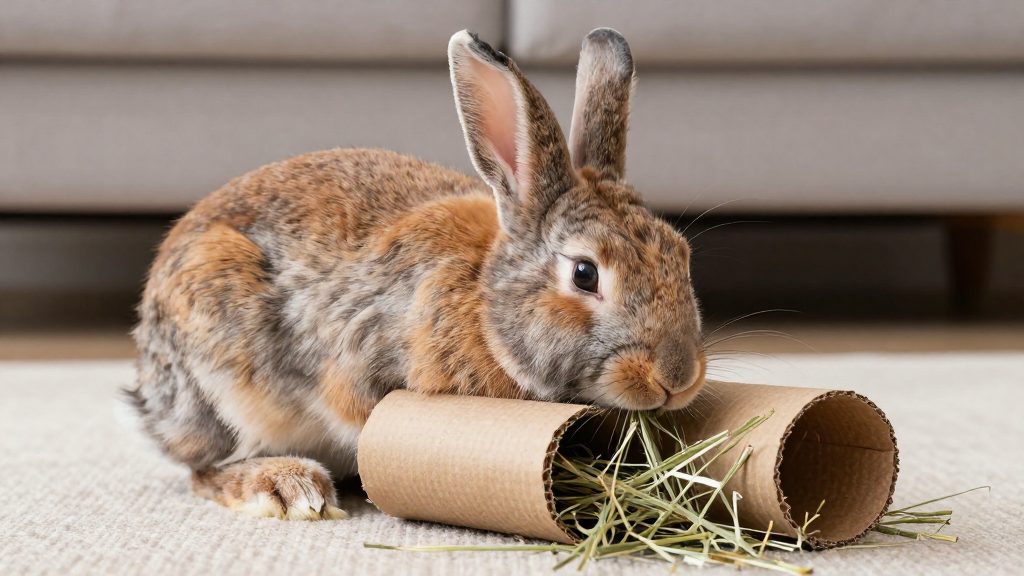
Stuffing hay into empty toilet roll tubes produces a low-cost foraging toy. The rabbit pulls the hay out piece by piece, which combines searching with chewing.
Puzzle feeders
Puzzle feeders make the rabbit manipulate a device to reach its food. Vet Verified (2024-09-26) includes them as one foraging option alongside hidden food. The sources consulted give no design specifications, so judge a feeder by observation: if the rabbit cannot reach its food without repeated frustration, the feeder is too difficult for it.
Clearing uneaten fresh food
Hiding food creates more places where fresh food can be left behind, so check every hiding spot when you clear the bowl.
What can rabbits chew safely?
Rabbits chew to wear down their teeth and to explore, so every chew item needs to be safe to gnaw. The main rule for wood is to choose untreated, unpainted wood for chewing (Vet Verified, 2024-09-26). The checks below turn that rule into steps you can carry out before an item goes into the enclosure.
Starting from plain wood
Use wood with no coating on the surface. Paint, varnish, stain and dye all change what the rabbit ingests while chewing, so any visible finish is a reason to reject the item. Plain wood can be checked by eye and by touch, but a surface that looks plain does not prove the wood is untreated.
Spotting treated wood
Treated wood can look the same as untreated wood, so the check has to rely on information rather than appearance:
- Ask the seller or supplier, in writing, whether the wood has been treated.
- Read any packaging or labels for a treatment statement.
- Do not offer reclaimed or unidentified offcuts, because their history is unknown.
If the answer is unclear, do not use the item.
Dyes, printed surfaces and glued finishes
Coloured or painted blocks are excluded. Rabbit Care Tips (2026-10-10) advises against glossy printed cardboard, so printed inks and glossy surfaces are also excluded. Items assembled with glue or made of bonded layers need the same scrutiny: ask the supplier what the adhesive is, and reject the item if the answer is not known.
Checking for loose fragments and splinters
Inspect each item before every session:
- Run fingers along the surface and edges for splinters.
- Look for flaking layers, loose pieces and sharp edges.
- Remove any item that splits or sheds small pieces, and replace it.
Rabbit Care Tips advises avoiding swallowable soft toys, so a fragment is a reason to remove the item even if it looks harmless.
| Check | What to look for | Action |
|---|---|---|
| Surface finish | Paint, varnish, stain, dye | Reject |
| Treatment status | No written confirmation the wood is untreated | Do not use until confirmed |
| Glued parts | Adhesive joins or bonded layers, adhesive unidentified | Ask supplier; reject if unknown |
| Printed surfaces | Glossy printed ink or coating | Avoid (Rabbit Care Tips, 2026-10-10) |
| Fragments | Splinters, flakes, loose pieces | Remove and replace |
Can rabbits dig indoors?
Yes. Digging is a natural rabbit behaviour, and an indoor rabbit can express it in a dig box filled with a suitable substrate. The two sources in the reference set disagree on the substrate. Vet Verified (dated 2024-09-26) states that a dig box should contain only non-toxic sand or soil. Rabbit Care Tips (dated 2026-10-10) lists digging among the instincts enrichment should target, and advises avoiding sand. Because of this conflict, confirm the substrate with a vet before setting up the box.
Dig box construction
- Container: use a sturdy tray or box with walls the rabbit cannot push over or chew through. Check that the container has no sharp edges.
- Filling: keep the substrate deep enough for the rabbit to dig, and refill or replace it when it becomes soiled or damp.
- Placement: position the box in the enrichment area so the rabbit can reach it without climbing over obstacles.
Substrate options
| Substrate | Vet Verified (2024-09-26) | Rabbit Care Tips (2026-10-10) |
|---|---|---|
| Non-toxic sand | Permitted in a dig box | Advises avoiding sand |
| Non-toxic soil | Permitted in a dig box | Not mentioned in the excerpt |
Confirming the substrate
The sources do not agree on sand, and neither source gives a safe-depth or particle-size figure. Take the exact material you plan to use to a vet and ask whether it is suitable for a rabbit. Do not treat a general “non-toxic” label as sufficient without that check.
Tunnels, hideouts and climbing spots
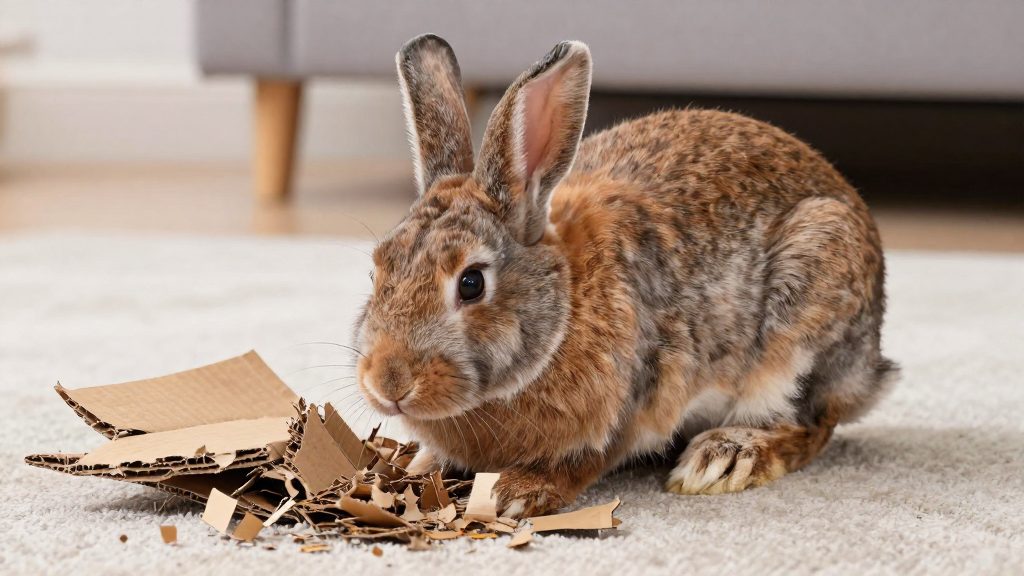
Structural enrichment gives a pet rabbit shelter and room to move indoors. Tunnels, cardboard hideouts and climbing platforms address the instincts that Rabbit Care Tips (2026-10-10) lists as part of rabbit enrichment: to explore, climb and hop, with hiding places given as an example. Each structure needs a safety check before the rabbit uses it, and the entrances are where the main risk sits.
| Structure | Instinct addressed | Check before use |
|---|---|---|
| Tunnel | Explore, hide | Openings clear of edges that could catch the head |
| Cardboard hideout | Hide, shelter | Unprinted cardboard, with holes cut to size |
Cutting cardboard openings
The National Animal Welfare Trust (UK, 2026) advises cutting box holes so the rabbit’s head cannot get stuck. Cut each entrance so the rabbit can pass through without its head or body wedging in the opening. Check each cut edge by hand before the box is placed in the room.
Climbing platforms and vertical space
A raised platform gives the rabbit a vertical space to climb onto and hop down from, which the same guide lists as a climbing-related enrichment example.
Supervising the first introduction
Introduce one structure at a time and watch the rabbit use it during the first sessions. The National Animal Welfare Trust (UK, 2026) advises supervising new toys, and the same principle applies to new structures. Note whether the rabbit enters, leaves and moves through the structure without difficulty, and whether it becomes stuck. Remove the structure if it appears to catch the head or body.
How often should you rotate toys?
The verified sources do not give a fixed rotation interval, so the schedule should follow how the rabbit actually uses its enrichment, not a calendar. Check observed engagement at the end of each session, and swap items only when the rabbit stops interacting with them. This keeps the enclosure novel without replacing so many objects at once that the rabbit cannot investigate what is left.
Setting the interval from observed engagement
Track which items the rabbit approaches, chews, digs, climbs or forages with, and which it passes without interest. Keep items that are still used. Mark items that are ignored across several sessions as candidates for removal. Change only one or two items per cycle, so you can see which change affected behaviour.
Storing removed toys between cycles
Store removed items in a clean, dry place out of the rabbit’s reach so they can return later as novelty. Keep stored items separate from the active set so you know what is available for the next cycle.
Not every removed item should be kept:
- Cardboard or tubes that are soiled or chewed to pieces should be discarded, not stored.
Recognising loss of interest
A single unused session does not indicate loss of interest. A sustained pattern of neglect across several sessions does. Compare the rabbit’s behaviour with each item and with the enclosure as a whole:
| Observed engagement | Action |
|---|---|
| Explores, chews or forages with the item in most sessions | Keep it in the active set |
| Sniffs briefly, then ignores it across several sessions | Remove it for the next cycle |
When to call a vet
Contact a veterinarian as soon as a rabbit seems unwell. Vet Verified (2024-09-26) gives this as its general safety rule, and it applies to every item in an indoor setup. Its guidance does not list symptom thresholds, so the decision rests on observed change, not on a waiting period.
Signs that need a vet
After a new toy, box, cable or hiding place is introduced, contact a vet if you notice:
- Not eating, reduced appetite or fewer droppings (contact a vet right away; do not wait to see if it passes)
- Lethargy, hunched posture or reluctance to move
- Limping, a visible wound or bleeding
- Any sign of pain when the rabbit is touched
Seek veterinary care without waiting for symptoms if you saw the rabbit chew a wire, swallow part of a toy, or get its head caught in a box opening.
Enrichment incidents to report
| Enrichment item | Risk named in the source | Action |
|---|---|---|
| Electrical wires | Chewing | Contact a vet if the rabbit has chewed one |
| Cardboard box with an opening that is too small | Head can get stuck | Free the rabbit calmly and contact a vet if it is injured |
Describing behaviour changes to the vet
Keep a short behaviour record before the appointment. Include:
- The date the change started
- What changed in the setup: a new toy, box, substrate or hiding place
- Appetite and drinking compared with normal, including hay and fresh food
- Observable activity, such as hiding more, hopping less or resisting handling
Bring photos or video of the enclosure and the item in question, plus the packaging or label of any product the rabbit has access to, so the vet can check its materials.