Bearded dragon enclosure, substrate, heat, lighting and humidity: what the guides specify
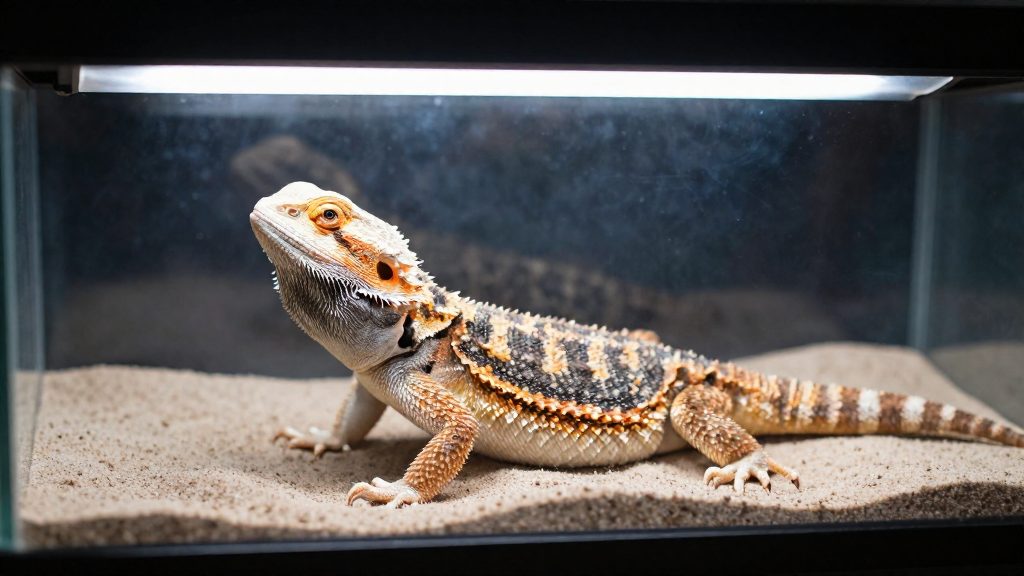
The Phoenix Herpetological Society recommends a 120-gallon enclosure measuring 48” x 24” x 24” for an adult bearded dragon. For juveniles, the same guide says the animal can start in a 40-gallon tank. Enclosure size should follow the animal’s body size at each life stage, so the tank is replaced or upgraded as the dragon grows.
What size enclosure does a bearded dragon need?
| Life stage | Recommended enclosure | Source |
|---|---|---|
| Juvenile (starting size) | 40-gallon tank | Phoenix Herpetological Society, 2026 |
| Adult (minimum) | 120-gallon enclosure, 48” x 24” x 24” | Phoenix Herpetological Society, 2026 |
Adult minimum. The 48” x 24” x 24” footprint gives an adult enough floor length and width to move between a warm basking area and a cooler zone. The guide recommends these dimensions for an adult, so a smaller enclosure falls short of its recommendation.
Juvenile start. The guide does not give juvenile dimensions, so the 40-gallon volume is the only juvenile figure to use when planning the set-up.
Upgrading as the dragon grows. Plan the move to the adult enclosure before the juvenile tank becomes too small. Check the animal’s length and body proportions regularly, and when it reaches the adult size range, transfer it to the 120-gallon enclosure. Keep the same zones and equipment layout when you move it, so the animal does not face a sudden change in its environment.
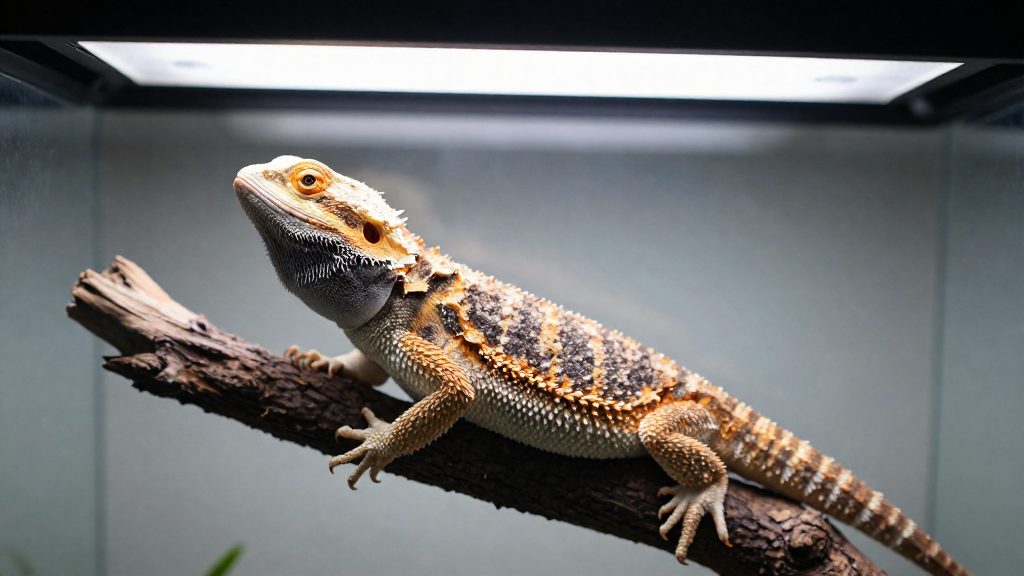
Choosing a safe substrate
The substrate is the floor covering of the enclosure, and for a bearded dragon it has one main safety requirement: it must not be something the lizard can swallow. The Phoenix Herpetological Society (2026) recommends that juvenile bearded dragons be kept on plain, non-particulate surfaces. It advises against calcium sand and other dusty substrates because they can cause impaction, a blockage of the digestive tract.
Juvenile options
The guide’s substrate advice is aimed at juveniles, because swallowed particles can cause impaction. The guide lists three appropriate materials for juveniles:
| Material | Guide recommendation | Practical use |
|---|---|---|
| Newspaper | Recommended for juveniles | Flat, disposable, easy to replace |
| Butcher paper | Recommended for juveniles | Flat, disposable, easy to replace |
| Tile | Recommended for juveniles | Hard, smooth, cleanable surface |
The cleaning and replacement steps described below apply to all three materials.
Calcium sand and dusty substrates
Calcium sand and other fine, dusty materials are excluded for the same reason: a bearded dragon can swallow small particles while catching prey or licking the floor. Once swallowed, particles can accumulate and obstruct the gut. The guide names this specific risk and does not recommend these materials for juveniles. Avoid calcium sand and other dusty substrates, as the guide advises. The guide gives substrate recommendations for juveniles only, so ask a reptile vet about substrate for an adult.
Spot-cleaning and replacement routine
The Phoenix Herpetological Society (2026) guidance does not give a fixed cleaning interval, so the routine should follow the condition of the substrate rather than a calendar:
- Spot-clean droppings, urates and uneaten food as soon as they are seen. Waste left in place soon becomes a bacterial and odour problem.
- Replace the whole substrate layer when paper or tile surfaces become soiled, torn or heavily marked, rather than only removing the top sheet.
- Disinfect the floor surface when the substrate is changed, using a reptile-safe product applied according to its label, and rinse and dry before the lizard returns.
How to set up the basking and cool zones
A bearded dragon needs two distinct temperature zones in its enclosure: a basking spot at the warmest point, and a cool side at the opposite end where it can lower its body temperature. The Phoenix Herpetological Society sets the target surface temperatures below. Night temperatures are not covered in this section.
| Zone | Target surface temperature | Source |
|---|---|---|
| Adult basking spot | 95–105°F | Phoenix Herpetological Society, 2026 |
| Juvenile basking spot | Up to 110°F | Phoenix Herpetological Society, 2026 |
| Cool side | 75–85°F | Phoenix Herpetological Society, 2026 |
Building the gradient
Position the heat source over one end of the enclosure so that the basking surface sits directly beneath it. Keep the opposite end free of direct heat so it stays cooler. The distance between the two ends creates the gradient. The animal moves onto the warm surface to raise its body temperature and back to the cool side to lower it.
Juveniles share the same layout, but the guide allows a higher basking ceiling of up to 110°F. Set the basking zone for the animal’s current age group, and adjust the layout as it grows into the adult range.
Measuring the basking surface
Measure the temperature at the surface where the animal lies, not the air above it.
- Let the heat source run until the reading stabilises.
- Place a digital probe thermometer flat on the basking surface, directly under the heat source.
- Record the reading and compare it with the range for the animal’s age group.
- Repeat the probe reading at the cool side, at the same surface height.
Probe readings are taken at the substrate or décor surface, so the thermometer must be placed on the actual surface the animal will touch.
Do bearded dragons need UVB lighting?
Yes. Fluker’s Farms, a reptile equipment manufacturer, states that UVB lighting is not optional for bearded dragons. The Phoenix Herpetological Society also recommends a UVB 10.0 T5 bulb for the indoor enclosure. Fluker’s Farms links metabolic bone disease (MBD) to inadequate UVB or calcium, so the lamp is a fixed requirement and cannot be replaced by supplements or diet alone.
Sizing and scheduling the lamp comes down to four parameters:
| Parameter | Guidance | Source |
|---|---|---|
| Lamp type | T5 linear, UVB 10.0 rating | Phoenix Herpetological Society (2026); Fluker’s Farms |
| Coverage | About two-thirds of the enclosure length | Fluker’s Farms |
| Daily photoperiod | 12–14 hours of light per day | Fluker’s Farms |
| Replacement interval | Every 6–12 months | Phoenix Herpetological Society (2026); Fluker’s Farms |
To apply the coverage figure, measure the enclosure’s interior length and multiply it by two-thirds. For the 120-gallon adult enclosure in the Phoenix guide (48 inches long), that gives roughly 32 inches of lamp coverage (48 × 2/3). Mount the lamp so that the animal can reach the UVB-exposed zone across that length, without placing the bulb where it is blocked by a screen, a hide or a basking fixture.
Run the lamp on a fixed timer within the 12–14 hour window. Keeping the same start and stop times each day gives the animal a consistent light cycle. Note the install date on the bulb or on the enclosure, since replacement timing counts from that date. UVB output declines over time even when the tube still emits visible light, so a working lamp is not necessarily a UVB-effective one.
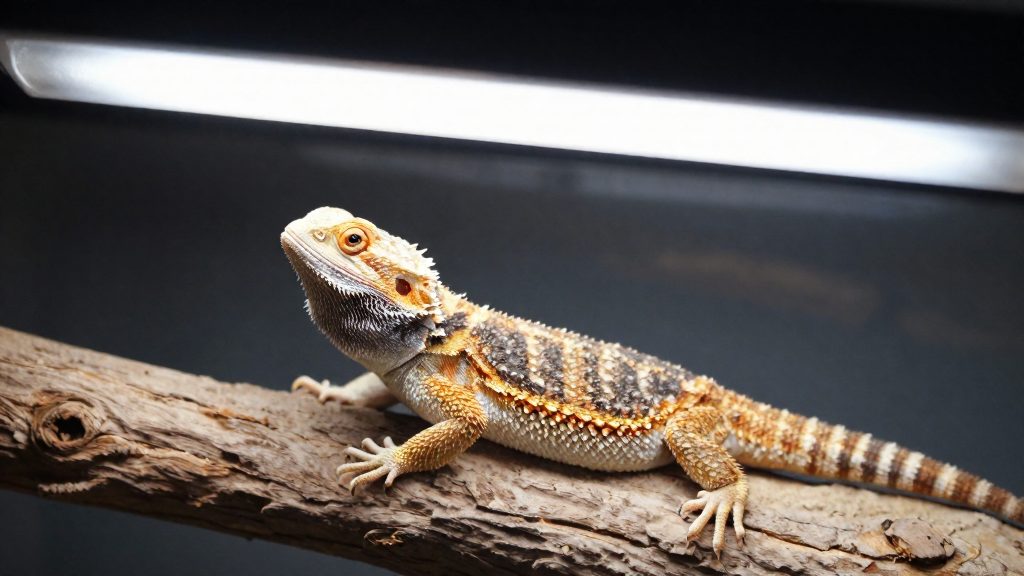
What humidity and night temperatures are right?
For an indoor bearded dragon enclosure, the Phoenix Herpetological Society recommends a relative humidity of 30–40% and night temperatures of 65–75°F (about 18–24°C). Both figures come from the same guide (Phoenix Herpetological Society, 2026), so they can be set and checked together.
| Parameter | Target | Source |
|---|---|---|
| Relative humidity | 30–40% | Phoenix Herpetological Society, 2026 |
| Night temperature | 65–75°F (about 18–24°C) | Phoenix Herpetological Society, 2026 |
Reading relative humidity
Relative humidity is measured with a hygrometer, a device that displays the moisture in the air as a percentage. A digital hygrometer gives a clearer reading than an analogue dial that is hard to read at a glance. Place it at mid-height inside the enclosure, away from the water dish, so the reading reflects the air the animal breathes rather than the water surface. Keep it out of direct heat, since heat lowers the reading and can make the air seem drier than it is.
Holding the range overnight
Night temperatures are the lower end of the daily cycle, so the enclosure should stay within 65–75°F after the lights go off. Check the reading in the evening and again in the morning. A reading outside the range during the night indicates that the heating or room temperature needs adjusting, not that the target itself has changed.
Where the figures stop
The guide sets these targets but does not specify the heating equipment, the room temperature around the enclosure, or how to adjust humidity in practice. Confirm the readings over several days before treating the enclosure as stable, because a single reading only shows conditions at one moment.
Furnishing the habitat
Furniture in a bearded dragon enclosure has two jobs: letting the animal regulate its body temperature by moving between warm and cool areas, and providing surfaces for the climbing and perching it does naturally. Choose each item for stability first. Furniture that tips over or breaks into fragments creates a hazard in a space where the animal can reach every surface.
Hides on both sides
A hide should be available on both ends of the enclosure, not only under the heat source. A hide in the cool zone lets the animal rest without heat, while a hide near the basking area gives it a place to retreat after warming up.
| Position | Purpose | Selection criteria |
|---|---|---|
| Basking-side hide | Retreat after warming up | Low profile, flat stable base |
| Cool-side hide | Rest away from heat | Placed within the cool zone |
Hides should be large enough for the animal to turn around inside and should not be made of thin material that can crack or split.
Climbing branches anchored securely
Branches or platforms give the animal climbing routes and perches at different heights. Choose branches thick enough to hold the animal’s weight without flexing. Secure each one to the enclosure floor or back wall so it cannot shift when the animal climbs. Check ends for splinters, and position branches so they do not lean against the lamp or heat fixture, since contact with a hot surface can cause burns.
Décor without hazards
Décor should have no sharp edges, rough points, or small loose parts that the animal could swallow. Before adding an item, check that:
- Surfaces are smooth and free of broken edges.
-
- Pieces are one solid unit, fixed so they cannot separate, and too large to be swallowed.
- No small items can be pulled off and ingested.
- Decorative pieces are too large to be swallowed whole.
Keep decor simple. Fewer, well-anchored pieces reduce the number of potential hazards and make the enclosure easier to inspect for damage during regular cleaning.
Warning signs to bring to a reptile vet
Metabolic bone disease (MBD) is the condition the Fluker’s Farms guide singles out for owner monitoring. The guide lists three signs to watch for: a soft jaw, tremors and weak limbs. If you notice any of these signs, contact a reptile veterinarian promptly rather than waiting to see whether they resolve. This list covers MBD only and is not a complete list of warning signs. Bring a short written list of when each sign was first seen and how often it recurs, since the vet will ask for it.
MBD signs to report
- Soft jaw: the lower jaw feels pliable rather than firm.
- Tremors: involuntary shaking or trembling in the body or limbs.
- Weak limbs: reduced strength or coordination when the animal moves.
Report each sign separately, even if they appear together. The vet can then assess each one during the examination.
Other symptoms to take to a vet promptly
The data available for this section does not list signs beyond the MBD set, so the points below are general guidance, not sourced thresholds. Sudden changes in alertness, a refusal to move, or a sign that persists rather than passing are reasons to contact a reptile vet without delay. Do not wait for a scheduled appointment in these cases.
Husbandry records to bring to the consultation
Written records give the vet a basis for assessment. Bring the following:
| Record | What to note |
|---|---|
| Enclosure size | Dimensions and volume of the tank |
| Basking surface readings | Date, time and reading taken at the basking surface |
| UVB bulb details | Model, installation date and planned replacement date |
| Light schedule | Hours of daily lighting |
| Humidity readings | Readings and the time of day taken |
| Substrate | Material currently in use |