Set up the apartment before the kitten arrives so that its first hours are spent learning the layout, not discovering hazards on its own. A kitten that comes home to a space you have already checked has fewer unplanned encounters with unfamiliar objects while it is still learning what is safe. Preparation does not need to be exhaustive on day one, but the main pass should be finished before the kitten crosses the threshold.
Why set up before the kitten arrives?
Kittens investigate by climbing, squeezing into gaps, and chewing, so the first days in a new home are when they are most likely to meet objects they cannot assess. The ASPCA states that kittens may chew electrical cords, and that string, rope, yarn, and similar items can lodge in the stomach or intestines and may need emergency surgery (ASPCA, 2019-06-05). Kittens that are still learning a new space may meet these hazards before you notice, which is why preparation should come first.
Exploration pattern in the first days
A newly arrived kitten typically explores in short, repeated bursts and returns to spots that feel secure. Expect it to:
- Test vertical spaces, such as shelves, furniture tops, and gaps behind appliances.
- Investigate by mouth, especially items that move or dangle.
- Retreat to a low, enclosed spot after a period of activity.
Because kittens climb, squeeze into gaps and chew, check the apartment from the kitten’s height, not only from standing eye level.
Timing: before pickup versus after arrival
| Timing | Advantage | Limitation |
|---|---|---|
| Before pickup | The kitten arrives to a settled space, and you can walk through the apartment as the kitten will see it | You do not yet know the kitten’s temperament or activity level |
| After arrival | You can adjust preparation to the kitten’s actual behaviour | The kitten is already exploring, so any gap you missed may be found by accident |
Completing the main preparation before pickup is the safer sequence. Use the first hours after arrival to observe, then refine.
Recognising stress in an unfamiliar environment
A kitten adjusting to a new home may show stress through behaviour changes such as prolonged hiding, refusing food or water, avoiding the litter tray, or sudden changes in grooming. Some of these signs are normal during the first days, but if a kitten stops eating, stops using the litter tray, or appears lethargic, contact a veterinarian rather than waiting to see whether the signs resolve.
Which room works as a safe space?
Choose one small, enclosed room with a door that closes fully as the kitten’s base. Giving a new kitten the whole apartment makes it harder to supervise and to find a kitten that has gone under furniture, and it exposes the animal to more noise and foot traffic than it can handle in the first days. A enclosed room limits the area to explore while the kitten adjusts, and it lets you control who comes and goes. Use the criteria below to pick the room.
| Criterion | What to look for | Why it matters |
|---|---|---|
| Closed door | A solid door that shuts completely | Keeps the kitten contained and allows you to enter and leave without the kitten following |
| Size | A room small enough that you can check every corner quickly | Makes the kitten easier to locate and keeps exploration manageable |
| Quiet | A room away from the front door, kitchen and television | Reduces sudden noises during the settling-in period |
| Easy cleaning | Hard floors or a surface that is simple to wipe down | Makes accidents and spills quicker to clear up |
Once the room is chosen, arrange two types of resting place inside it:
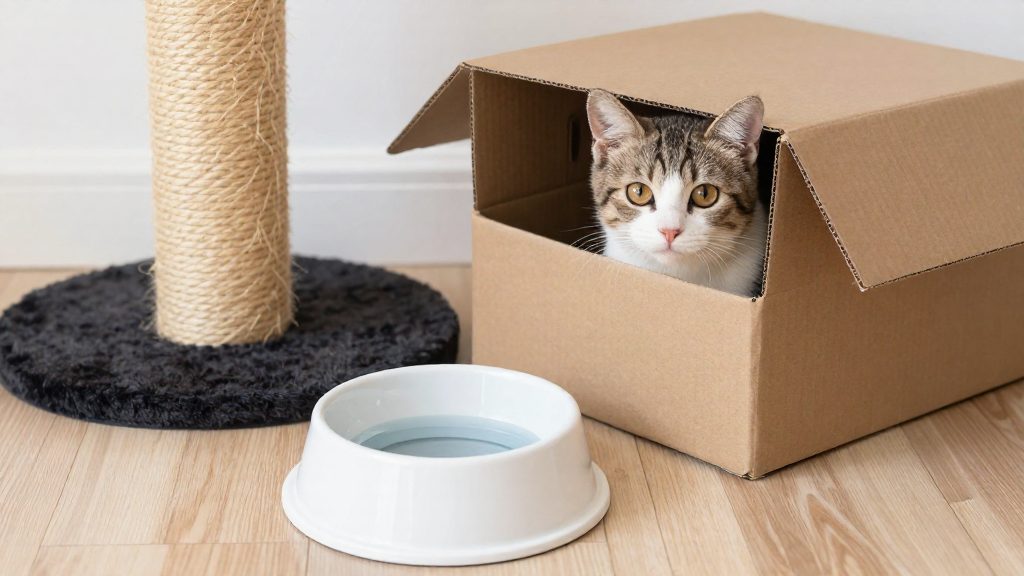
- Hiding spot: Place a covered box or shelter with an opening at floor level. A kitten that feels threatened needs a place to retreat out of sight, and a low hide is the first refuge most kittens will use.
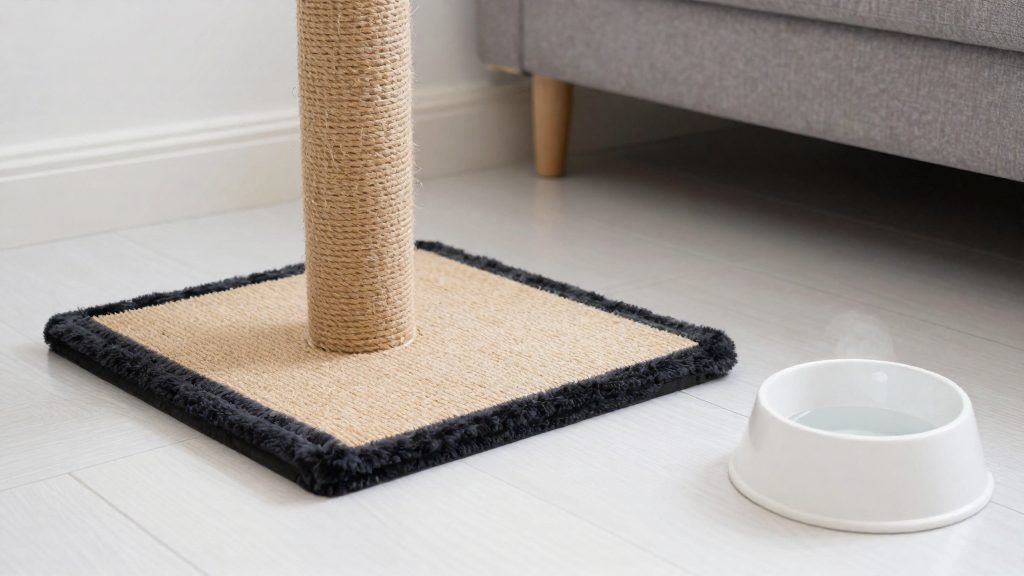
- Vertical resting place: Set a stable perch, such as a shelf or cat tree secured against a wall, where the kitten can look down on the room. Height gives a kitten a view of its surroundings and a spot to rest away from floor-level activity. Check that the structure does not wobble before the kitten uses it.
Position the litter tray away from the feeding and water area, in a quiet corner that is not in the path to the door. Kittens generally avoid soiling close to where they eat and drink, so separating these zones supports clean habits from the start. Keep the tray on a short, clear route from the hiding spot so the kitten can reach it without crossing the room.
What hazards should you remove first?
Before a kitten arrives, clear the objects it can reach on the floor, climb to from furniture, or fit into its mouth. Items at floor height, near a jumping point, or small enough to swallow are the first priorities. Cords, medications, plants and string are covered in their own sections. This pass focuses on four areas: floor-level chemicals, swallowable objects, open windows and balconies, and gaps behind furniture.
Cleaning products and chemicals at floor level
Move detergents, bleach, drain cleaners, pesticides, antifreeze and similar products into a closed cabinet higher than the kitten can reach, or into a cabinet with a child-proof latch. Under-sink cupboards often have gaps a kitten can push through, so check that the door closes fully. Keep products in their original labelled containers, and wipe up spills straight away so the kitten cannot lick residue off the floor.
Small objects a kitten can swallow
Pick up buttons, beads, hair ties, rubber bands, coins, earring backs, bottle caps and small batteries. Check under beds and sofas, and inside open bags, sewing boxes and laundry baskets. Store craft supplies in sealed boxes and keep loose items off low shelves. Discard small plastic pieces from toys and packaging, since a kitten can chew them off and swallow them.
Open windows, balconies and railings
Fit window stops or restrictors so the window cannot open wide enough for a kitten to pass through, and do not rely on screens alone. Keep balcony doors closed when no one is supervising. Check balcony railings for gaps a head or body could pass through, and close them with mesh or netting if needed. Move chairs, planters and tables away from railings and windowsills, because they give a kitten a climbing route. Test window screens for firmness, since a kitten pushing on loose mesh can fall.
Gaps behind furniture and appliances
Sofas, closets, radiators, refrigerators and washing machines often leave spaces where a kitten can wedge itself or become trapped. Block these gaps with boards or covers where possible, or push furniture flush against the wall. Before running a washing machine or dryer, or closing a drawer or door on a cabinet, check that the kitten is not inside. Keep trash can lids closed so the kitten cannot climb in.
Are your houseplants safe for cats?
Not every houseplant carries the same risk. Lilies are the priority case: according to the ASPCA, every part of the plant, including the water it stands in, can cause kidney failure in cats. Check each plant against the ASPCA toxic plant list and either remove toxic ones or keep them out of reach (ASPCA, 2019-06-05).
Lilium species: all parts are toxic
The ASPCA identifies Asiatic, Easter, Stargazer and Oriental lilies as Lilium species that are toxic to cats. For these species, all parts of the plant are toxic (ASPCA, 2022-04-06). Exposure is not limited to eating the plant. The table below lists the three routes the ASPCA describes.
| Exposure route | Risk to a cat | Source |
|---|---|---|
| Eating any part of the plant | All parts of Lilium species are toxic | ASPCA, 2022-04-06 |
| Drinking vase water | Cats can be harmed by drinking the water a lily stands in | ASPCA, 2022-04-06 |
| Grooming pollen off the fur | Pollen that lands on the coat can be ingested during self-grooming | ASPCA, 2022-04-06 |
The grooming route means a kitten can be exposed without ever touching the plant itself, if pollen has transferred to its fur. Keeping lilies out of the home removes all three routes at once.
Non-toxic plants can still cause stomach upset
A plant missing from the toxic list is not automatically safe. The ASPCA notes that even non-toxic plants can upset a kitten’s stomach (ASPCA, 2019-06-05). A plant that poses no poisoning risk can still cause vomiting or digestive discomfort. Placing all houseplants out of reach, not only the toxic ones, is the simplest way to prevent this.

Cords, strings and medications
Electrical cords, string-like objects and loose medications cause some of the most serious indoor injuries in kittens. The steps below are the ones the ASPCA recommends for each risk (ASPCA, 2019-06-05).
Electrical cords
Kittens may chew electrical cords. The ASPCA identifies two injuries from this: mouth burns and fluid in the lungs. Check every cord, including those behind furniture, and use these methods:
- Hide cords out of sight.
- Redirect the kitten to toys when it approaches a cord.
- Use a bite-deterrent spray on cords that cannot be moved.
String, rope, yarn and tinsel
String, rope, yarn, fabric, tinsel and similar items can lodge in a kitten’s stomach or intestines. Removing a lodged item may require emergency surgery, so these items must be kept out of reach at all times, not only during play. Store sewing supplies and gift wrap in closed containers, and dispose of loose strings from packaging immediately after opening.
Medications
Store all medications, both human and pet, in a locked storage cabinet or somewhere out of reach. Kittens may swallow loose pills, and the ASPCA notes that even a small amount can be dangerous because of their size (ASPCA, 2019-06-05). Check the storage area, and recheck it as the kitten grows, since its reach and climbing ability change.
What supplies do you need on day one?
Three functional items should be ready before the kitten arrives: a litter tray, food and water bowls, and a carrier. None of them needs a specific brand to work. What matters is the shape, material and size of each item relative to the kitten’s body, and how easily it can be cleaned. Having them in place on the first day means the kitten has a safe way to eliminate, eat, drink and travel from the start.
Litter tray and litter type
Choose the tray for the kitten’s current size, not its adult size. A tray with high sides is hard for a small kitten to enter.
| Criterion | What to check |
|---|---|
| Entry height | Low enough for the kitten to step in without jumping |
| Floor space | Enough room to turn around and dig |
| Lid | Open trays are easier for young kittens to enter; covered trays need enough interior room to turn around |
| Litter texture | Fine-grained litter is easier for small paws to dig in than large pellets |
| Packaging | Check the label for ingestion warnings, since kittens may swallow litter while digging |
Food and water bowls
- Material: Choose smooth, non-porous surfaces that can be washed thoroughly. Scratched or chipped bowls collect residue and are harder to clean.
- Size: Pick bowls that are wide and shallow enough that the kitten’s whiskers do not brush the sides when it eats or drinks.
- Separation: Use one bowl for food and one for water so each can be cleaned and refilled independently.
Carrier
A carrier serves two purposes: transport and enclosed vet visits. Check these features:
- Size: The kitten should be able to stand up and turn around inside. Choose a size that will still fit as the kitten grows, or plan to replace it.
- Opening: A top-opening door lets you lift the kitten in without pulling it through a narrow front entrance.
- Door security: A door that latches firmly prevents the kitten from pushing it open during transport.
- Cleaning: Removable linings or surfaces that can be wiped down make accidents easier to manage.
When should you call a vet?
Call a veterinarian immediately whenever a kitten may have swallowed, chewed, or been exposed to something harmful. Do not wait to see whether symptoms appear, because waiting can cost critical time. For lily exposure, contact a veterinarian or the ASPCA Animal Poison Control Center at 888-426-4435 immediately. The ASPCA reports that lily kidney injury can often be prevented with aggressive veterinary treatment, but it is frequently fatal if treatment starts more than 18 hours after ingestion (ASPCA, 2022-04-06). This applies if a kitten may have eaten any part of a lily, drunk the water from a lily vase, or had pollen on its fur.
For any other suspected exposure, the ASPCA advises contacting a veterinarian or the ASPCA Animal Poison Control Center at 888-426-4435 right away (ASPCA, 2019-06-05). Before you call, note the following so the clinician can act quickly:
- The substance, including its name or packaging if you have it
- Approximately when the kitten was exposed
- The kitten’s age and weight
- Any change in behaviour since the exposure
| Situation | Action | Contact |
|---|---|---|
| Suspected lily exposure (any part, vase water, or pollen on fur) | Call immediately; lily kidney injury is frequently fatal if treatment starts more than 18 hours after ingestion | Your veterinarian or the ASPCA Animal Poison Control Center, 888-426-4435 |
| Suspected exposure to another dangerous substance | Call immediately | ASPCA Animal Poison Control Center, 888-426-4435, or your veterinarian |
| Kitten stops eating, stops using the litter tray, or appears lethargic | Contact a veterinarian rather than waiting to see whether the signs resolve | Your veterinarian |
Look up the nearest 24-hour emergency veterinary clinic now, and save its number and the ASPCA Animal Poison Control Center number in your phone before the kitten arrives.
Frequently asked questions
Which household items should I secure first before a kitten arrives?
Thread-like items such as string, rope, yarn, fabric, and tinsel can lodge in a kitten’s stomach or intestines and may need emergency surgery (ASPCA, 2019-06-05). Put these items in closed drawers or out of reach before pickup.
Are lilies really dangerous to kittens, and what should I do if one may have touched a lily?
All parts of Lilium species (Asiatic, Easter, Stargazer, Oriental) are toxic to cats, and drinking vase water or grooming pollen off the fur can also cause harm (ASPCA, 2022-04-06). Lily kidney injury is frequently fatal if treatment starts more than 18 hours after ingestion, so contact a veterinarian or the ASPCA Animal Poison Control Center at 888-426-4435 immediately for any suspected exposure (ASPCA, 2022-04-06; ASPCA, 2019-06-05).
Do I need to lock away medications if the kitten is only going to be in one room?
Yes. Store all medications in a locked cabinet or out of reach, because kittens may swallow loose pills and even a small amount can be dangerous given their size (ASPCA, 2019-06-05). Limiting a kitten to one room does not remove this risk, since a dropped pill can reach any space the kitten enters.