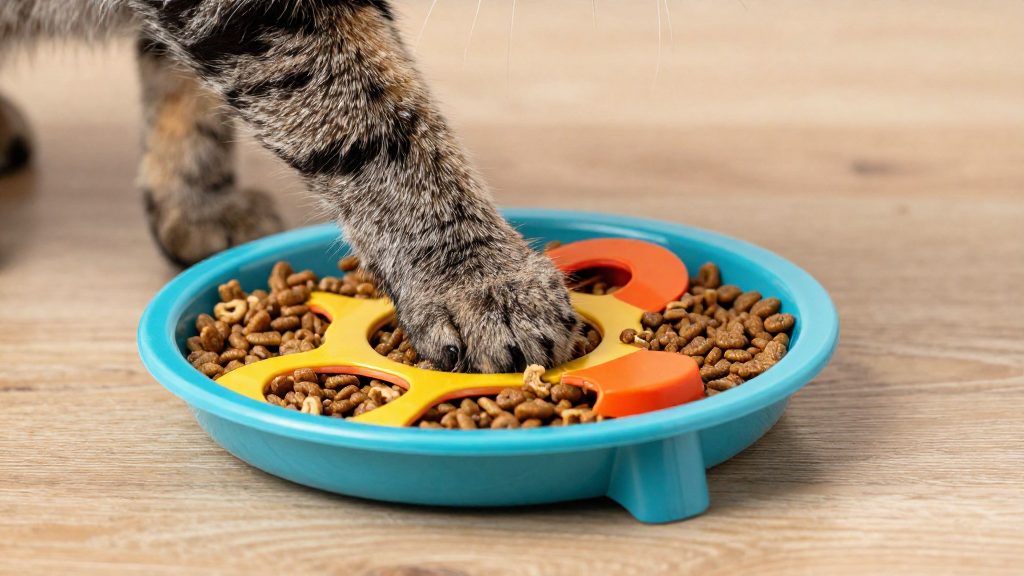
Indoor cats need deliberate stimulation at mealtime because the routine that structured a cat’s feeding day is largely absent in a home. Texas A&M College of Veterinary Medicine & Biomedical Sciences (published 2026-04-16) notes that indoor cats rarely hunt for food, roam, or eat small meals. Structured feeding enrichment restores some of the effort and movement that indoor life removes.
Why do indoor cats need food puzzles?
Feeding patterns that indoor life removes
Outdoors, food is obtained through effort. The source identifies three patterns that indoor cats often lose:
- Hunting: searching for, stalking, and catching food instead of finding it in a bowl.
- Roaming: moving across an area, which combines food-seeking with exploration.
- Small meals: eating several small portions across the day instead of one or two set servings.
| Pattern | Typical indoor routine | What a food puzzle restores |
|---|---|---|
| Hunting | Food is placed in a bowl and is immediately available | The cat must work to access each portion |
| Roaming | Food stays in one fixed spot | Feeding requires movement to a different location or position |
| Small meals | Scheduled servings, often at two or three set times | Portions are released gradually across a session |
Signs of under-stimulation
Under-stimulation shows up as behaviour that is directed at the wrong target:
- Chewing household items such as cords, plants, or packaging.
- Eliminating outside the litter box.
- Excessive scratching of furniture or other surfaces.
These signs indicate that the daily routine may not be meeting the cat’s needs. They are not a diagnosis. A sudden change in litter-box use, or litter-box avoidance that continues, warrants a veterinary examination to rule out medical causes before behaviour is treated as the only explanation. Straining in the litter box or passing little or no urine is an emergency: contact a vet or emergency clinic immediately, without waiting for the next day or for the cat to improve.
Deliberate stimulation compared with outdoor roaming
A free-roaming outdoor cat receives stimulation incidentally, because searching, moving, and eating small amounts happen throughout its day without planning. An indoor cat receives none of this by default, so the owner must design it. The practical approach has three steps:
- Identify which of the three patterns is missing from the current routine.
- Choose a feeding method that requires effort for that pattern, such as a puzzle feeder for dry or wet food, as listed by Texas A&M.
- Divide the daily food allowance into several sessions instead of a single bowl fill, which better approximates small meals.
Start with simple DIY puzzle feeder ideas
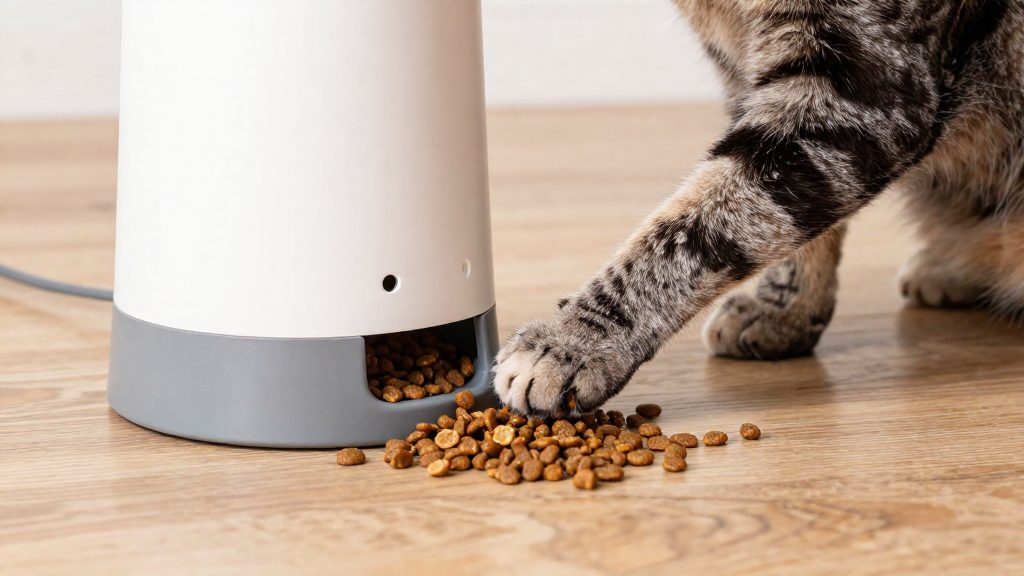
Three low-cost setups let you test whether a cat will work for food before you buy a commercial puzzle. Texas A&M College of Veterinary Medicine & Biomedical Sciences lists treats wrapped in a small towel as a homemade search game; the container and scatter setups are general suggestions not taken from that source. Each method below asks the cat to use its nose, paws and attention to reach a meal, instead of eating it from a single bowl in seconds. Begin with the simplest version and make it harder only once the cat eats readily from it.
| Method | What you set up | What the cat does |
|---|---|---|
| Towel-wrapped treats | A few treats folded inside a small towel | Pulls and unwraps the fabric to reach each treat |
| Container feeder | Kibble in a shallow container with a few loose pieces hidden under or between smaller bowls | Sniffs, paws and tips the containers to find the food |
| Flat-surface scatter | Dry food spread over a flat, easy-to-clean tray or mat | Searches the surface and picks up pieces one by one |
Towel-wrapped treats as a search game
Place a few treats in the centre of a small towel, fold the edges over, and set the bundle on the floor in front of the cat. Let the cat unwrap the towel to reach the food. This is the homemade search game that Texas A&M names as a mealtime option. Because the cat must pull and shake the fabric, each treat arrives after a short sequence of actions rather than immediately. Use a small towel so the task stays simple enough for a first attempt.
Building a simple feeder from containers and bowls
Use two or more containers, such as a wide bowl and a few smaller cups or bowls. Put a small portion of kibble in the wide bowl, then place the smaller containers around it with a few pieces of food in some of them. The cat must move the containers or investigate each one to find the food. Keep the layout open enough that the cat can reach every piece without squeezing into a tight space.
Scattering kibble on a flat surface for beginners
This is the most basic option and suits cats that have never worked for food. Spread a measured portion of dry food across a flat tray or mat, leaving the pieces separated so the cat has to move from one to the next. Start with a small area and a few pieces, then increase the spread over several sessions. If a cat gives up or ignores the food, reduce the difficulty and try again later.
Are lick mats and treat hunts good puzzle feeders?
Silicone lick mats and treat hunts are two mealtime enrichment ideas that Texas A&M’s College of Veterinary Medicine & Biomedical Sciences lists for indoor cats. They suit different food types, so the choice depends on what you are serving.
Silicone lick mats: wet food and soft treats
The source matches silicone lick mats to wet food or soft treats. The cat works the food off a textured surface with its tongue, so the tool is designed for food that can be spread and licked. The source does not list dry kibble for lick mats, so keep dry food out of this tool.
Treat hunts: around the house or in one room
A treat hunt hides treats around the house or within a single room, and the cat searches for each one. A single room keeps the search small and easier to supervise, while the whole house offers more movement. The source describes the hunt in terms of treats and does not specify a food form.
Dry food versus wet food by tool
| Tool | Food types named in the source | Notes |
|---|---|---|
| Silicone lick mat | Wet food, soft treats | Dry food is not named for this tool |
| Treat hunt (house or one room) | Treats | The source does not name dry or wet food |
The source names dry food only for puzzle feeders, which are covered separately. For a dry-food diet, the source names puzzle feeders; a treat hunt uses treats and does not replace the full meal.
How do you introduce a puzzle feeder?
Use a gradual introduction that starts with the easiest possible setup. Texas A&M College of Veterinary Medicine & Biomedical Sciences (published 2026-04-16) notes that some cats find having to work for food frustrating at first, so the early sessions should make success quick. Keep the cat’s usual food, portion and mealtime, and change only the challenge. Puzzle feeders suit both dry and wet food, so start with whichever the cat already eats.
Start with an easy, accessible setting
Begin with the device in its simplest form: food exposed or near the openings, few obstacles, and a shallow layout. Let the cat solve it without help before making anything harder. Increase difficulty in small steps, and only after the cat is reliably getting food out on its own.
| Stage | Setup | Move on when |
|---|---|---|
| 1 | Food exposed near the openings | The cat eats from the device without stalling |
| 2 | Food partly covered | The cat retrieves food without abandoning the device |
| 3 | Full puzzle setting | The cat completes the sequence at its own pace |
Use short sessions at first. Observe the cat’s behaviour rather than timing it, and stay at a stage until the cat handles it calmly.
Recognizing frustration
Frustration signs indicate that the challenge is too high for the current stage. Watch for pawing at the device and then walking away, vocalizing near the feeder, knocking it over repeatedly, or sitting beside it without trying. Return to the previous stage when these appear, and do not force the cat to finish. A cat that stops eating altogether, or eats far less than usual, needs a veterinary check rather than more practice with the device.
Use wide, open bowls to protect whiskers
Serve food in wide, open bowls so the whiskers stay off the food. According to the same Texas A&M article, this may also reduce whisker fatigue, a term for discomfort caused by whiskers repeatedly brushing against the sides of a dish. Choose shallow, wide dishes for any bowl placed beside or within the puzzle routine, and avoid deep, narrow containers that force the face against the walls. If a cat eats cautiously, drops food, or backs away from its bowl, check the dish shape first and mention the change to a veterinarian if it persists.
Are puzzle feeders safe?
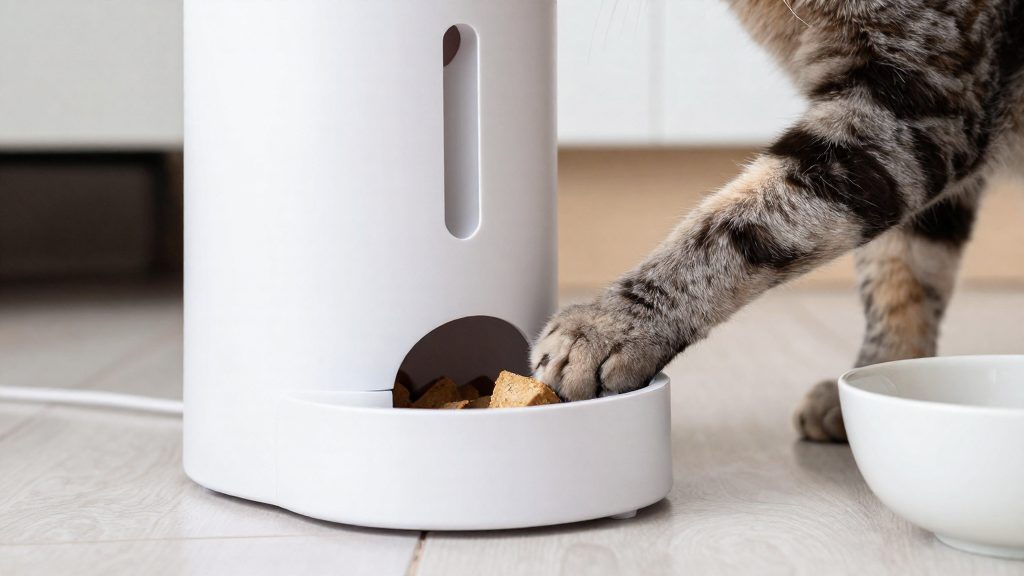
Puzzle feeders are safer when the cat can reach only the food and not loose parts or harmful materials, but the checks below reduce the risk rather than remove it. Texas A&M College of Veterinary Medicine & Biomedical Sciences (published 2026-04-16) gives four checks: avoid puzzles with small swallowable parts, inspect homemade items for broken pieces, confirm the product has no toxic coating or paint, and clean the puzzle after each use. Each check covers a different hazard, so a feeder that passes one can still fail another.
| Check | What to look for | Action |
|---|---|---|
| Small swallowable parts | Removable or loose components small enough to swallow | Choose a different puzzle |
| Broken pieces (homemade items) | Cracks, splits, or detached parts | Inspect regularly and stop using a damaged item |
| Toxic coating or paint | Painted or coated surfaces the cat can chew or lick | Confirm no toxic coating or paint before use |
| Food residue | Leftover food in compartments or grooves | Clean after each use |
Physical hazards
Homemade puzzles need the most attention because their construction varies. Build-ups of glue, tape, or thin parts can break over time, so check them on a fixed schedule rather than only at setup. A piece that comes loose is a swallowing risk regardless of how well the rest of the puzzle was made.
Materials and hygiene
Materials matter as much as design. A product with a toxic coating or paint is unsafe even if its shape is sound, so verify the materials before offering it. Cleaning is the second half of the routine: the Texas A&M guidance calls for cleaning puzzles after each use, which removes leftover food and keeps the feeder ready for the next session.
Can puzzle feeders help with weight?
Puzzle feeders can add activity to meals, which matters because inactivity can lead to weight gain, but they do not reduce calories on their own. Ask your vet how much your cat should eat daily. The Texas A&M College of Veterinary Medicine & Biomedical Sciences (dated 2026-04-16) states that inactivity can lead to weight gain and reduced mobility. Puzzle feeding counters inactivity by making the cat work for part of its food.
How puzzle feeding changes the meal
| Feeding pattern | Single bowl, filled at once | Puzzle feeder |
|---|---|---|
| Access to food | Immediate | Requires manipulation before food is released |
| Meal structure | One quick portion | Food is spread across a longer, more active session |
| Physical activity | Eating in place | The cat moves and problem-solves to reach the food |
The source describes these benefits as enrichment. It does not quantify how many calories a puzzle session burns, so this section makes no calorie claim.
Adjusting the daily ration
A puzzle only supports weight management if the total intake stays controlled. The daily total is the figure to track, not the size of the puzzle portion.
- Record the full daily food amount, including treats, before introducing a puzzle.
- Move part of that amount into the puzzle instead of adding it on top.
- Reduce the regular bowl portion by the same amount, so the day’s total stays the same.
- Recheck the total whenever treats or puzzle contents change.
Overweight prevalence
Overweight prevalence in cats is often quoted from a 2022 U.S. survey, cited in the source as 61%. That figure is a secondary citation, so it is not used here until it is checked against the original survey.
When should you talk to your vet?
Most puzzle-feeder problems are behavioural and can be fixed by adjusting the toy, the bowl, or the feeding routine. Some signs mean the cat needs a veterinary assessment, and waiting can make a problem worse. Contact your vet if a cat may have swallowed a part, if behaviour changes continue after you have added enrichment, or if the cat stops eating after a puzzle is introduced.
Signs a cat may have swallowed a puzzle part
If you suspect a cat has swallowed a piece, contact your vet or an emergency clinic right away, even if the cat seems normal, and do not try to make the cat vomit unless a vet tells you to. Signs that make it more urgent include:
- Vomiting, gagging, or repeated attempts to swallow
- Drooling or pawing at the mouth
- Reduced appetite or hiding
- Changes in stool, or no stool passed
Remove the puzzle from reach while you arrange care, and bring the piece or the puzzle to the appointment if you have it.
Behaviour changes that persist despite enrichment
If chewing, litter-box avoidance, or scratching continues after you have added more play, varied meal presentation, or treat hunts, the cause may be medical rather than environmental. A vet can check for pain, urinary problems, or other conditions before you adjust the environment further.
Appetite loss after puzzle introduction
If the cat stops eating or eats far less than usual after a puzzle is introduced, contact a vet promptly rather than waiting for the appetite to return. A cat that stops eating can develop health problems quickly, so do not wait to see whether the appetite returns.
Frequently asked questions
Are puzzle feeders safe for my cat?
Puzzle feeders carry risks that the checks from Texas A&M College of Veterinary Medicine & Biomedical Sciences (2026-04-16) reduce but do not remove, so supervised use matters even with a well-chosen product. If you suspect your cat has swallowed a piece, contact a vet or emergency clinic immediately, even if the cat seems normal, and do not wait for symptoms to appear.
My cat is new to puzzles and seems frustrated. What should I do?
Some cats find having to work for food frustrating at first, so begin with the simplest setup, such as a treat hunt in one room, and make the task harder only after the cat engages with it (Texas A&M College of Veterinary Medicine & Biomedical Sciences, 2026-04-16). Use a gradual introduction, and if the cat stops eating or eats far less than usual, contact a vet promptly rather than waiting.
Can a puzzle feeder help my cat lose weight?
A puzzle feeder can add movement to mealtimes, and inactivity is linked to weight gain in the same Texas A&M source, but the feeder does not reduce calories on its own. Weight is controlled through the total daily intake, so ask your vet how much your cat should eat each day before changing portions.