Why is hay the base of a rabbit’s diet?
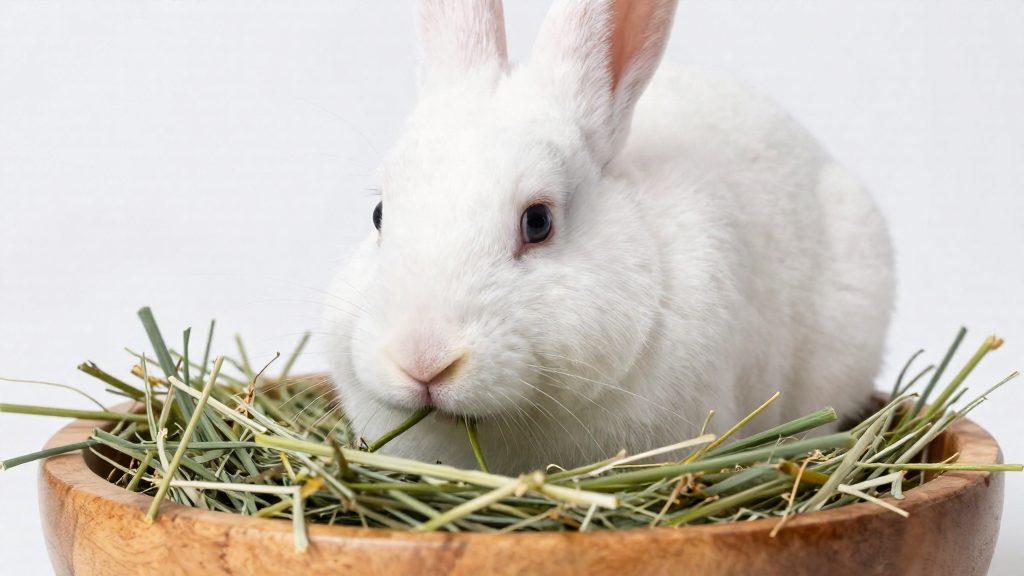
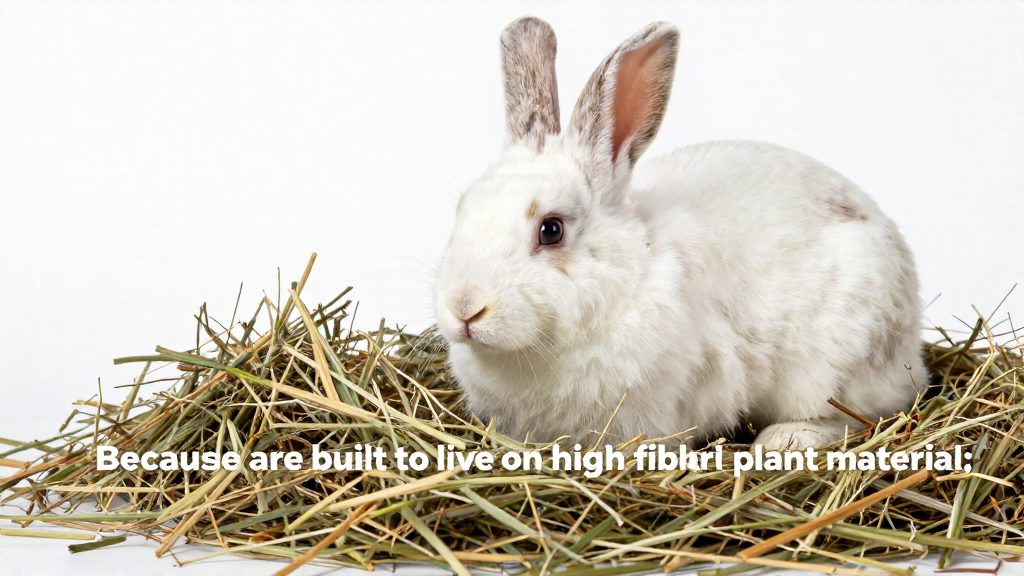
Hay is the base of a rabbit’s diet because its fibre does three jobs that pellets and vegetables cannot do as reliably: it keeps the gut moving, it wears down the continuously growing teeth, and it feeds the microbes in the caecum that break down plant material. Rabbits are herbivores with a digestive system built around a steady supply of long-stemmed roughage. The official sources consulted do not give quantified figures for these mechanisms, so this section describes them qualitatively.
How fibre supports gut motility
Fibre adds bulk and structure to the digestive tract. Long, coarse stems require sustained chewing, and the material they produce moves through the intestines in a way that supports regular gut motility. A rabbit that eats little hay has less material to stimulate this movement.
Why continuous tooth wear depends on chewing
A rabbit’s incisors and cheek teeth grow throughout life. Chewing fibrous material is the mechanism that grinds them down evenly. Soft foods do not produce the same sustained grinding, so a diet dominated by them allows the teeth to overgrow over time.
Watch for difficulty chewing, drooling, dropping food from the mouth, or weight loss. These can indicate dental problems, and a vet should examine the rabbit.
Caecal fermentation and gut balance
The caecum is a large fermentation chamber located after the stomach and small intestine. Rabbits are hindgut fermenters, so microbes in the caecum break down fibre that the rabbit cannot digest on its own. The microbial community that performs this work depends on a consistent intake of fibre.
Abrupt diet changes can upset this microbial balance. Diarrhea, bloating, or abnormal droppings are signs of digestive disturbance.
| Function | What the fibre does | Warning signs |
|---|---|---|
| Gut motility | Adds bulk and requires sustained chewing | Reduced appetite, fewer droppings |
| Tooth wear | Grinds continuously growing teeth | Difficulty chewing, drooling, weight loss |
| Caecal fermentation | Supplies material for microbes that digest plant fibre | Diarrhoea, bloating, abnormal droppings |
How much of the diet should be hay?
For an adult rabbit, hay should make up about 95% of the daily diet, according to Pets.ca (2026), a Canadian pet publisher. Pets.ca does not state whether this share is measured by weight or by volume, so use it as a general guide to the proportions of the diet. Hay is the bulk of the diet, and all other foods fill the remaining slice.
| Food group | Share of adult daily diet | Source |
|---|---|---|
| Hay | About 95% | Pets.ca (2026) |
| Vegetables and pellets combined | About 5%, shared between the two | Pets.ca (2026) |
The 5% is a combined allowance. Vegetables and pellets share the remaining slice, so giving more of one leaves less room for the other. The Pets.ca source does not state a fixed split between the two, so the division should not be set from that source alone.
To check the ratio against other foods, judge each meal by what the rabbit actually eats:
- Look at the bowl as a whole. Hay should be the largest part of it.
- If the greens or pellets look as large as the hay, the proportions have moved away from the 95% target.
- Recheck the ratio whenever a new food is added, because each addition draws from the same 5% slice.
How many pellets does a pet rabbit need?
For a pet rabbit under 5 lb (about 2.3 kg), Pets.ca (2026) suggests about 1/8 cup of pellets per day. Pets.ca treats pellets as a food to be limited, so this figure is a measured portion within a hay-based diet, not a daily serving that can be refilled freely. The guidance does not give an amount for rabbits of 5 lb or more, so owners of larger rabbits have no quantity to work from in this source.
Pellet guidance by body weight
| Rabbit body weight | Daily pellet amount (Pets.ca, 2026) |
|---|---|
| Under 5 lb (about 2.3 kg) | About 1/8 cup per day |
| 5 lb (about 2.3 kg) and above | Not specified in the Pets.ca guidance |
What a pellet limit means in practice
- Measure the portion with a measuring cup rather than filling a bowl by eye, so the amount stays close to the stated figure.
- Treat the 1/8 cup figure as the amount Pets.ca suggests for an under-5 lb rabbit, and measure it rather than estimating by eye.
- Keep the pellet portion separate from hay.
The gap for heavier rabbits
Because Pets.ca does not state a pellet amount for rabbits of 5 lb or more, the 1/8 cup figure should not be scaled up by weight. Owners of larger rabbits should ask a veterinarian to set a portion for their individual animal.
What about vegetables and treats?
Fresh produce and sweet items need to be chosen and measured with care.
Introducing new vegetables one at a time is the most practical method. Offer one new vegetable, observe your rabbit, and add a different one only after the first has been tolerated. This makes it possible to link a change in appetite or droppings to a specific food. The official sources consulted do not specify how many days to wait between introductions, so base the pace on your rabbit’s response rather than a fixed schedule.
Fruit and sugary items belong in the treat category, not in the daily base of the diet. Offer fruit in small portions and only occasionally.
For foods to avoid, the sources consulted do not provide a complete list of toxic or unsuitable items. Before offering anything unfamiliar, check it with a veterinarian or a recognised veterinary body in your country. Do not substitute human snacks or processed foods for hay or fresh vegetables.
Choosing hay and pellets
Choosing hay and pellets means checking the product itself: the grass species, the label, and the condition of the bag. The official sources consulted do not specify preferred hay species or pellet formulas, so the checks below are practical steps you can carry out at any shop.
Grass hay: Timothy and other grasses
Timothy is a common grass hay sold for rabbits. Meadow hay is a mix of grasses cut from pasture, so its composition varies from bag to bag. Check the species named on the bag and compare the two before buying.
| Check | What to look for |
|---|---|
| Species named | Timothy, meadow, or another named grass, not just “natural hay” |
| Strand length | Long, stiff stems that a rabbit can chew, not chopped or powdery material |
| Mix | A single named grass gives a predictable product; a mix can vary between batches |
Reading a pellet label
Pellet labels list a guaranteed analysis, including fibre and protein percentages. Compare these figures between products. The official sources consulted do not give target values, so ask a veterinarian which figures suit your rabbit’s age and weight. Also check the ingredient list: pellets should be a uniform product, not a mix that includes seeds, dried fruit or coloured pieces that a rabbit may pick out.
Freshness, colour and dust
Fresh hay is green or golden, with a sweet, grassy smell. Reject any bag with a musty smell, damp patches, dark or mouldy spots, or a visible cloud of dust when shaken. For pellets, check the best-before date and discard any that are crumbled or damp. Store both in a dry, closed container away from moisture.
Feeding changes for young or older rabbits
Feeding a pet rabbit at different life stages means adjusting the balance of hay, pellets and vegetables, not keeping one fixed routine. For young and senior pet rabbits, the official sources consulted do not specify quantities by age, so changes should be checked against the animal’s body condition.
Young rabbits and weaning-stage changes
A young pet rabbit is still moving from milk to solid food. The sources consulted do not specify a weaning age or a day-by-day diet schedule. If the rabbit refuses a food or its droppings change, revert to the previous food and keep the new item out of the diet until the rabbit’s condition is stable.
Senior rabbits: dental and weight monitoring
Older pet rabbits need regular checks more than new feeding rules. The sources consulted do not give age thresholds for adjusting food, so the adjustment is based on what the owner observes:
| Monitoring item | What to record | Why it matters for diet |
|---|---|---|
| Body weight | Weight on the same scale at regular intervals | Shows whether current food amounts still fit the animal |
| Chewing | Speed of eating and whether hay is fully eaten | Changes in chewing can point to dental monitoring needs and affect what the rabbit can eat |
| Droppings | Size, shape and regularity | Reflects how much fibre is being digested |
A sustained change in weight or chewing is a reason to review the diet with a veterinarian rather than to change amounts alone.
Transition between junior and adult diets
The official sources consulted do not specify the age at which a pet rabbit moves from a junior to an adult diet. The transition should instead be timed by the animal’s stability. Move pellet or vegetable amounts only after weight and droppings have stayed steady on the current diet.
When should you call a vet?
A rabbit that eats less, stops producing droppings, or changes its stool pattern may be showing a digestive problem, and these signs need prompt veterinary assessment rather than a wait-and-see approach. Because rabbits depend on continuous gut movement, a feeding problem can become serious quickly. The signs below are the feeding-related changes to act on, and the official sources consulted do not specify exact time thresholds for when each one becomes an emergency, so the safest rule is to contact a vet as soon as a change is noticed.
Reduced appetite and stopped droppings
Eating less, or refusing hay, is the most important warning sign in feeding. Check the rabbit’s behaviour alongside appetite:
- Reduced appetite: the rabbit leaves hay or pellets untouched, or eats only treats.
- Fewer or no droppings: the rabbit produces little or no faeces, which can point to a slowdown in gut movement.
- Lethargy or hunched posture: the rabbit sits still, grinds its teeth, or appears uncomfortable.
Changes in stool size, shape, or frequency
Normal droppings are firm, round, and fairly uniform, and a rabbit normally produces them regularly throughout the day. Compare what you see against the rabbit’s usual pattern.
| Observation | Why it matters | Action |
|---|---|---|
| Smaller or fewer droppings than usual | Possible slowdown in gut movement | Contact a vet promptly |
| Misshapen, irregular, or very soft droppings | Possible change in digestion or diet tolerance | Contact a vet promptly and note recent food changes |
| Mucus-coated droppings | Possible irritation of the digestive tract | Contact a vet promptly |
| Diarrhoea or wet fur around the bottom | Possible digestive upset | Contact a vet promptly |
When to contact a vet about diet concerns
Prepare a short record before the appointment, because the vet will ask about what the rabbit eats. Note:
- Which hay, pellets, and vegetables the rabbit receives, and roughly how much of each.
- Any recent change in food brand, type, or amount.
- How long the appetite or stool change has been present.
- Whether the rabbit is drinking normally.