Some fruits and vegetables harm dogs for two different reasons: they contain plant compounds that are toxic, or their structure (pits, cores, seeds, cobs) can physically block or injure the digestive tract. The hazard depends on the species and the part of the plant eaten, so the flesh of a food may be harmless while its pit or stem is not. Individual dogs also vary in how they respond, so no single food can be assumed safe for every animal.
Why are some fruits and vegetables dangerous for dogs?
Toxic compounds depend on species and plant part
Toxicity is not uniform across a plant. The same fruit can be safe as flesh and harmful as a pit or stem, and some vegetables are hazardous only in certain forms or stages.
| Food | Part or form of concern | Hazard listed by source |
|---|---|---|
| Cherry | Pits and stems | Cyanide (Hartz Mountain Corporation, Canada site, 2026) |
| Onion and garlic | Raw, in all forms | Raw forms are the most dangerous (Hartz Mountain Corporation, 2026); onions in all forms, including leeks and chives, are on the avoid list (The Vet Desk, 2025) |
| Tomato | Unripe or green parts | Listed as a food to avoid (The Vet Desk, 2025) |
| Tomato | General | Solanine (Hartz Mountain Corporation, 2026) |
Avocado, mushrooms and rhubarb also appear on The Vet Desk’s avoid list (2025), but the official sources consulted do not specify their compounds or affected parts in the material reviewed.
Physical hazards from pits, cores and seeds
Some dangers are mechanical rather than chemical. Pits, cores, seeds and rinds can be swallowed whole and lodge in the gut. Corn on the cob is flagged by Hartz Mountain Corporation (2026) for the risk of intestinal blockage, a hazard that comes from the cob’s size and shape rather than from any compound it contains.
Why individual dogs react differently
Reactions vary between animals, and health status is one documented factor. The Vet Desk (2025) states that dogs with diabetes or pancreatitis should only eat what their vet recommends. The official sources consulted do not specify weight, breed or age thresholds for these foods, so no reliable general safe quantity can be derived. When a dog has a known condition or eats a pit, stem or cob, contact a veterinarian promptly rather than relying on general guidance.
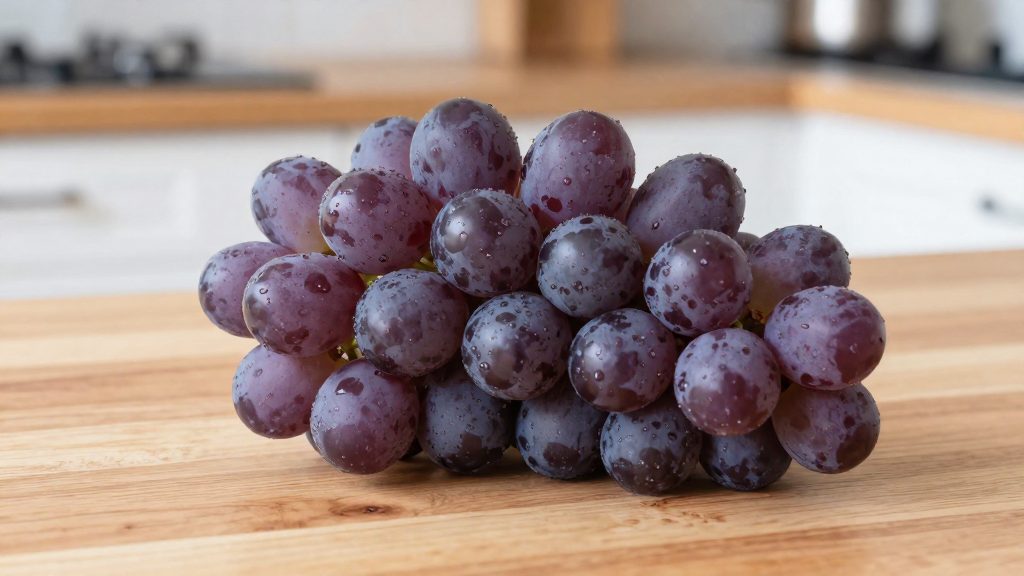
Which fruits are safe for dogs?
Veterinary guidance sorts common fruits for dogs into two groups: fruits listed as fine in small amounts, and fruits listed as acceptable only in moderation. The Vet Desk (2025-10-29), a page reviewed by Dr. Maja Platisa, DVM MRCVS, places green-list fruits of apples, blueberries, peaches, pears and watermelon in the first group, and bananas, cantaloupe, cranberries and strawberries in the second, labelled moderation-only fruits. A Canadian site run by a pet-food manufacturer (Hartz Mountain Corporation, 2026) reaches a similar view for apples, blueberries, watermelon, strawberries and bananas. Because that source is a commercial publisher rather than a veterinary body, the veterinary classification is the one to follow.
| Fruit | Group | Listed by |
|---|---|---|
| Apples | Green list (small amounts) | The Vet Desk (2025-10-29); Hartz Mountain Corporation (2026) |
| Blueberries | Green list (small amounts) | The Vet Desk (2025-10-29); Hartz Mountain Corporation (2026) |
| Peaches | Green list (small amounts) | The Vet Desk (2025-10-29) |
| Pears | Green list (small amounts) | The Vet Desk (2025-10-29) |
| Watermelon | Green list (small amounts) | The Vet Desk (2025-10-29); Hartz Mountain Corporation (2026) |
| Bananas | Moderation only | The Vet Desk (2025-10-29); Hartz Mountain Corporation (2026) |
| Cantaloupe | Moderation only | The Vet Desk (2025-10-29) |
| Cranberries | Moderation only | The Vet Desk (2025-10-29) |
| Strawberries | Moderation only | The Vet Desk (2025-10-29); Hartz Mountain Corporation (2026) |
Green-list fruits
Apples, blueberries, peaches, pears and watermelon are the fruits with the most consistent positive classification in the sources consulted. The Vet Desk treats each of them as fine when given in small amounts, and the Hartz list also names apples, blueberries and watermelon. Being on the green list does not mean a dog can eat unlimited quantities. The amount a dog should receive is covered in a separate section.
Moderation-only fruits
Bananas, cantaloupe, cranberries and strawberries are the fruits the veterinary list places on the moderation-only side. Bananas and strawberries also appear in the Hartz list as generally safe in moderation. The consulted Hartz list does not name cantaloupe or cranberries, so the veterinary classification is the only source for those two. For these fruits, offer small pieces occasionally rather than as a regular part of the diet.
Which vegetables can dogs eat?
Vegetables are sorted into two practical groups: a green list of vegetables that The Vet Desk (reviewed by Dr. Maja Platisa, DVM MRCVS, 2025-10-29) lists as fine in small amounts, and a moderation-only group that the same source treats as acceptable only occasionally. Within the moderation-only group, the source lists broccoli, Brussels sprouts, peas, pumpkin and sweet potatoes.
| Group | Vegetables | Status in The Vet Desk (2025-10-29) |
|---|---|---|
| Green list | Carrots, celery, cucumbers, green beans | Listed as fine in small amounts |
| Moderation only | Broccoli, Brussels sprouts, peas | Listed as moderation-only |
| Moderation only, starchy | Pumpkin, sweet potatoes | Listed as moderation-only |
The distinction matters because the green-list vegetables are the ones The Vet Desk lists as fine in small amounts, while the moderation-only vegetables call for more caution. The moderation-only vegetables carry more caution, and the same page places them in the same category as bananas, cantaloupe and strawberries. Hartz Mountain Corporation’s Canadian site (2026) also describes broccoli, celery and cucumbers as generally safe in moderation, which agrees with The Vet Desk’s placement of celery and cucumbers.
Vegetables do not replace a complete diet. The Vet Desk (2025-10-29) states that dogs on a complete, balanced diet do not need extra produce, so any vegetable here is an addition to that food, not a nutritional requirement.
Foods to avoid completely
Dogs should never eat grapes, raisins, onions in any form, avocado, rhubarb, mushrooms, cherry stems or leaves, or unripe and green tomato parts. The veterinary sources consulted agree on this list, but the reasons differ. Grapes and raisins have no established safe amount. Raw garlic and onions are named by Hartz as the most dangerous forms. Cherry stems are flagged for cyanide, and tomatoes for solanine. For avocado, rhubarb and mushrooms, the sources consulted do not specify the toxic mechanism.
Grapes and raisins
No safe amount of grapes or raisins is established for dogs. Cornell University College of Veterinary Medicine (2026) states that the amount that causes harm varies and cannot be predicted, and that a few can be dangerous for some dogs. Raisins are not a lower-risk form. Cornell and The Vet Desk (2025) list them alongside grapes, so a few raisins in trail mix or a baked good count as the same exposure. Hartz Mountain Corporation’s Canadian site (2026) notes that grapes and raisins can cause kidney problems.
Onions, leeks, chives and garlic
The Vet Desk (reviewed by Dr. Maja Platisa, DVM MRCVS, 2025) lists onions in all forms, including leeks and chives. Its wording covers onions in all forms, so no form is listed as an exception. Hartz (2026) names onions and garlic as the most dangerous forms when raw. Garlic appears only in the Hartz source, so the sources consulted do not give a separate garlic rule from The Vet Desk.
Cherry stems and leaves
The Vet Desk lists cherries with their stems and leaves as foods to avoid. Hartz (2026) flags cherry stems for cyanide. Cherry pits are covered in the section on pit and seed hazards.
Unripe and green tomato parts
The Vet Desk lists unripe or green tomato parts. Hartz (2026) links tomatoes to solanine, a compound found in the green parts of the plant. The avoid entry is limited to unripe and green parts.
Avocado, rhubarb and mushrooms
The Vet Desk lists all three as foods to avoid. The official sources consulted do not specify their toxic compounds or the signs they cause in dogs. Treat them as off-limits, and keep whole avocados, rhubarb stalks and mushrooms out of reach, including mushrooms that grow in lawns or planters.
Summary by food
| Food | Listed by | Reason given in sources consulted |
|---|---|---|
| Grapes and raisins | Cornell (2026); The Vet Desk (2025) | No safe amount; kidney problems (Hartz, 2026) |
| Onions, leeks, chives | The Vet Desk (2025) | Raw onion named most dangerous (Hartz, 2026) |
| Raw garlic | Hartz (2026) | Named most dangerous with onion |
| Cherry stems and leaves | The Vet Desk (2025) | Stems flagged for cyanide (Hartz, 2026) |
| Unripe or green tomato parts | The Vet Desk (2025) | Solanine (Hartz, 2026) |
| Avocado, rhubarb, mushrooms | The Vet Desk (2025) | Not specified in sources consulted |
How much produce is too much?
Limit fruit and vegetables by their share of daily calories, not by a fixed weight. Treats, including produce, should stay under 10% of daily calories, according to The Vet Desk (reviewed by Dr. Maja Platisa, DVM MRCVS, 2025-10-29). Within that ceiling, the amount depends on the dog’s energy needs, so the same handful of carrot can be a small or large share for two dogs of different sizes.
The 10% treat allowance
The 10% ceiling is the upper limit for everything given outside the main meals. Count every extra item together: produce, commercial treats, table scraps and chews. Produce that is low in calories, such as cucumber or green beans, uses up only a small part of the allowance. Produce that is higher in calories, such as bananas or sweet potatoes, uses up more. The sources consulted do not give a calorie value per gram for individual fruits or vegetables, so check the calorie figure on the product label or a published nutrition database before weighing portions.
Dogs on complete diets need no extra produce
A dog eating a complete, balanced diet does not need additional fruit or vegetables to meet its nutritional needs. Produce is therefore an optional treat, and the allowance is a maximum, not a daily target. If a dog’s weight is rising, remove produce from the treat total before cutting the main meal.
Converting the calorie share into portions
| Step | Action |
|---|---|
| 1 | Ask your vet for your dog’s daily calorie requirement. |
| 2 | Calculate the treat ceiling: daily calorie requirement x 0.10. |
| 3 | Subtract the calories of any other treats given that day. |
| 4 | Divide the remaining calories by the calories per gram of the produce, taken from the label or a nutrition database. |
| 5 | Serve that weight in small, cut pieces. |
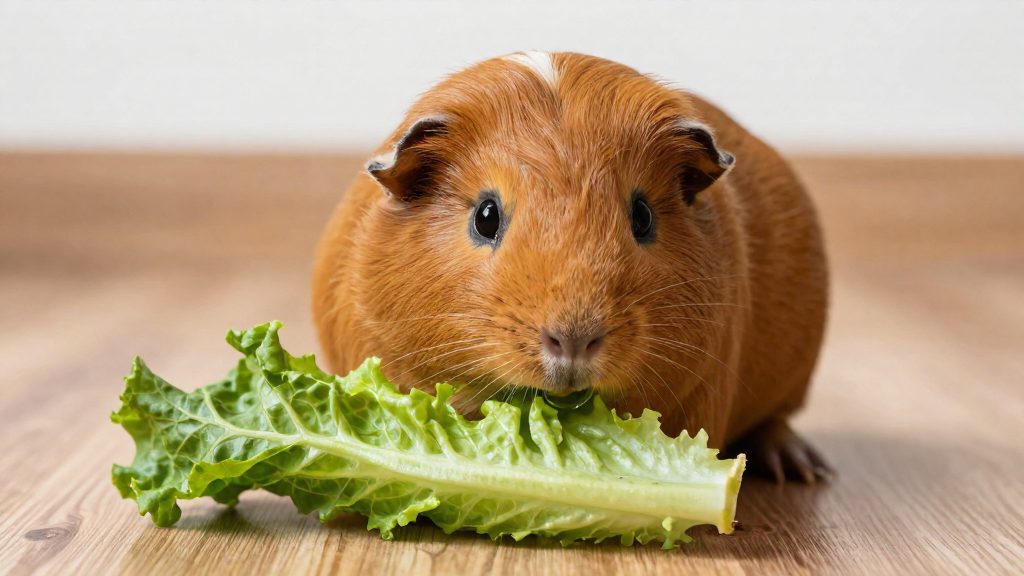
How should you prepare fruits and vegetables for dogs?
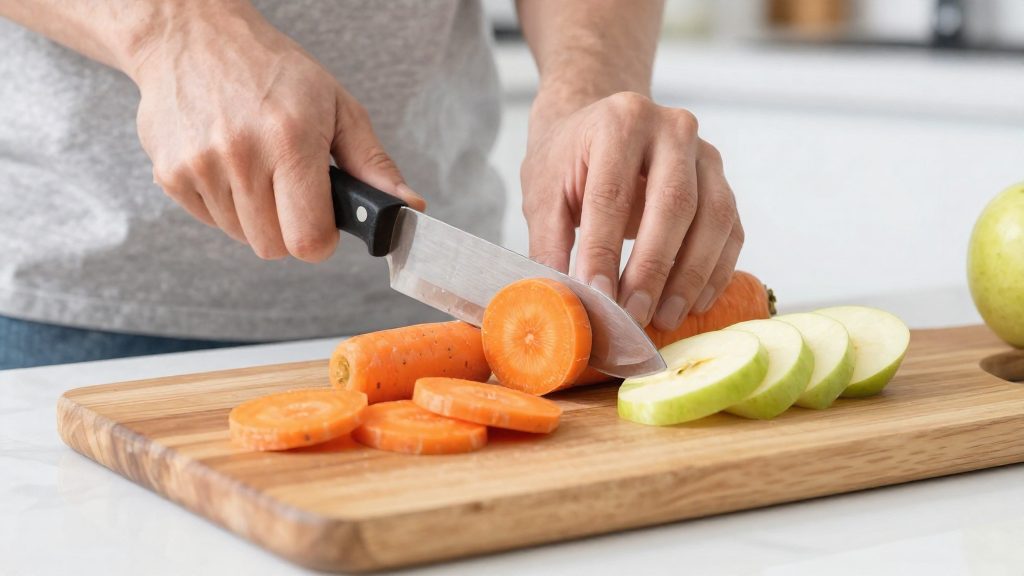
Preparation means four steps applied before produce goes into the bowl: wash it, remove the parts that should not be eaten, cut it into manageable pieces, and cook it when needed. According to The Vet Desk (2025), the safe-preparation checklist is to remove cores, seeds, pits and rinds, cut food into small pieces, and avoid canned fruit in syrup. Applying the same routine to every item prevents most preparation errors.
Washing and reducing pesticide residue
Rinse all produce under running water before serving, and scrub firm items such as carrots, cucumbers and apples with a brush. The official sources consulted do not specify how much pesticide residue this removes, so no removal rate is claimed here. Wash produce before cutting, so that surface contamination does not transfer to the cut flesh.
Removing cores, seeds, pits and rinds
Remove these parts before cutting, not after. The Vet Desk (2025) lists the following fruits and vegetables as fine in small amounts:
| Produce | Parts to remove before serving |
|---|---|
| Apples | Core and seeds |
| Pears | Core and seeds |
| Peaches | Pit |
| Watermelon | Rind and seeds |
| Carrots, cucumbers, celery, green beans | No removal listed; wash and trim the ends |
Cutting to size
Cut produce into small pieces that the dog can chew rather than gulp. Slices or thin sticks work well for carrot, celery and cucumber. The official sources consulted do not give a specific piece size, so match the cut to the dog’s size and mouth.
Steaming and cooking
Cooking softens firm vegetables such as carrots and green beans. Steam or boil them plainly, without oil, salt, butter or seasoning. Let the pieces cool before serving. The official sources consulted do not give cooking times or temperatures. A practical check is whether a piece is soft enough to mash easily with a fork.
What should you do if your dog eats something toxic?
If your dog eats grapes or raisins, call a vet immediately. Cornell University College of Veterinary Medicine (October 2026) advises treating any ingestion as an emergency.
Step 1: Contact a vet or poison line
Call your regular vet or the nearest emergency veterinary clinic and say that your dog ate grapes or raisins. Cornell names two US-based poison lines: the ASPCA Animal Poison Control Center at 1-888-426-4435 and the Pet Poison Helpline at 1-855-764-7661. The official sources consulted do not list equivalent services for other countries, so outside the US, your local vet emergency service is the first point of contact.
Step 2: Gather the facts before you call or travel
Staff will ask for specific details. Collect these before leaving:
| Detail | What to record |
|---|---|
| Food | The exact item eaten, and its packaging or label if available |
| Amount | Your best estimate of how much was eaten |
| Time | When the ingestion happened, and when you found your dog |
| Weight | Your dog’s current body weight |
Step 3: Understand the timeline
Signs of grape or raisin poisoning often appear within 6 to 24 hours of ingestion. Cornell lists the following patterns:
| Timing | Possible signs |
|---|---|
| Within 6 to 24 hours | Vomiting (the most common sign), diarrhoea, loss of appetite, lethargy, abdominal pain |
| Over 1 to 3 days | Increased thirst and urination, or an inability to urinate |
Some dogs show no early signs at all. A calm first few hours therefore does not confirm that your dog is unaffected, and the timeline should not replace a call to a vet.
Step 4: Steps before reaching the clinic
- Keep your dog calm and confined so it cannot eat more grapes or raisins.
- Remove any remaining fruit from the dog’s reach and bring the packaging with you.
- Do not give home remedies or try to induce vomiting unless a vet or poison line tells you to do so.
- Write down the times of ingestion and any changes you observe, and bring these notes to the clinic.
When should you see a vet?
Call a vet when a dog has eaten a food from the risk lists below, or shows signs that could follow a toxic exposure. For grapes and raisins, the timing rule is strict. Cornell University College of Veterinary Medicine (Riney Canine Health Center) (October 2026) states that any ingestion should be treated as an emergency, with a vet called right away without waiting for symptoms.
Signs that need same-day assessment
Cornell lists these signs for grape or raisin poisoning. Any of them is a reason to contact a vet right away, and their absence does not mean the dog is safe:
- Vomiting, which Cornell identifies as the most common sign
- Diarrhea
- Loss of appetite
- Lethargy
- Abdominal pain
- Increased thirst and urination, or an inability to urinate
The official sources consulted do not give a separate symptom list for cherry pits, corn cobs or alliums, so a dog with unexplained signs after eating any of these should still be assessed by a vet rather than monitored at home.
Exposures where early symptoms may be absent
Symptoms are not a reliable test of exposure. Cornell notes that some dogs show no early signs after eating grapes or raisins, so a normal-looking dog is not proof of safety. Hartz (2026) names other risks that the consulted sources do not link to early symptoms:
| Exposure | Risk named by the source | Assessment rule |
|---|---|---|
| Grapes or raisins | Kidney problems (Hartz); emergency per Cornell | Call a vet right away, without waiting for symptoms |
| Cherry pits and stems | Cyanide (Hartz) | Contact a vet; the consulted sources do not specify symptoms or a timing rule |
| Corn on the cob | Intestinal blockage (Hartz) | Contact a vet; the consulted sources do not specify symptoms or a timing rule |
| Raw garlic and onions | Named as the most dangerous forms (Hartz); onions in all forms listed to avoid (The Vet Desk, October 2025) | Contact a vet; the consulted sources do not specify symptoms or a timing rule |
Choosing an emergency clinic or regular vet hours
The official sources consulted do not specify how to choose between a regular veterinary practice and an emergency clinic. Applying Cornell’s guidance, a grape or raisin exposure should not wait for a regular appointment or opening hours. For other exposures, call the regular practice first if it is open and it can advise on timing, and go to an emergency clinic if the dog is showing signs or the practice cannot be reached.
Cornell names two poison-control lines: the ASPCA Animal Poison Control Center (1-888-426-4435) and the Pet Poison Helpline (1-855-764-7661). Both are US-based services, and the consulted sources do not list local equivalents for other countries, so owners should confirm the local emergency number for their area before an incident occurs.
Frequently asked questions
Is a small amount of grapes or raisins safe for my dog?
No safe amount of grapes or raisins has been established for dogs, and even a few can be dangerous for some animals. Cornell University College of Veterinary Medicine (2026) advises treating any ingestion as an emergency and calling a vet right away, without waiting for symptoms. Signs such as vomiting, which is the most common, often appear within 6 to 24 hours, but some dogs show no early signs at all.
Which fruits and vegetables can I give my dog as treats?
The Vet Desk (2025) lists apples, blueberries, cucumbers, peaches, pears, watermelon, carrots, celery and green beans as acceptable in small amounts. Treats should stay under 10% of daily calories, and cores, seeds, pits and rinds should be removed before feeding. Dogs with diabetes or pancreatitis should eat only what their vet recommends.
My dog swallowed a cherry pit or part of a corn cob. What should I do?
Contact a vet promptly, because cherry pits and stems carry a cyanide risk and corn on the cob can cause intestinal blockage, according to Hartz Mountain Corporation (Canada site, 2026). The poison control lines named by Cornell University College of Veterinary Medicine, such as the ASPCA Animal Poison Control Center, are US-based. The official sources consulted do not specify an equivalent service for other countries, so use your local veterinary clinic.