Pet rabbits need puzzle toys because a toy turns eating into a task, which a bowl of food never does. According to Best Friends Animal Society, a foraging toy is any toy that hides a small treat, so the rabbit has to solve a puzzle to reach it. Nevada Humane Society adds that a rabbit’s teeth never stop growing, so the same activity can also give the rabbit something safe to chew.
Why do pet rabbits need puzzle toys?
Foraging instinct
Rabbits are natural foragers. A foraging toy lets a pet rabbit act on that instinct indoors. The rabbit has to work out how to reach the hidden treat, and the effort itself is part of what the toy provides. A bowl offers the food without any search, so the toy adds the step that a bowl removes.
Boredom when food is always available
Best Friends Animal Society notes that pet rabbits often have free access to food. When food is always within reach, there is nothing to search for and little to occupy the animal’s time. Foraging toys change this by making the rabbit work for its food.
Continuous tooth growth and chewing
Nevada Humane Society states that a rabbit’s teeth never stop growing, and that safe chew toys and crunchy treats help keep them worn down. A puzzle toy that the rabbit must push, pull or gnaw combines this need with the foraging task, so chewing happens as part of the activity rather than as a separate chore.
What counts as a rabbit puzzle toy?
A foraging toy is any toy that hides a small treat, so the rabbit has to work out how to reach the food. The defining feature is the hidden reward, not the material or shape. A toy that holds food in plain view, or that is simply something to gnaw, does not meet this definition. A foraging toy changes the way the rabbit eats: the same food becomes something it has to solve for.
Foraging toys differ from two other everyday items:
| Item | Purpose | Puzzle element |
|---|---|---|
| Foraging toy | Hides a treat that the rabbit must reach | Yes: the rabbit solves a task to get food |
| Chew toy | Keeps the teeth worn down | No: the rabbit gnaws for wear, with no food to recover |
| Hay | Ongoing food supply | No: hay on its own is available without effort |
Hay can overlap with puzzles. When hay fills a tube or serves as bedding in a digging box, it is a component of the puzzle rather than the puzzle itself, because the rabbit still has to search or dig to reach a treat.
Mechanisms that turn an item into a foraging toy are based on the action the rabbit performs to get food:
- Pushing: Nevada Humane Society describes a rolling feeder, a container with holes and treats inside, which the rabbit pushes around to release the snacks.
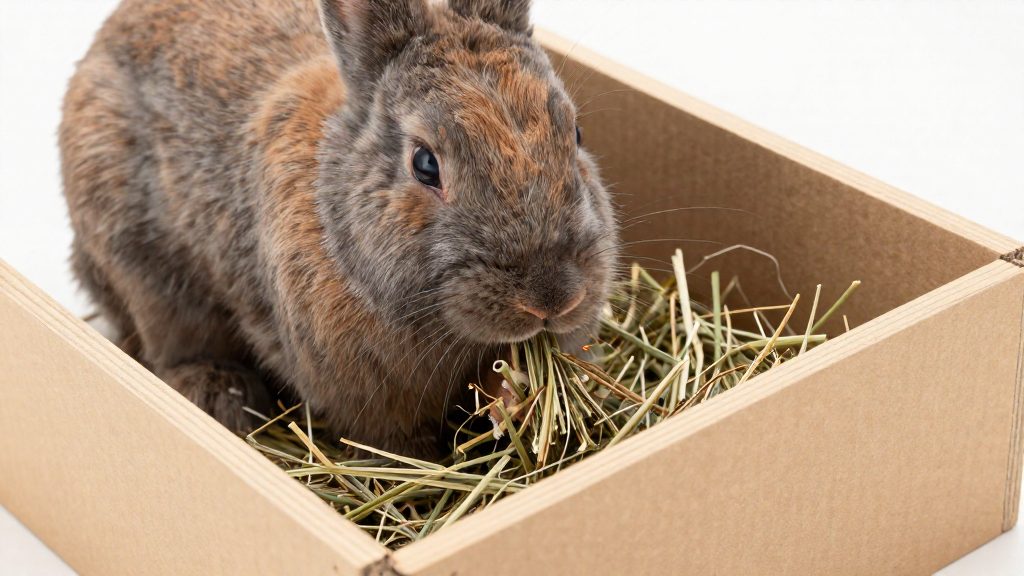
- Digging: Digging boxes filled with hay, where treats are buried or hidden, require the rabbit to dig.
Which materials are safe for rabbit puzzle toys?
Rabbits chew everything they can reach, so the material of a puzzle toy matters as much as its design. The Nevada Humane Society advises that puzzle feeders can be bought or homemade, but their materials must be safe to chew. The main test is whether the rabbit can gnaw the object without contacting a stain, paint or chemical treatment on its surface.
| Material | Status | Basis |
|---|---|---|
| Plain, untreated wood | Acceptable | Wood must not be stained, painted or chemically treated |
| Untreated, rabbit-safe wicker or straw basket | Acceptable | Baskets should be untreated and rabbit-safe |
| Stained, painted or chemically treated wood | Avoid | Excluded by the same guidance |
| Treated wicker or straw basket | Avoid | Baskets must be untreated |
Untreated wood
Wood is a common base for foraging toys. According to the Nevada Humane Society, it should not be stained, painted or chemically treated. Wood with a finish is unsuitable even if the finish looks minor, because the rabbit chews through the surface. Choose plain wood and remove any painted or coloured parts before giving it to the animal.
Wicker and straw baskets
Wicker or straw baskets can hold treats and work as foraging containers, but they must be untreated and rabbit-safe. The rule covers the whole object, including the weave and any varnish, dye or coating applied to it, not only the main fibre.
Checking purchased items for chemical treatments
Commercial toys often do not describe their finishes in detail, so verify before use:
- Ask the seller or manufacturer whether any part is stained, painted, varnished or chemically treated. If the answer is unclear, do not offer the item.
- Inspect the surfaces for colour, gloss or a shiny coating. Remove any painted tag, glued decoration or sticker that can be peeled off.
- Smell the item. A strong chemical odour is a reason not to give it, but the absence of an odour does not prove the item is untreated.
- Check every part the rabbit can reach, not just the main body.
DIY puzzle toys you can make at home
Household items can be turned into foraging toys. Three builds cover the materials named in the sources consulted: a stuffed paper tube, a wrapped paper puzzle, and a rolling feeder.
| Build | Materials named | How it works | Source |
|---|---|---|---|
| Stuffed tube or paper puzzle | Toilet paper tube, brown paper, twine, hay | Treats are hidden inside the tube or paper and the rabbit must pull them out | Best Friends Animal Society; Nevada Humane Society |
| Rolling feeder | Cleaned-out coffee can, treats | The rabbit pushes the can to release snacks through the holes | Nevada Humane Society |
| Hay digging box | Hay as bedding | Hay gives the rabbit material to dig in | Nevada Humane Society |
Toilet paper tube and brown paper puzzles
Best Friends Animal Society lists toilet paper tubes, brown paper and twine as homemade puzzle materials. A basic method:
- Place a small portion of the rabbit’s usual treats inside an empty tube, or wrap them in a sheet of brown paper.
- Fill the tube with hay so the treats are partly hidden.
- Fold the paper closed around the treats so that no string or loose strands are left for the rabbit to swallow.
The rabbit then has to tear, pull or nose its way in to reach the food.
Cleaned coffee can rolling feeder
The Nevada Humane Society describes a rolling feeder made from a cleaned-out coffee can with holes poked in it, with treats placed inside. Clean and dry the can thoroughly before use, then poke holes in the sides and add the treats. The rabbit pushes the can around to get the snacks. The consulted sources do not specify hole size or number, so check the finished feeder for sharp or jagged edges and for any openings that could catch the rabbit before offering it.
Hay as filling and digging-box bedding
The Nevada Humane Society notes that hay can fill cardboard tubes and serve as bedding in digging boxes. Hay therefore serves two purposes in these builds: it hides treats in a tube, and it provides material for digging in a box.
How do you introduce a puzzle toy to your rabbit?
Introduce a puzzle toy in short, supervised sessions. Start with a setup the rabbit can solve at once, and make it harder only after it reliably reaches the food. The first sessions should show the rabbit that the object contains food, not test whether it can solve a problem.
Start with easy setups where treats are visible
Begin with a simple build that keeps part of the treat in plain view. A rabbit that sees a treat and pushes or pulls to reach it learns the basic action before any obstacle is added.
- Place the toy in the rabbit’s usual area so it is calm and familiar with the space.
- Put a few treats where they are visible and easy to reach.
- Stay nearby for a few minutes, then remove the toy.
Supervise early sessions and check for damage
Stay in the room during the first supervised sessions and watch how the rabbit handles the toy. Inspect the toy before and after each session for loose parts, tears, or fragments that could be swallowed. Replace damaged toys rather than patching them.
Raise difficulty once the rabbit solves the toy
Increase the difficulty only when the rabbit opens the toy quickly and consistently. Hide treats under paper or hay instead of leaving them visible, add a second layer, or switch to a rolling feeder.
| Stage | Setup | Move on when |
|---|---|---|
| 1. Visible | Treats in plain view on a tube | The rabbit reaches the treats without hesitation |
| 2. Hidden | Treats under paper or hay inside the tube | The rabbit finds treats within a single session |
| 3. Mechanical | Rolling feeder or multi-layer toy | The rabbit works the toy repeatedly across sessions |
Can foraging help an overweight rabbit?
Foraging adds activity to a rabbit’s day, but it does not control how much the rabbit eats. According to Best Friends Animal Society, foraging toys make rabbits work for food, which adds exercise and can help with weight loss. The benefit is real but partial: foraging changes how the food is eaten, not how much is available.
Free access and unmonitored intake
When hay, pellets or treats are always within reach, the rabbit decides when and how much to eat. With free access to food, the rabbit decides how much it eats, so regular weighing is the way to see whether its weight is rising or falling. A foraging toy does not change this. A hidden treat is still food, and the toy only controls the pace at which the rabbit reaches it.
Extra activity from working for food
The mechanism is physical and mental effort. The rabbit must push, turn, pull or dig to reach the reward, which adds movement. Best Friends Animal Society describes this effort as the source of the added exercise. The sources consulted do not specify how much activity a given toy produces or how long a rabbit must spend on it to affect body weight, so no session length can be recommended on that basis.
Limits of foraging without diet management
- Foraging does not reduce the food supply. If the daily portion stays the same, the toy adds exercise but leaves total energy intake unchanged.
- Treats placed in toys still count. Every item in a puzzle is part of the day’s intake and should be tracked like any other food.
- The official sources consulted do not give portion sizes for overweight rabbits. Any change to the diet management plan should be set with a veterinarian rather than estimated from the toy.
When should you see a vet?
Puzzle toys are useful for enrichment, but some signs mean a rabbit needs a prompt veterinary assessment rather than a wait-and-see approach. These include eating less, drooling, weight loss, a missing piece of toy, and a sudden change in behaviour. Rabbits tend to hide illness, so a change from the normal routine is often the first visible sign. Owners who supervise foraging sessions are best placed to notice it early.
Warning signs and the action to take
| Sign | Likely area | Action |
|---|---|---|
| Eating less, or refusing food and favourite treats | Teeth, mouth or digestion (can become an emergency quickly) | Contact a vet immediately; do not wait to see whether it improves |
| Drooling, or a wet chin and fur around the mouth | Dental or mouth pain | Book a vet visit promptly |
| Weight loss over time | Dental problems or general illness | Weigh the rabbit regularly and report the trend to a vet |
| Food dropped or stuck in the cheeks while chewing | Dental problems | Book a vet visit promptly |
| A missing piece of toy that may have been swallowed | Toy injury | Contact a vet immediately |
| Twine or string hanging from the mouth or rear end | Toy injury | Do not pull it; contact a vet immediately |
| Fewer droppings, bloating, or lethargy after chewing | Digestive blockage risk | Contact a vet immediately |
| Hunched posture, teeth grinding, or reluctance to move | Pain | Book a vet visit promptly |
Toy-related injuries
Puzzle toys made from cardboard, brown paper, twine or wood can be chewed apart. A rabbit can swallow small pieces or bite off strands of twine. Rabbits cannot vomit, so a swallowed object cannot be brought back up, and there is no safe home remedy to try first.
Sudden behaviour changes
A rabbit that stops using a puzzle toy it previously solved, hides more than usual, or becomes unwilling to be handled may be in pain or unwell. Changes in activity level, posture, or appetite should be compared with the rabbit’s normal baseline. Record when the change started so the vet has a clear timeline.
Frequently asked questions
Can I make a puzzle toy for my rabbit at home?
Yes. According to Best Friends Animal Society, a homemade foraging toy can be built from items such as toilet paper tubes and brown paper. Fold the paper closed around the treats instead of tying it with string, because loose strands can be swallowed.
Which materials are safe for a puzzle toy that my rabbit will chew?
According to Nevada Humane Society, wood should not be stained, painted or chemically treated, and wicker or straw should be untreated and rabbit-safe. Check any metal container, such as a repurposed can, for sharp or jagged edges before you give it to the rabbit.
My rabbit has stopped eating its treats. Should I wait to see if it improves?
No. Contact a vet without delay and do not treat a puzzle toy as a substitute for veterinary assessment. The official sources consulted here do not set a time limit for this situation, so the safest course is to make contact the same day.