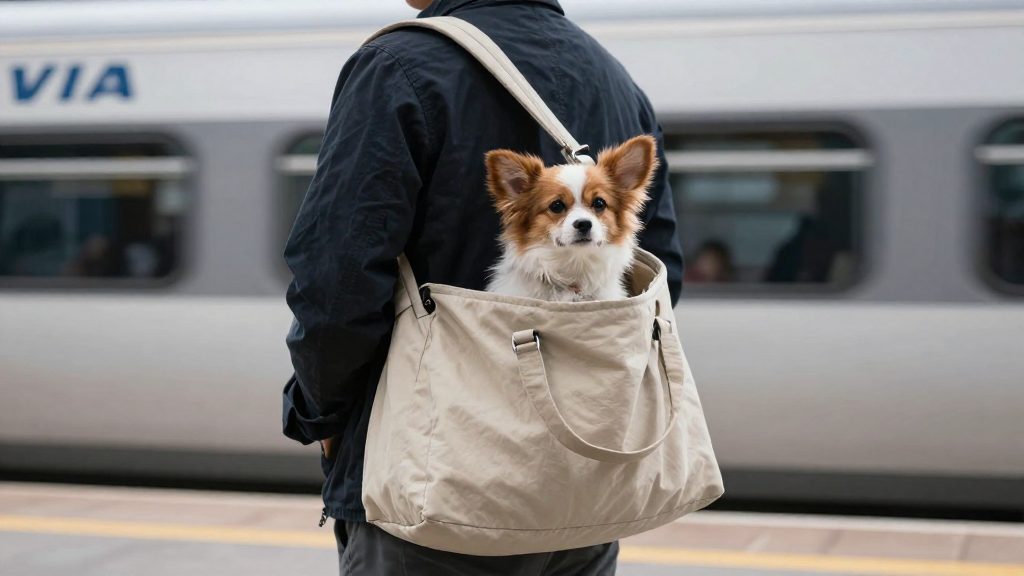
Yes. Each Canadian carrier publishes its own pet policy, so fees, eligibility and accepted animal types differ between airlines, even on the same domestic route. Only Air Canada’s rules on size, age, weather and check-in are detailed here. For WestJet, Porter and Flair, the sources give only fees and emotional support dog status. Air Canada’s 2026 policy is the reference point here. Within Canada, one cat or one small dog per passenger may travel in the cabin, for a one-way fee of CA$50–60. The figures below apply only to flights within Canada. The official sources consulted do not specify the reasons each carrier sets its own rules.
Do airline rules for pets in Canada differ?
The differences go beyond price. Air Canada’s policy shows the basic structure: a limit on the number of animals, a required carrier type and a published fee. Each airline then sets its own answers to the remaining questions, such as whether it carries pets in the hold and whether it accepts emotional support dogs.
The one-animal-per-passenger limit
According to Air Canada (2026), one cat or small dog per passenger may travel in the cabin on domestic flights. The sources consulted do not say how many pets a group travelling together may bring, so confirm this with the airline before booking. The sources consulted for other carriers do not describe a carrier-type requirement, so the Air Canada rule should not be assumed to apply elsewhere.
Fees and hold transport by carrier
| Carrier | In-cabin fee (within Canada) | Baggage compartment (within Canada) | Emotional support dogs in cabin |
|---|---|---|---|
| Air Canada | CA$50–60 one-way | CA$105–126 one-way | Accepted |
| WestJet | CA$50–59 | CA$100–118 | Not accepted |
| Porter | CA$50 | Not carried in the hold | Accepted |
| Flair | CA$79 online, CA$99 at the airport | Not carried in the hold | Accepted |
The in-cabin and hold fees for WestJet, Porter and Flair come from Frugal Flyer (2025-11-10). The Air Canada figures come from Air Canada (2026). Frugal Flyer also reports that only Air Canada and WestJet carry pets in the baggage compartment on domestic flights.
Service dogs and emotional support dogs
Emotional support dogs are treated differently from service dogs.
Checking a carrier’s policy before booking
Because each carrier’s rules are set independently, compare the carrier’s own current published policy for the route rather than relying on another airline’s terms. Fees in the table above are dated, so confirm the current amount with the carrier before paying.
Cabin or cargo: which option fits your pet?
Within Canada, the choice between the cabin and the baggage compartment depends on three factors: the passenger’s seat and status, the airline, and the kennel’s construction. A pet that does not meet the cabin conditions can only travel in the baggage compartment, and only if its kennel and breed meet that compartment’s rules. (Air Canada, 2026)
Who can travel with a pet in the cabin
The passenger’s booking determines cabin eligibility on Air Canada:
| Passenger situation | Pet in cabin |
|---|---|
| Unaccompanied minor | Not permitted (Air Canada, 2026) |
| Seated in an exit or bulkhead row | Not permitted (Air Canada, 2026) |
| Booked in Premium Economy | Not permitted (Air Canada, 2026) |
| Booked on a codeshare flight | Not permitted (Air Canada, 2026) |
Kennel construction sets the compartment
The two compartments require different kennel types:
| Compartment | Required kennel construction | Source |
|---|---|---|
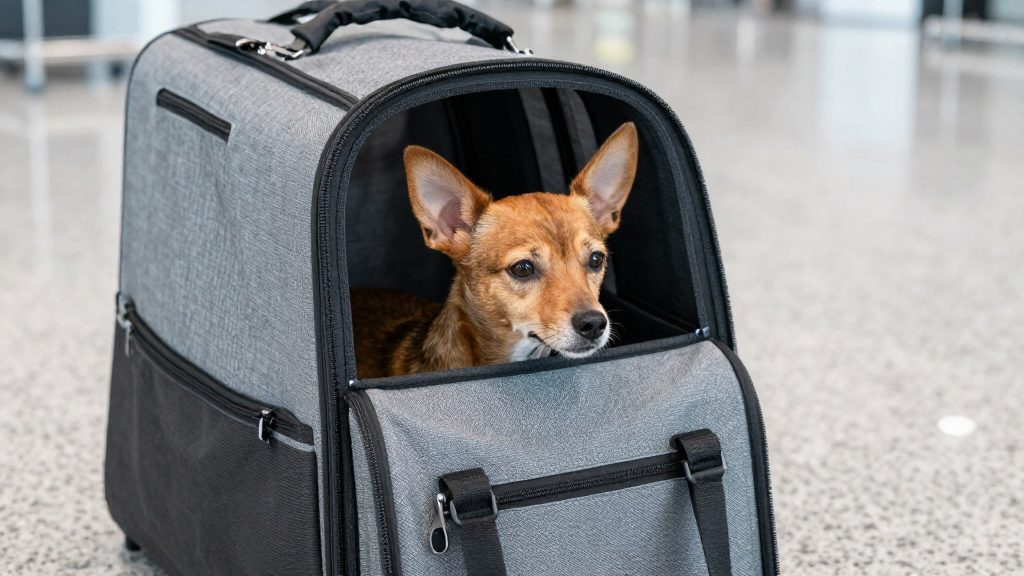
| Cabin | Soft-sided carrier, closed and stowed under the seat in front | Air Canada (2026) |
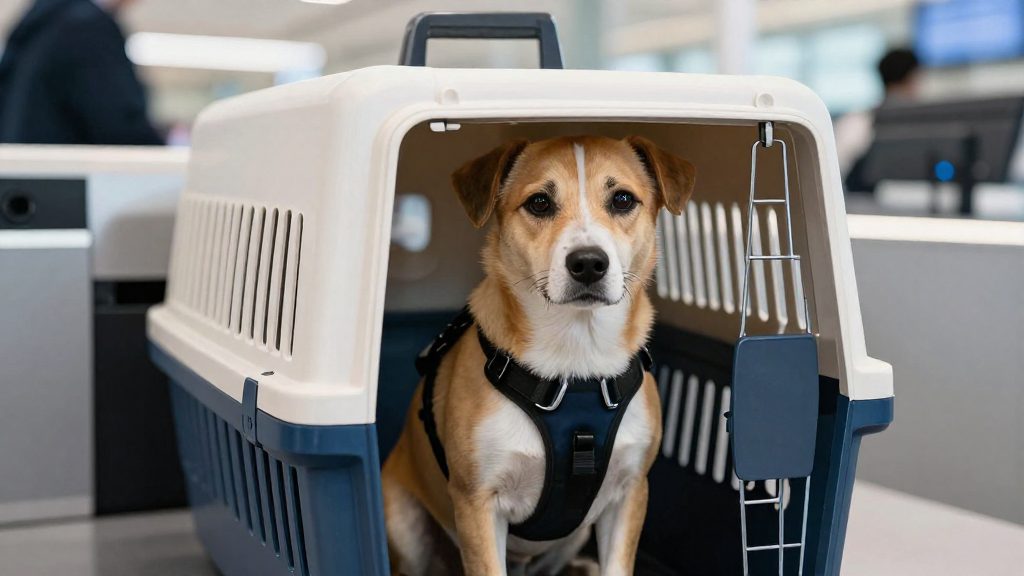
| Baggage compartment | Hard-sided kennel with no mesh on top | Air Canada (2026) |
Since 1 June 2025, Air Canada requires soft-sided carriers for pets in the cabin. A kennel that meets one requirement may fail the other, so the construction should be checked against the compartment booked.
Brachycephalic dogs
Short-nosed (brachycephalic) dogs are not allowed in the baggage compartment on Air Canada (Air Canada, 2026). For these dogs, a cabin booking is the only route on that airline within Canada. The official sources consulted do not specify the cabin conditions for brachycephalic dogs beyond the general one-pet limit.
What does it cost to fly with a pet in Canada?
Both figures are stated per one-way trip, and the official sources consulted do not give a round-trip total.
Published one-way fees
| Travel option | Published one-way fee (CA$) | Published condition |
|---|---|---|
| Cabin (under the seat in front) | 50–60 | One cat or small dog per passenger |
| Baggage compartment | 105–126 | Pet must be in a hard-sided kennel |
How the two options compare
- The baggage compartment range (CA$105–126) starts CA$55 above the lowest cabin fee (CA$50) and ends CA$66 above the highest cabin fee (CA$60).
- The cabin fee applies only if the passenger is eligible.
- The baggage compartment fee applies to a different set of conditions. Air Canada states that short-nosed (brachycephalic) dogs are not allowed in the baggage compartment, so the fee is not an option for those dogs.
- The official sources consulted do not specify whether the fee is charged once or per flight segment on connecting itineraries.
Which carrier size and pet age are accepted?
On Air Canada flights within Canada, the animal must be able to stand, turn and lie down inside the carrier. The maximum allowed size depends on the aircraft type operating your flight.
Maximum carrier dimensions by aircraft
| Aircraft | Maximum carrier size (cm) |
|---|---|
| Standard maximum | 40 x 43 x 20 |
| Dash 8-400, E175 and CRJ900 | 40 x 55 x 27 |
Check the dimensions against the aircraft listed on your booking, because a carrier that fits the regional aircraft limit can still exceed the standard maximum.
Minimum age and weaning
Air Canada generally requires cabin pets to be at least 10 weeks old and fully weaned (Air Canada, 2026). Young kittens and puppies that have not reached this age are generally not accepted in the cabin, so owners of young animals should confirm the animal’s age against this threshold before booking a trip, rather than assuming a younger pet will be accepted at check-in.
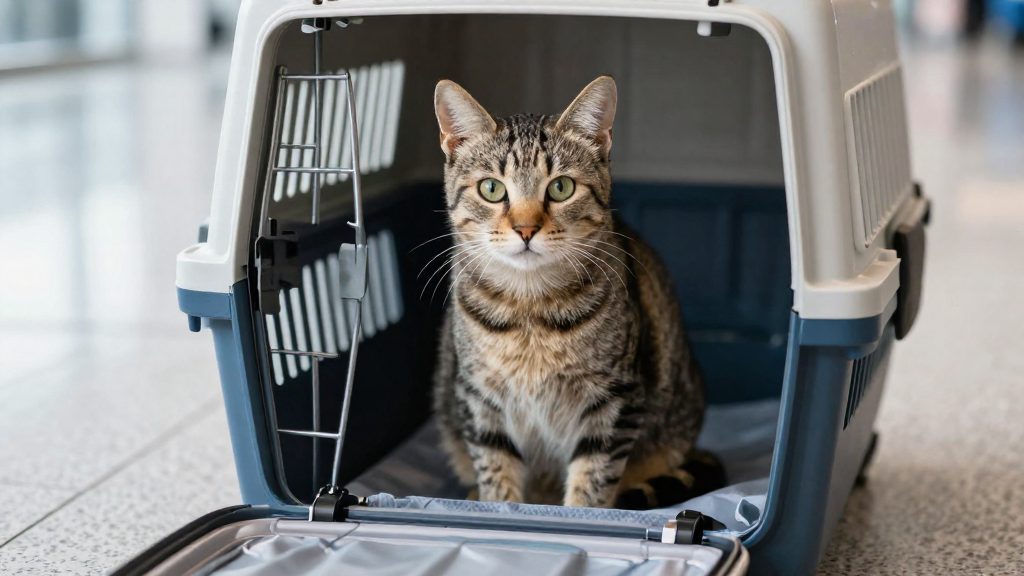
How do weather embargoes affect pet flights?
Air Canada applies three date and temperature rules that remove pets from the baggage compartment and cargo, so a pet can be refused even when its booking is confirmed. The cold-weather limit covers small animals, the holiday blackout covers a fixed period, and the heat rule allows refusal at high temperatures. Each rule is set by the airline.
The rules as published by Air Canada (2026):
| Restriction | Animals affected | Dates or conditions |
|---|---|---|
| Cold-weather limit | Cats and dogs under 4.5 kg | 1 November to 31 March, or at or below 0 °C |
| Holiday blackout | All pets as checked baggage or cargo | 18 December to 4 January |
| Heat refusal | Pets | Refusal possible above 29.5 °C |
The cold-weather limit has two triggers. Either the travel date falls between 1 November and 31 March, or the temperature is at or below 0 °C. Under either condition, a cat or dog weighing under 4.5 kg is not accepted in the baggage compartment. Heavier animals are not covered by this specific threshold in the Air Canada source.
The holiday blackout is absolute for the stated period. From 18 December to 4 January, no pets travel as checked baggage or cargo, regardless of weight or temperature. A pet that must fly during these dates needs a different arrangement, such as travelling in the cabin where the airline allows it.
The heat rule is discretionary. The source says pets may be refused above 29.5 °C, so acceptance at high temperatures is not guaranteed. The official sources consulted do not specify how the airline assesses the temperature at each stage of the journey.
These limits are specific to Air Canada. The Frugal Flyer (2025-11-10) notes that WestJet also carries pets in the baggage compartment within Canada, but the sources consulted do not give WestJet’s own weather or holiday thresholds.
What to do before and on the day of the flight
Pet registration comes first. On Air Canada, a cabin pet must be added to the reservation, ideally within 24 hours of booking. A pet that is not registered is not accepted at the airport (Air Canada, 2026). Treat this as the first step, not something to settle at the counter.
Arrival timing
- Arrive 30 minutes earlier than the recommended check-in time (Air Canada, 2026). Work backwards from departure and add this buffer to the standard check-in window.
- Do not plan on self-service. Online check-in and kiosks are unavailable when travelling with a pet (Air Canada, 2026), so the full check-in must be completed at the counter.
On the day
- The pet must already be registered on the reservation, otherwise it is not accepted at the airport (Air Canada, 2026).
- Check-in must be done at the counter, because online check-in and kiosks are unavailable with a pet (Air Canada, 2026).
Can service and emotional support animals fly?
Air Canada’s cabin rules for pets are set out in its own pet pages, but those pages, as consulted, do not separate service dogs from ordinary pets in detail. What the sources do establish is that a service dog travels at no extra cost and that the airline must be notified in advance. Emotional support status is treated differently from service status, and the rules vary by carrier.
For service dogs, the key points are:
- No extra charge: Service dogs fly at no extra cost, unlike the in-cabin pet fee that applies to other animals (Frugal Flyer, 2025-11-10).
- Advance notice: Passengers generally must contact the airline at least 48 hours before departure and submit a Service Dog Request Form (Frugal Flyer, 2025-11-10).
For emotional support dogs, acceptance depends on the airline:
| Carrier | Emotional support dog in cabin | Source |
|---|---|---|
| Air Canada | Accepted | Frugal Flyer (2025-11-10) |
| Porter | Accepted | Frugal Flyer (2025-11-10) |
| Flair | Accepted | Frugal Flyer (2025-11-10) |
| WestJet | Not accepted | Frugal Flyer (2025-11-10) |
Gaps remain. The official sources consulted do not specify the documentation an airline may request for a service or emotional support dog, whether service animals of species other than dogs are accepted, or whether emotional support animals are subject to the same cabin conditions as ordinary pets. The status of an emotional support animal is not stated in the official pet pages consulted.
Frequently asked questions
What size carrier does Air Canada require for a pet in the cabin?
According to Air Canada (2026), the pet must stay in a soft-sided carrier that remains closed under the seat in front, and the animal must be able to stand, turn and lie down inside it. The standard maximum is 40 x 43 x 20 cm, while the Dash 8-400, E175 and CRJ900 aircraft allow 40 x 55 x 27 cm.
Can my dog travel in the hold on a domestic flight within Canada?
Air Canada and WestJet carry pets in the baggage compartment on domestic routes, while Porter and Flair do not, according to Frugal Flyer (2025-11-10). Air Canada requires a hard-sided kennel with no mesh on top, excludes short-nosed (brachycephalic) dogs from the hold, and does not accept cats or dogs under 4.5 kg there from 1 November to 31 March or when the temperature is at or below 0 °C.
Will my emotional support dog be allowed in the cabin on every Canadian airline?
No. Air Canada, Porter and Flair accept emotional support dogs in the cabin, but WestJet does not, according to Frugal Flyer (2025-11-10). Service dogs fly at no extra cost, but the airline generally needs to be contacted at least 48 hours ahead and sent a Service Dog Request Form.