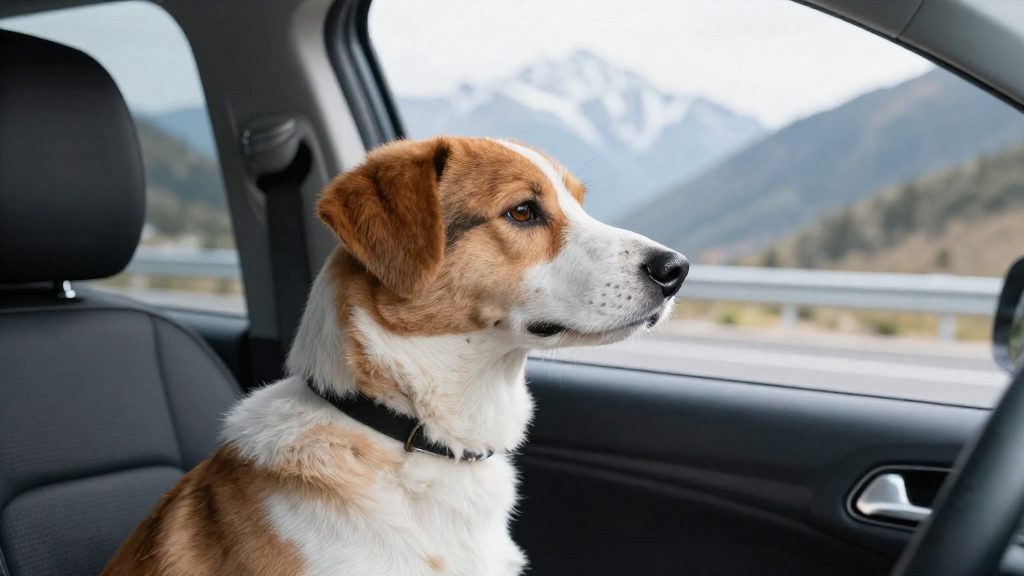
Canada’s entry rules for dogs depend mainly on the animal’s age and on whether it comes from a rabies-free country. According to the Canadian Food Inspection Agency (CFIA, 2025), pet dogs under 3 months old need neither a rabies vaccination nor a certificate of rabies-free origin to enter Canada. From 8 months old, a dog coming from a country that is not rabies-free, including the United States, needs a valid rabies vaccination certificate or a rabies neutralising antibody titre test result of at least 0.5 IU/ml. Dogs between 3 and under 8 months are a separate category in the CFIA’s pet import tool. The requirement for this age band is not confirmed here, so check it in the CFIA pet import tool, or with the CFIA directly, before you travel.
What does Canada require to bring a dog across the border?
Age is the first filter. The CFIA’s pet import tool sorts dogs into three age groups: under 3 months, 3 to under 8 months, and 8 months or older. Each group carries different paperwork, so the dog’s exact age on the date of entry matters.
Age and origin thresholds at a glance
| Dog profile | Rabies paperwork at entry | Other requirement |
|---|---|---|
| Pet dog under 3 months, any origin | No rabies vaccination or certificate needed | None for an accompanied dog; an unaccompanied dog under 8 months needs the extra veterinary certificate described below |
| Pet dog 8 months or older from a non-rabies-free country | Valid rabies vaccination certificate from a licensed veterinarian in the country of origin | Certificate in English or French, identifying the dog and showing current vaccination |
| Unaccompanied dog under 8 months | Not applicable to the rabies rule above | Extra veterinary certificate confirming examination, age of at least 8 weeks, freedom from clinical disease, and vaccination against distemper, hepatitis, parvovirus and parainfluenza |
Accompanied dogs from a non-rabies-free country
For a dog aged 8 months or older travelling with its owner, the certificate must be issued by a licensed veterinarian in the country of origin and must show current vaccination. Ask the vet to write the dog’s details exactly as they appear on the microchip and identity documents, so that the certificate matches the animal presented at the border.
Unaccompanied dogs under 8 months
A dog under 8 months that travels without its owner needs the extra veterinary certificate described above. The examination must take place shortly before departure: the dog must arrive in Canada within 72 hours of the exam.
Which rabies documents should you carry?
For a dog aged 8 months or older coming from a country that is not rabies-free, which includes the United States, the Canadian Food Inspection Agency (CFIA) accepts one of two proofs at entry: a valid rabies vaccination certificate, or a rabies neutralising antibody titre test result. Both documents must identify the individual dog, so a generic record or a copy that does not name the animal does not satisfy the requirement. According to CFIA (2025-10-08), these rules apply to pet dogs in this category.
| Document | Issued by | Key content requirement |
|---|---|---|
| Rabies vaccination certificate | Licensed veterinarian in the country of origin | Dog identified; current rabies vaccination shown; English or French |
| Rabies titre test report | Laboratory test on the dog | Dog identified on the report; result of at least 0.5 IU/ml |
The rabies vaccination certificate
The certificate must be issued by a licensed veterinarian in the country of origin. It has to be written in English or French, identify the dog, and show that the rabies vaccination is current. The CFIA guidance consulted lists only these two languages, so a certificate in any other language is not covered by the stated requirement.
The rabies titre test report
A rabies neutralising antibody titre test result of at least 0.5 IU/ml is accepted as an alternative to vaccination certification. Two conditions apply: the dog must be identified on the lab report, and the report must travel with the dog. In practice, keep the original report with the dog for the whole journey rather than sending it separately or storing it in a different piece of luggage. The official sources consulted do not specify whether a digital copy is accepted, so confirm this with the CFIA before departure.
When the documents do not meet the requirements
If a dog does not meet the entry requirements, an inspector may order the owner to have it vaccinated against rabies within a set period, at the owner’s expense. Animals that do not qualify may be required to leave Canada. The official sources consulted do not specify the length of the set period, so check the current position with the CFIA or the inspector at the port of entry.
How do you keep your dog safe in the car?
According to CAA Magazine (2025), citing the Canada Safety Council, a dog should be restrained with a harness or a crate fastened in the vehicle. Both methods keep the dog in a fixed position.
Anchor the restraint to the vehicle
A crate should be secured so it cannot slide, tip or rotate under braking. Place it where it cannot shift into the footwell or push against the front seat backs. A harness with tether should fit the dog’s chest rather than rely on a collar, and the tether should attach to the vehicle’s seatbelt system, not to a loose clip or the seat itself. The tether must be short enough that the dog cannot reach the front of the cabin, but long enough for it to sit and lie down.
| Restraint | How it is secured | What to check before each trip |
|---|---|---|
| Crate | Fastened to the vehicle so it cannot slide or tip | Door latches closed; crate does not move when pushed |
| Harness with tether | Tether attached to the seatbelt system | Harness sits flat on the chest; tether has no slack that allows a forward jump |
Rear seat placement and airbag clearance
Keep the dog in the rear seat rather than the front. A front passenger airbag can injure a dog, and a dog in the front is more likely to interfere with the driver. Keeping the dog in the back also reduces the risk of it moving into the driver’s arms or feet while the car is in motion.
Load placement and loose objects
Stow bags, bowls, leads and food so they cannot slide forward when the vehicle brakes. Loose items become projectiles in a sudden stop and can strike the dog or the driver. Keep the dog’s access to the front cabin blocked, using a crate, a barrier or a tethered position behind the front seats. Open windows only far enough to ventilate the cabin, so the dog cannot put its head or body out.
Is it ever safe to leave a dog in the car?
No. The CAA’s road-trip guidance for dogs says a dog should never be left unattended in the car, and the official sources consulted do not describe any conditions under which a parked vehicle is safe for a dog. The risk comes from how fast the cabin heats up, which is hard to judge by feel. A mild outside temperature or a short errand does not reliably prevent the cabin from becoming dangerous.
How quickly a parked car heats up
The Canada Safety Council, as cited by CAA Magazine (Atlantic, 2025), reports the following for a small car parked on a 35°C day:
| Time parked | Reported interior temperature |
|---|---|
| About 20 minutes | About 50°C |
| Within 40 minutes | Above 65°C |
These figures apply to a small car on a 35°C day. The source does not give figures for other vehicle types or outside temperatures, so no safe duration can be drawn from it.
Cracked windows
The official sources consulted do not specify how much leaving a window open reduces the temperature rise. A partly open window should therefore not be treated as a safeguard.
Provincial animal welfare rules
The official sources consulted do not set out the animal welfare rules that apply in each Canadian province or territory for animals left unattended in vehicles. Before departure, check the provincial government website for every province and territory on your route, since the applicable rules are not confirmed here.
Who to contact about a dog left in a vehicle
The official sources consulted do not name a national reporting line for this situation. If you see a dog showing distress in a parked car, contact local police or the municipal animal services for the place where the vehicle is parked. Note the vehicle’s location, make, model, and colour, and the time you first saw the dog, so responders can act quickly.
How do you plan dog-friendly stops and stays?
Planning dog-friendly stops means checking three things before each overnight and each walk: whether the accommodation accepts the dog, whether the park or trail allows it on a leash or off, and whether the route includes places where the dog can exercise. The official sources consulted do not set out pet fees, size limits or park bylaws, so the steps below describe how to verify each rule with the party that sets it.
Confirm lodging pet policies before booking
According to CAA Magazine (Atlantic) (2025), road-trippers should check hotel pet policies before booking. Each property sets its own policy, so a pet filter on a booking site is not a substitute for asking the property. Before paying:
- Ask in writing whether the dog is accepted, using email or the booking platform’s message thread, and save the reply with its date.
- Ask about any restrictions on breed, weight or number of animals.
- Ask whether the dog may be left alone in the room, and whether it may enter shared areas such as lobbies, breakfast rooms or corridors.
- Ask which rooms, if any, are designated for pets, since a pet-accepting property may limit animals to specific rooms.
Check park and trail rules for each stop
National and provincial parks set their own leash and dog rules, and these can vary within one park, for example between a day-use area and a backcountry trail. Use the official page of the agency that manages the park rather than a guidebook or forum post, and check the page on the day of travel, since rules can change. Note four points: whether the dog must be leashed at all times, whether certain trails are closed to dogs, whether any seasonal closures apply, and whether the page shows a last-updated date.
Plan routes around off-leash and dog-free areas
Off-leash zones, beaches and dog-free sections are often set by the municipality or the individual site, so a route that looks dog-friendly on a map can include sections where dogs are not allowed. Build the route day by day:
| Stop type | What to check | Source to use |
|---|---|---|
| Overnight lodging | Written pet acceptance, permitted room types, access to shared areas | The property’s own policy, confirmed in writing |
| National or provincial park | Leash requirement, trail restrictions, seasonal closures | The managing agency’s official park page |
| Off-leash or dog-free area | Whether dogs may be off-leash, and at which times | Municipal or site signage at the entrance |
CAA also advises scheduling frequent stops on a road trip with a dog, so build walk breaks into the route and choose stops that have a permitted leash walk, not only a parking area.
What should you pack for the trip?
On travel days the dog’s routine changes at every stop, so the supplies that matter most are the ones that keep food, water, hygiene and identification consistent with home. Pack them in one bag you can reach from the front seat, so you do not have to unload the vehicle at each stop.
| Item | What it covers on travel days |
|---|---|
| Regular food from home | Food continuity across the whole trip |
| Spare food days beyond the planned schedule | Delays, closed roads or unplanned stops |
| Collapsible bowl | Drinking at each stop |
| Drinking water from home | Daily water intake during driving |
| Waste bags | Clean-up at every stop, with spares kept in the vehicle |
| ID tag on the collar | Contact details if the dog is separated from you |
| Microchip number and registry details | Identification record kept on hand |
Water needs the most attention in warm weather. Offering hydration at every stop therefore matters more than the total volume carried.
For identification, the collar and ID tag should fit securely before departure. Check that the tag shows current contact details. Confirm that the microchip details are current before leaving, as CAA Magazine (Atlantic) (2025) advises. Carry a written copy of the chip number and your contact details separately from your phone, so the information is still available if the phone is lost or its battery runs out.
When should you see a vet on the road?
On a road trip, a dog’s health problems can escalate faster than usual because the animal is confined, stressed, and exposed to unfamiliar climates and food. Treat heatstroke signs, laboured breathing, pale or bluish gums, collapse and seizures as emergencies: go to the nearest emergency clinic immediately, and phone ahead if you can. For other signs, such as repeated vomiting, contact a vet without delay. Waiting until the next scheduled stop or the destination can cost valuable time.
Warning signs that need assessment
| Sign | Why it needs veterinary assessment |
|---|---|
| Heavy panting that does not slow when the dog rests in shade or cool air | Can indicate heatstroke, a condition that worsens quickly |
| Drooling, weakness, staggering, or collapse | Can accompany heatstroke or other serious conditions |
| Repeated vomiting, vomit containing blood, or inability to keep water down | Risk of dehydration and an underlying problem |
| Laboured breathing, noisy breathing, or pale, bluish, or grey gums | Signs of breathing difficulty that require immediate care |
| Unresponsiveness or seizures | Emergency at any time |
Breathing difficulty is the sign that should never be monitored at home. Cooling a dog with a heatstroke sign should be done while arranging transport, not instead of it.
Locating emergency clinics along the route
Before departure, identify emergency veterinary clinics for each overnight stop and for the longest driving stretches. Save the name, address, phone number, and opening hours of at least one clinic per stop in your phone and on a paper copy. Hours differ from one clinic to another, and some are not open around the clock, so check whether each one provides out-of-hours emergency care. Keep the navigation app’s route and a plan for the next clinic on the road in case the first one cannot treat your dog.
Medical history summary for emergency clinics
Prepare a one-page summary that a clinic can read in minutes:
- Dog’s name, age, weight, sex, and microchip number
- Current vaccinations and the date of each, with the vet’s name and contact details
- Chronic conditions, previous surgeries, and known allergies
- All medications, including the name and dosing schedule as prescribed by your vet
- Diet and any recent changes, including treats eaten on the trip
- Your regular vet’s phone number and clinic address
Frequently asked questions
Does a puppy under 3 months old need rabies paperwork to enter Canada?
No. According to the Canadian Food Inspection Agency (CFIA, 2025), a pet dog under 3 months old needs neither a rabies vaccination nor a certificate of rabies-free origin, whatever its country of origin. The CFIA’s pet import tool still sorts dogs by age, so check the dog’s exact age on the date of entry.
My dog is 10 months old and I’m travelling from the United States. What paperwork do I need?
The CFIA (2025) requires a rabies vaccination certificate issued by a licensed veterinarian in the country of origin. The certificate must be in English or French, identify the dog, and show current vaccination. A rabies neutralising antibody titre test result of at least 0.5 IU/ml is accepted instead, provided the dog is named on the lab report and the report travels with the dog.
Can I leave my dog in the car while I stop for food or fuel?
No. The Canadian Automobile Association’s magazine CAA Magazine (Atlantic, 2025) advises never leaving a dog unattended in the car. It cites the Canada Safety Council’s figure that, on a 35°C day, the interior of a small car can reach 50°C in about 20 minutes. Restraining the dog in a harness or a crate fixed in the vehicle reduces the risk of injury during braking as well.