Dehydration in Cats: Signs, Checks and When to See a Vet
Dehydration in cats usually shows up as changes in eating, energy and appearance rather than as one obvious symptom. PetMD (2025-12-16) lists lack of appetite, lethargy or low energy, sunken eyes, panting, weakness and collapse as signs of dehydration. Because each of these can also have other causes, the most useful reference point is the cat’s own normal routine. A clear change from that baseline is the signal to observe closely.
What does dehydration look like in cats?
Appetite loss and low energy
Appetite loss is the first behavioural sign on the list. Note whether the cat skips meals, leaves food in the bowl, or ignores treats it normally accepts. Lethargy, or low energy, appears as a cat that sleeps more than usual, stops starting play, or responds slowly to its name or to movement in the home. These signs are easy to miss in a cat that is naturally inactive, so compare the cat with its own pattern over recent weeks rather than with what you think a typical cat does.
Visible changes: sunken eyes and panting
Sunken eyes are a visible marker: the eyes may look set back into the face. Check in even, good light and compare both eyes with photos taken when the cat was well. Panting is also listed as a sign and should be noted and reported, not dismissed as normal breathing. Record when it happens, for example at rest, after play, or in warm conditions, because that context helps the veterinarian interpret it.
Weakness progressing to collapse
Weakness is the next stage in the list, and collapse is the most advanced sign PetMD names. Watch for unsteady walking, difficulty standing up, or failure to jump to favourite spots. A cat that cannot stay upright has reached the most serious sign on this list.
| Sign listed by PetMD (2025-12-16) | What to observe at home |
|---|---|
| Lack of appetite | Skipped meals, food left in the bowl, ignored treats |
| Lethargy or low energy | More sleep, reduced play, slow response to stimuli |
| Sunken eyes | Eyes appear set back; compare with the cat’s usual look |
| Panting | Open-mouth breathing or visible effort; note timing and trigger |
| Weakness | Unsteady movement, difficulty standing or jumping |
| Collapse | Cat cannot stay upright; most advanced sign listed |
How to check gums and skin elasticity
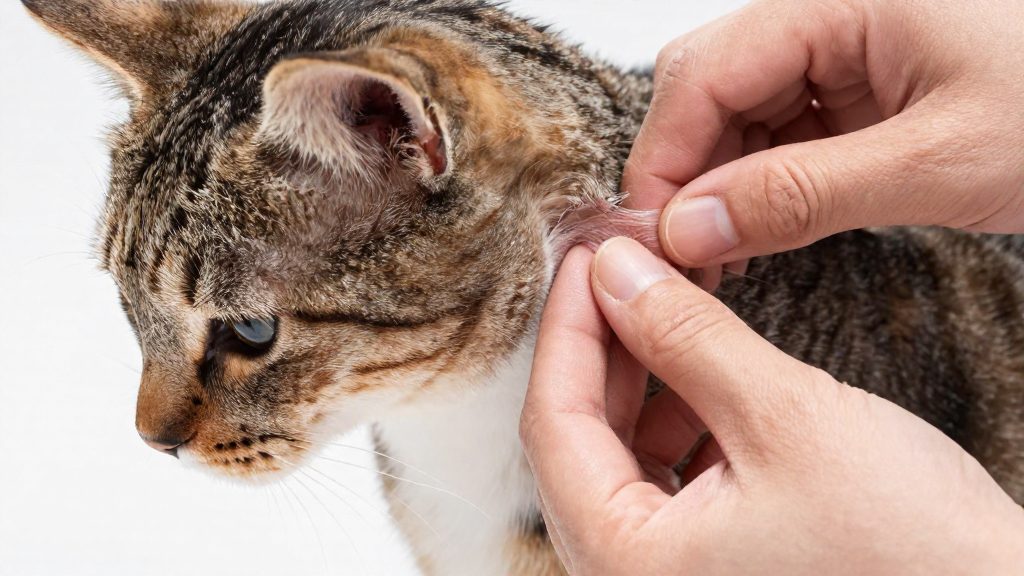
Two hands-on checks can help you judge whether a cat may be dehydrated: a look at the gums and a skin-recovery test over the shoulders. Each answers a different question, and neither replaces a veterinary examination. Knowing what each result means, and where it becomes less dependable, matters as much as performing the check correctly.
| Check | What a dehydrated result looks like | How to perform it |
|---|---|---|
| Gum moisture | Tacky gums that feel dry instead of wet and slimy | Lift the lip and touch the gum with a fingertip |
| Skin-recovery test | Skin settles back slowly instead of snapping back | Lift the skin over the shoulder blades, release it, and watch the return |
Performing the gum check
Healthy gums feel wet and slimy. Gently lift the cat’s lip and compare the gum surface with what you normally feel. If the gum feels dry or sticky, PetMD (16 December 2025) lists this as a sign of dehydration. Do the check when the cat is calm, because a struggling cat makes the result harder to read.
Performing the skin-recovery test
Lift the loose skin over the shoulder blades between two fingers, then let go. A hydrated cat’s skin snaps back into place. In a dehydrated cat, it settles back slowly. Repeat once on the other side if the first result is unclear, and note how long the return takes so you can describe it accurately to your vet.
Where reliability drops
The skin-recovery test is less reliable in older cats and in cats with chronic illness, according to PetMD (16 December 2025). In those cats, a quick recovery should not be read as reassurance, and a normal result on either check does not rule out dehydration. The sources consulted do not specify a comparable limitation for the gum check, so a dry gum feel should be treated as a sign to act, not as a measurement.
Is my cat drinking too little?
Reduced drinking is easiest to catch early when you know what a normal day looks like for your own cat. Cats often drink small amounts at a time and may drink from places you do not see, so a simple daily routine works better than guessing. Tracking the water bowl, noting how food is served, and watching the litter tray gives you three checkpoints that often change before other problems become obvious.
Measuring daily water intake
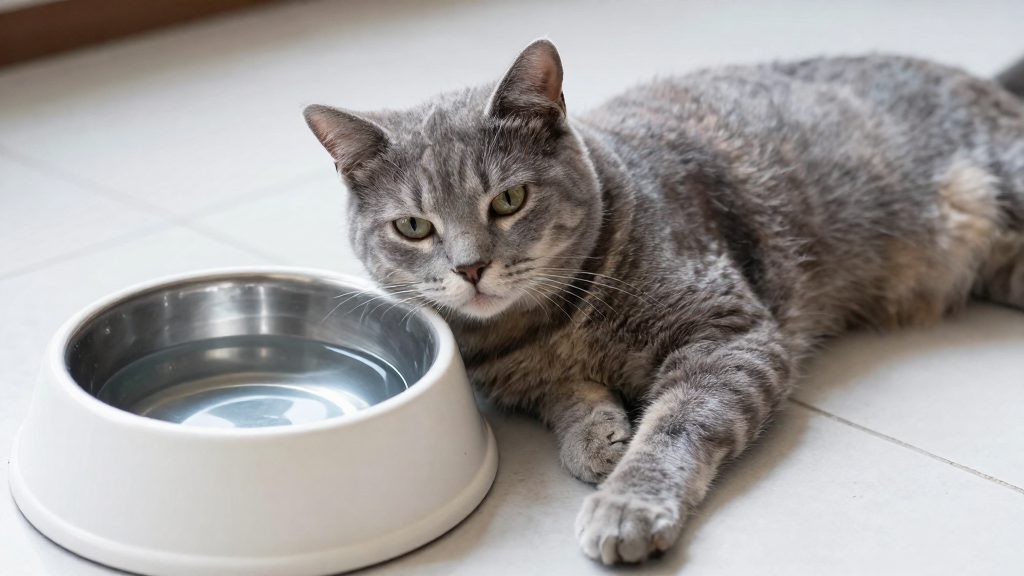
Fill the bowl to a fixed mark each morning and record the level in the evening. Note any top-ups, since they show how much was actually consumed. Compare several days rather than one, because intake naturally varies with activity, temperature and meals. Establish a baseline over a typical week, then treat any drop below that pattern as a change worth recording. If it comes with any sign of dehydration, contact a veterinarian right away. Use the same bowl and the same fill point each time, so the numbers stay comparable.
Bowl placement, water source and wet food
| Factor | What to check | What to record |
|---|---|---|
| Bowl position | Distance from the litter tray and food bowl | Location, and whether the cat approaches it |
| Water source | Bowl, fountain or tap | Which source the cat uses most |
| Wet food share | Proportion of wet versus dry food | Number of meals that include wet food |
Diet changes the amount of water a cat takes in from food, so a change in wet food share can make bowl readings look lower without any change in health. Record the wet food share alongside the bowl level, and compare like with like. Change only one factor at a time, such as moving the bowl or switching water source, so you can see which change affected drinking.
Changes in litter box urine output
Clump count and clump size are the simplest indicators of urine output. Each day, count the clumps and note whether any are noticeably smaller than usual. Clean the tray on a consistent schedule so that a drop in clumps is visible rather than hidden by a delayed clean-out.
If the bowl level, food pattern and clump count move in the same direction, bring the written log to your veterinarian. If the cat also shows any sign of dehydration, contact a vet immediately and do not wait for several days of data.
Why are kittens and senior cats at higher risk?
Very young and very old cats are the groups most likely to become dehydrated quickly. PetMD (2025-12-16) describes both groups as more fragile. The official sources consulted do not give quantified body water reserves or kidney-function thresholds for these age groups, so the points below describe the mechanisms in general terms.
Smaller body water reserves in kittens
A kitten has less body mass to absorb fluid losses than an adult cat. With less reserve, a short period of reduced drinking combined with fluid loss can shift its hydration status faster than in an adult. Kittens also depend entirely on their carer to offer water and food at regular intervals, so an illness that stops them eating or drinking removes their main intake at the same time as losses may be occurring.
Reduced thirst and mobility in senior cats
Older cats may drink less and move less. A senior cat with limited mobility may find it harder to reach a water bowl, especially if the bowl is on another floor or behind a barrier. Reduced activity can also mean less frequent visits to the bowl, which makes intake harder to notice.
How kidney function changes with age affect fluid balance
The kidneys regulate how much water the body retains. As cats age, changes in kidney function can affect this regulation. The official sources consulted do not specify the thresholds at which these changes become significant or how they present in an individual cat. Any sign of dehydration in a cat, especially a very young or very old one, needs veterinary assessment rather than home management.
| Factor | Why it raises risk | Practical step |
|---|---|---|
| Limited body water reserve (kittens) | Less buffer against fluid losses | Offer water at regular intervals and note daily intake |
| Reduced thirst and mobility (seniors) | Harder to reach or notice the water bowl | Place water in several locations at the cat’s level |
| Kidney function changes (seniors) | Fluid regulation may be less effective | Veterinary assessment for any sign of dehydration |
Common causes: vomiting, diarrhea and illness
Illness is a common route to dehydration in cats. Vomiting and diarrhea remove water from the body, and when a cat is unwell its drinking often drops at the same time, so losses and reduced intake compound each other.
Fluid losses from repeated vomiting
Each vomiting episode expels stomach contents that carry water, so repeated vomiting can create a fluid deficit even when the cat appears to drink normally. A single episode and a run of episodes carry different risks. The official sources consulted do not specify how many episodes mark the threshold for concern.
Fluid losses from diarrhea and fever
Diarrhea adds fluid loss through the intestine. When vomiting and diarrhea occur together, two loss routes operate at once, which makes the fluid deficit harder for the cat to offset. The sources consulted do not specify fluid-loss figures for fever, so fever should be treated as a general stressor on hydration rather than a measured one.
Chronic conditions such as kidney disease
Long-term illness changes how dehydration can be judged. The sources consulted do not quantify fluid loss from kidney disease. For a cat with a known chronic condition, the practical step is to ask a veterinarian to assess hydration rather than relying on home checks alone.
When should you see a vet right away?
According to PetMD (2025), a cat with signs of dehydration should see a veterinarian immediately. Vomiting or diarrhea also warrants a prompt vet visit. Treat these as reasons to contact a vet now, not to wait and see whether the cat improves. The same-day rule applies to any sign of dehydration: do not hold off for a routine appointment, and do not wait for a second symptom before calling. The official sources consulted do not specify country-specific emergency thresholds, so check your national or local veterinary guidance for after-hours emergency contacts.
Red-flag signs that need same-day care
Any suspected dehydration in a cat needs a veterinarian immediately. The source does not rank one sign above another, so the practical step is to call the nearest open clinic or emergency veterinary service as soon as you notice it, and say that the cat is showing signs of dehydration so the clinic can triage the call.
Vomiting and diarrhea
Vomiting or diarrhea calls for a prompt vet visit (PetMD, 2025-12-16). Do not wait to see whether it stops on its own. If the cat also shows signs of dehydration, see a veterinarian immediately. If the cat is also showing signs of dehydration, the same-day rule applies.
What to bring to the visit
Before the appointment, write down the following. This gives the vet a clear timeline and makes the triage faster.
- Timing: when the first symptom appeared, and whether it has become more frequent, stayed the same, or come and gone.
- Intake: when the cat last ate and last drank, and how the amount compares with its usual intake. Note any refusal of food or water.
- Vomiting and diarrhea history: the number of episodes, the time of each, and what the vomit or stool looked like, including any blood or unusual colour you noticed.
- Medicines and products: the names of any medicines, supplements, or household products the cat has had recently, with the packaging or label to hand.
If you are travelling to the clinic, keep the list on your phone or on paper so you can read it to the staff at the desk.
What not to do at home
Some home actions meant to rehydrate a cat can make the situation more dangerous. The main hazard is trying to get liquid into a cat that refuses to drink. Other common reflexes, such as trying home remedies or offering substitute drinks, have no verified benefit in the sources consulted. The sections below cover what to avoid and why, based on PetMD (2025-12-16).
Forcing water or using a dropper
Do not force water into a cat that won’t drink, and do not use a dropper to put liquid into its mouth. Forcing liquid is the specific action PetMD (2025-12-16) identifies as dangerous. Owners often try this when a cat is weak or reluctant to drink, but the source advises against it in that situation. The correct step is to stop attempting home fluid administration and take the cat to a veterinarian.
Lung aspiration and pneumonia risk
The core risk is aspiration, meaning fluid entering the lungs instead of the stomach. PetMD (2025-12-16) states that fluid can enter the lungs and cause severe pneumonia. This is why the source advises waiting until the cat reaches a vet rather than attempting to rehydrate it at home. Once a cat has inhaled liquid, the problem moves from dehydration to a lung infection, which needs professional treatment.
Unverified home remedies and substitute drinks
The official sources consulted do not specify any home remedy or substitute liquid that safely rehydrates a cat. Milk, broth, or other human drinks are not addressed in the source, so they should not be treated as a replacement for water or for veterinary care. Trying untested remedies while a cat is unwell can delay the visit it needs. Keep the time before reaching a vet as short as possible.
Frequently asked questions
How can I check whether my cat is dehydrated at home?
Lift the skin over the shoulder blades and release it: in a dehydrated cat it settles back slowly instead of snapping back, according to PetMD (2025-12-16). Also check the gums, which should feel wet and slimy. This skin-recovery test is less reliable in older cats or cats with chronic illness, so do not rely on it alone.
My cat won’t drink. Can I give it water with a syringe?
No. PetMD (2025-12-16) advises against forcing water or using a dropper on a cat that will not drink, because fluid can enter the lungs and cause severe pneumonia. Keep the cat calm and contact a veterinarian instead.
When should I stop monitoring and go to the vet right away?
PetMD (2025-12-16) states that a cat showing signs of dehydration should see a veterinarian immediately. Vomiting or diarrhea also warrants a prompt visit, and very young and very old cats are more fragile.