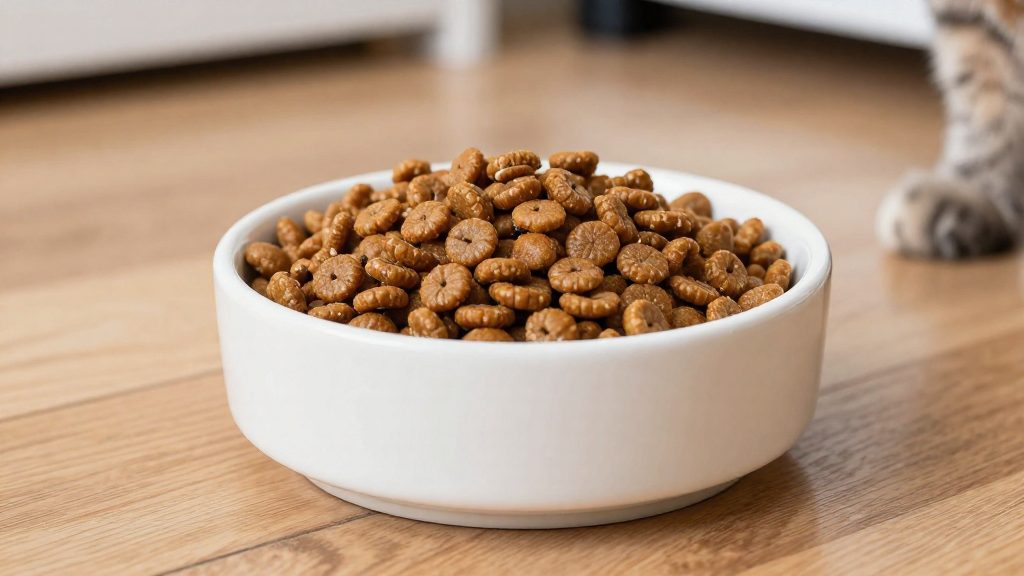
There is no single daily amount that suits every senior cat. Food-label portions are calculated for an average cat, so the figure on a bag or can is only a starting reference. According to Cornell University College of Veterinary Medicine (2024), an individual cat may need more or less than the label amount, depending on its energy expenditure. The right amount supports the weight, body condition and muscle condition your veterinarian considers appropriate for your cat; assess these together over time (AAHA, 2021).
How Much Should a Senior Cat Eat?
Why Label Portions Are Averages
A label portion is based on an average cat, not on your cat (Cornell University College of Veterinary Medicine, 2024). Two cats of the same age can have different energy expenditure, so one may need more food than the label suggests and another less. The label therefore answers the question “what does a typical cat eat on this food?”, not “what does my cat need?”
Using the Label as a Starting Point
- Begin with the feeding guidance printed on the product.
- Adjust the amount based on how your cat’s weight and body condition respond over time.
What to Monitor
| Measure | What it shows | Source |
|---|---|---|
| Body weight | Whether total intake matches energy use over time | AAHA (2021) |
| Body condition | Fat cover, assessed by touch and visual check | AAHA (2021) |
| Muscle condition | Lean tissue, which can decline while weight stays constant | AAFP / JFMS (2021) |
Treats Count Toward the Daily Amount
Treats and other extras should provide no more than 10% of daily calories, with at least 90% coming from complete and balanced nutrition (AAHA, 2021).
Why Calorie Needs Change With Age
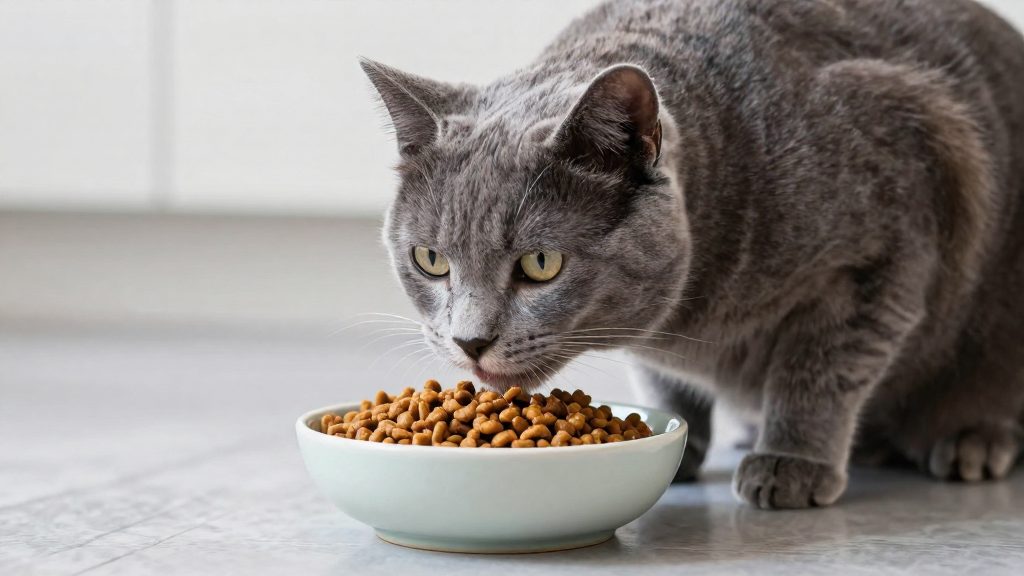
A senior cat’s calorie needs can rise rather than fall because aging can reduce how well the body digests fat, protein and energy. According to the American Animal Hospital Association (2021), advanced aging can lower these digestive abilities, so some senior cats require increased calorie intake. The same daily amount of food can therefore deliver less usable energy than it did when the cat was younger.
How Digestion Changes the Calorie Equation
Calories counted on a food label are not the same as calories the cat absorbs. When digestion of fat, protein and energy declines, the cat takes in the same food but uses less of it. This is why a senior cat may lose weight or muscle on a diet that previously maintained it.
| Digestive function affected | Effect on calorie intake |
|---|---|
| Fat digestion | Less energy absorbed from each meal |
| Protein digestion | Less protein available for maintaining muscle |
| Overall energy digestion | More food may be needed to meet energy needs |
Why Some Senior Cats Need More Food
The food’s quality matters as much as its quantity. A cat’s response to the same food can differ from one individual to another.
Monitoring Body and Muscle Condition
Convert Daily Calories Into Food Portions
A daily calorie target becomes a measurable portion only when you know how many kilocalories (kcal) the specific food provides per unit.
Read the energy density of your food
Energy density is the number of kcal in a given weight or volume of food. It varies between products, so the same weight of two different foods can provide different amounts of energy. Find the kcal figure on the packaging or in the manufacturer’s nutrition information, and note the unit it is stated in:
- kcal per kilogram (kcal/kg)
- kcal per can or pouch
- kcal per cup, which is a volume measure and depends on the kibble’s size and shape
Daily feeding amounts should be determined using the food’s energy density and nutrient content (American Association of Feline Practitioners / Journal of Feline Medicine and Surgery, 2021).
Calculate grams per day from kcal per unit
Once you have your cat’s daily calorie target from your veterinarian and the food’s kcal per unit, use this method:
- Kcal per gram = kcal per kg ÷ 1000
- Grams per day = daily calorie target ÷ kcal per gram
If the label gives kcal per cup, divide the daily calorie target by kcal per cup to calculate cups per day. To convert that portion to grams, weigh one level cup and multiply its weight in grams by cups per day. Repeat the check whenever you change products, because a new food has a different energy density.
Record actual intake and report changes
Owners should record actual intake, not only the planned portion (American Association of Feline Practitioners / Journal of Feline Medicine and Surgery, 2021). A simple log should include:
| Entry | What to record | Purpose |
|---|---|---|
| Amount offered | Grams weighed on a scale | Turns the calculated plan into a measured quantity |
| Amount left | Grams removed from the bowl | Shows what the cat actually ate |
| Food identity | Product name and kcal per unit from the label | Ties the calculation to the exact food in use |
| Body weight | Weight recorded at regular intervals | Shows whether intake matches the cat’s needs |
How Often Should You Feed Your Cat?
No single meal count suits every senior cat. Cornell University College of Veterinary Medicine (2024) advises keeping a senior cat’s established schedule unless a veterinarian recommends otherwise, so the starting point is the routine the cat already follows. Smaller, more frequent meals are a change that some older cats may benefit from, and the American Association of Feline Practitioners and the Journal of Feline Medicine and Surgery (2021) describe this approach for cats whose digestive changes limit how much they eat at each feeding.
Choosing Between Schedules
| Situation | Feeding approach | Source |
|---|---|---|
| Routine is stable and no veterinarian has advised a change | Keep the current meal times and frequency | Cornell University College of Veterinary Medicine (2024) |
| Digestive changes limit intake at each meal | Smaller, more frequent meals of calorie-dense food with highly digestible protein | AAFP and JFMS (2021) |
Why Small Meals Need Dense, Digestible Food
When each portion is small, the nutrients in each portion carry more of the daily load. Calorie-dense food with highly digestible protein may help older cats whose digestive changes limit how much they eat at each feeding (AAFP / JFMS, 2021).
Keeping Track of Meal Changes
Count Treats and Mixed Feeding
Treats and other extras should supply no more than 10% of a senior cat’s daily calories, and at least 90% of intake should come from complete and balanced nutrition, according to the American Animal Hospital Association (AAHA, 2021). Each treat therefore draws from a fixed daily budget. It is not an addition on top of a full meal.
Setting the Treat Budget
- Start from the daily calorie target. Use the target set with your veterinarian.
- Read the calorie content of each extra. Check the packaging or the manufacturer’s instructions for the calories per piece, since products differ.
- Total the treat calories for the day. Keep the total at or below 10% of the target.
- Reduce the main meal by the same amount.
Protecting the Complete Diet
The complete and balanced food is what supplies the protein, vitamins and minerals a senior cat needs. Reducing it to make room for treats should never bring total intake below the veterinarian’s target. Cutting the main meal too far works against that need.
Monitor Weight and Muscle Condition
Regular checks of body weight, body condition and muscle condition show whether a senior cat’s current intake still meets its needs. According to the American Animal Hospital Association (2021), these three measures should be assessed regularly for that purpose. Weight alone is not enough, because a cat can lose muscle while its weight stays the same.
Track Body Weight Over Time
Weigh the cat on the same scale at the same interval, and record each result. A single reading shows little, but a steady rise or fall across several readings shows a trend. Use the trend to decide whether the current amount is working.
Assess Body Condition by Touch
Body condition describes how much fat covers the body, and it is judged by hand as well as by weight:
- Ribs: You should be able to feel them under a light layer of tissue without pressing hard.
- Waist: Viewed from above, there should be a visible narrowing behind the ribs.
- Abdomen: Viewed from the side, the belly should tuck up rather than sag.
Repeat the check at each weigh-in. A cat whose ribs become easy to see or whose waist disappears is drifting in one direction, and the trend matters more than any single reading.
Check Muscle Condition as a Protein Signal
Muscle condition helps assess nutritional and health status, but muscle loss does not by itself establish inadequate protein intake; aging and disease can also contribute (AAFP / JFMS, 2021). The AAFP and the Journal of Feline Medicine and Surgery (2021) note that muscle loss can occur even when body weight stays constant. Check these areas by running your hands along the body:
| Area | What to feel | Change to watch for |
|---|---|---|
| Spine | Ridge along the back | Sharper, more prominent ridge |
| Hip bones | Bony points at the rear | Easier to feel through the skin |
| Skull | Top and sides of the head | Hollowing over the temples |
| Between ribs and hips | Flank muscle | Thinner, less firm tissue |
Muscle loss can occur despite stable weight, and unexplained loss requires veterinary investigation rather than an assumption of protein deficiency (AAFP / JFMS, 2021).
Adjust Intake When Checks Drift
If repeated checks show an unexplained trend, contact your veterinarian before changing portions. Make gradual feeding adjustments according to the agreed plan, then reassess weight, body condition and muscle condition (AAFP / JFMS, 2021).
When to Contact Your Veterinarian
A sustained change in body weight, body condition or muscle condition is the main signal that a senior cat needs prompt veterinary assessment. The American Association of Feline Practitioners and the Journal of Feline Medicine and Surgery (2021) state that unexplained changes in these three areas require veterinary investigation, and that muscle loss can occur even when body weight stays constant. A cat that eats normally but looks thinner under the coat, or has a stable scale reading with a loss of muscle over the spine, hips or shoulders, should be examined rather than simply fed more.
Unexplained changes that require evaluation
- Weight loss that is not linked to a diet change, a new food, or a known reason.
- Weight gain that is not linked to a documented change in intake or activity.
- Loss of muscle over the spine, hips or shoulders, even when the scale reading is unchanged.
- Changes in body condition that you notice by touch or sight, without a clear cause.
- Changes in appetite that persist alongside any of the above.
A veterinarian may need to determine whether an apparent loss reflects reduced absorption, a medical condition, or an intake problem. Only a veterinary examination can make that distinction. Do not adjust portions or add supplements to compensate for an unexplained change before the cat has been assessed.
Information to bring to the appointment
Record the following before the visit, so the veterinarian has a usable history:
| Item to record | What to note |
|---|---|
| Daily intake | Amount of food offered and amount actually eaten, by food type |
| Weight history | Dated weights, from the same scale, over the preceding weeks or months |
| Body condition | Any changes you have noticed in muscle or fat cover, with dates |
| Food details | Brand, product name and feeding instructions printed on the label |
| Extras | Treats and other extras given, as these count toward daily calories |
Timing of contact
Contact your veterinarian as soon as you notice an unexplained change in weight, body condition or muscle condition, rather than waiting for the next routine visit. Contact your veterinarian promptly about reduced intake or an unexplained appetite change, even without weight or muscle loss. If your cat stops eating, contact your veterinarian immediately (Cornell University College of Veterinary Medicine, “Anorexia,” undated; accessed November 11, 2026).