How Much Exercise Does an Indoor Cat Need Daily?
PetMD recommends that indoor cats receive two or three play sessions of 10 to 15 minutes each per day, with the exact amount adjusted to the cat’s age and energy level. This two-to-three-session total is the baseline that the rest of a daily routine builds on. Other sources give a different practical figure: the American Animal Hospital Association (2024) suggests at least 15 to 20 minutes of interactive play daily. These are differing practical recommendations, not a validated minimum that applies to every cat, so the baseline should be treated as a starting point to observe and adjust.
The Baseline: Two or Three Sessions
PetMD (reviewed by Veronica Higgs, DVM, 2024-05-08) sets the reference point at:
| Parameter | Baseline recommendation |
|---|---|
| Sessions per day | 2 to 3 |
| Duration per session | 10 to 15 minutes |
| Total daily play | Roughly 20 to 45 minutes (sessions × minutes per session) |
| Adjustment factors | Cat’s age and energy level |
Total daily play is calculated as session count × session length: 2 × 10 minutes gives 20 minutes, and 3 × 15 minutes gives 45 minutes.
Why the Baseline Is Not a Fixed Minimum
- No universal daily exercise minimum for every indoor cat has been established.
- Fixed exercise durations for kittens, senior cats, or cats with medical conditions have not been established. Kittens generally need more frequent play than adult cats (PetMD, reviewed 2024-05-08), but no exact minutes are attached to these groups.
- Starting from the baseline and observing the cat’s response is the practical approach. Age and energy adjustments are covered separately.
Reading the Cat’s Response
Behavior alone cannot establish that a cat needs more exercise.
Why Daily Play Matters
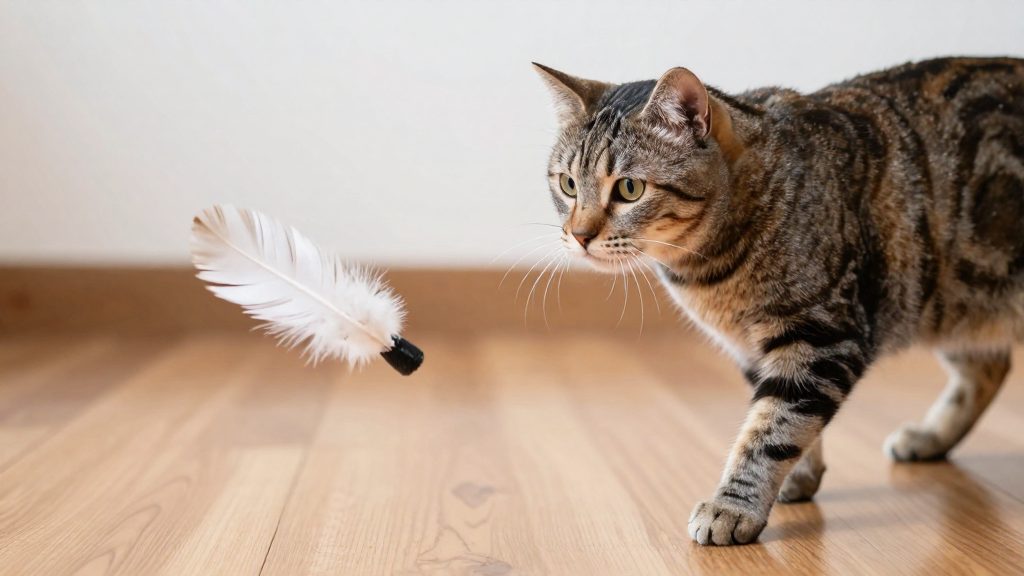
Indoor cats are hunters by design, and a home without prey, distance, or varied terrain offers few chances to act on that drive. Stalking, chasing, and pouncing are the core movements of a feline hunting sequence, and they are what a cat’s daily exercise is built around. The sections below explain which behaviours that sequence includes, how an indoor environment limits them, and why mental stimulation matters alongside physical movement.
Hunting Sequences Are Built Into the Cat
Stalking, chasing, and pouncing are instinctive hunting behaviours. When a cat watches, creeps low, then accelerates and grabs, it is running a complete predatory sequence.
How Indoor Environments Limit Movement
A home has fewer natural movement triggers than an outdoor territory. Without varied terrain or moving prey, many cats spend long periods resting.
Mental Stimulation Alongside Physical Exercise
Movement alone does not fully cover a cat’s needs. According to VCA Animal Hospitals (2023), food puzzles provide enrichment and exercise for sedentary indoor cats, combining problem-solving with physical effort. This pairing is useful when a cat has limited access to active play.
Build a Daily Play Routine
Timing also matters: VCA Animal Hospitals (2023) notes that morning and evening are often productive playtimes.
Anchor Sessions to the Morning and Evening
Start the first session in the morning and the second in the evening. Adjust each session to the cat’s interest, so the schedule works as a starting point rather than a fixed timetable. If the cat ignores a slot, move that session to a time when it is more responsive.
Split Play into Short Bouts
Several short sessions work better than one long one because cats can lose interest during prolonged play (PetMD, reviewed 2024). Keep each bout separate rather than extending one session to cover the whole day.
Stop Before Interest Fades
End each session while the cat is still engaged, before it walks away. Signs that interest is dropping include turning away from the toy, sitting down, or grooming instead of chasing. Finishing on a successful catch also leaves the cat more willing to play at the next session.
Adjust Play to Age and Energy
Play needs change across a cat’s life, and the same session length does not suit every animal. The table below sets out the session approach for each profile.
Kittens
Kitten play tends to centre on pouncing and short bursts of chasing. A practical step is to watch when the kitten is most active during the day and offer a wand toy at those moments, rather than at a fixed time.
Adult Cats
Energy differs between adult cats of similar age, so two adults on the same routine may respond differently. Judge an adult’s energy from its behaviour across several weeks, noting whether it runs, leaps or stalks readily, rather than from a single session.
Senior Cats
Keep toys at floor level and avoid games that require repeated jumping, since these are the movements most likely to strain an older cat. If an older cat shows reduced mobility, ask your veterinarian about its activity limits before changing its routine.
Matching Intensity to Energy Level
| Cat profile | Session approach | Source |
|---|---|---|
| Kitten | More frequent sessions | PetMD (2024-05-08) |
| Adult, high energy | Full range of sessions within the 10–15-minute window | PetMD (2024-05-08) |
| Adult, lower energy | Lower end of the session count | PetMD (2024-05-08) |
| Senior | Regular play at reduced intensity | PetMD (2024-05-08) |
Indoor Games That Encourage Movement
Indoor cats get most of their physical activity from play that triggers hunting behaviour: stalking, chasing, and pouncing. Several tools and setups support this. VCA notes that wand toys, food puzzles, climbing spaces, and rotating toys all add movement to an indoor routine. The sections below compare these formats and explain how each one encourages movement.
Wand Toys and Hunt Sequences
Wand toys are the most direct way to prompt movement. VCA Animal Hospitals / LifeLearn Animal Health (2023) states that wand toys can encourage stalking, chasing, and pouncing, the sequence a cat uses when hunting prey. Moving the toy low to the ground, behind cover, or in short bursts tends to produce the crouch-and-stalk phase, while quick, erratic movement triggers chasing and jumping.
To keep the cat engaged, let it catch the toy at the end of a sequence. VCA also notes that allowing the cat to catch the toy helps prevent frustration. A session that always ends with a capture gives the cat a complete hunt cycle rather than an unfinished chase.
Food Puzzles
Because the cat must work for each piece of food, it moves, reaches, paws, and repositions rather than eating from a bowl in one spot.
Food puzzles are most useful as a supplement to active play rather than a replacement for it, since they add movement mainly through searching and manipulating objects.
Climbing Spaces
AAHA (2024) reports that climbing spaces and rotating toys help create a stimulating indoor environment. Vertical space lets a cat jump, climb, and balance, which adds movement that floor-level toys do not provide. Placing perches or shelves at different heights gives the cat several routes around the home.
Rotating Toys
Rotating toys work through novelty. Keeping a set of toys out of sight and swapping them every few days maintains interest in each one.
What If Your Cat Won’t Play?
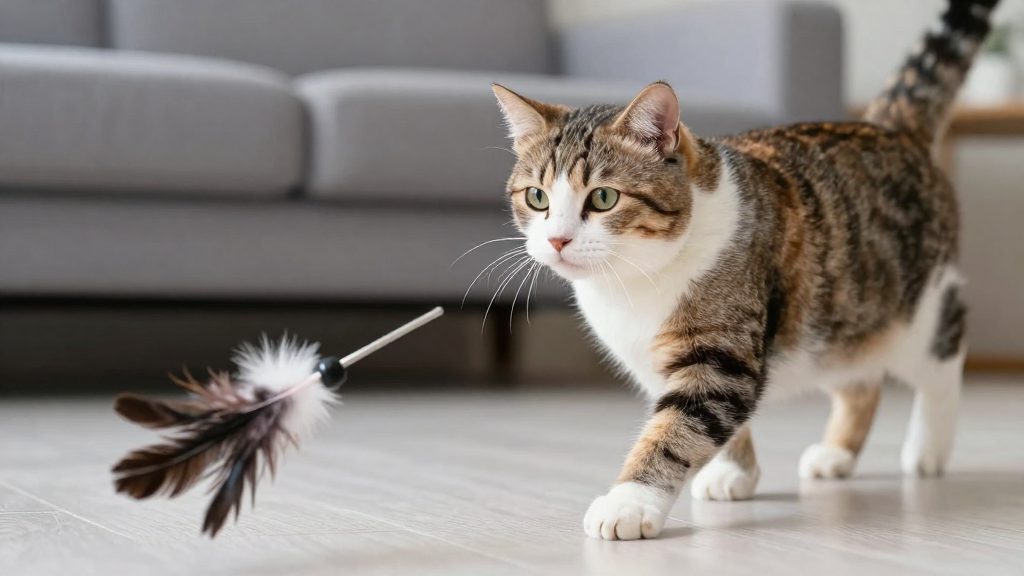
A cat that ignores toys is not automatically a cat that needs more exercise, and it is not automatically a sick cat. Low play interest usually has one of two sources: something in the toy or environment discourages play, or the cat’s interest has dropped for reasons that need a closer look. Start by ruling out the first, then track the second over several weeks before changing the routine.
Check whether the toy or setting discourages play
Look at the play setup before blaming the cat. Several factors can suppress engagement:
- Timing: Play attempted when the cat is normally asleep or eating may get little response.
- Environment: A room with no vertical space or a single toy left permanently in the same place offers little novelty.
- Food puzzles: A cat that has lost interest in a wand may still work for food.
Separate low interest from a sudden behaviour change
Gradual disinterest in play and an abrupt change in behaviour are different problems.
- Gradual decline over weeks often tracks with a toy that has become familiar, a change in household routine, or a cat that has grown older. A decline should prompt an adjustment rather than an assumption that play no longer matters.
- Sudden change in play, or play alongside other signs, needs different handling.
Monitor play interest over several weeks
Keep a simple log for two to four weeks before drawing conclusions. Record:
- Date and time of each session.
- Session length in minutes.
- Response: stalks, chases, pounces, ignores, or walks away.
- Changes made: toy, location, or time of day.
If the log shows engagement improving after a change, keep that change. If the cat shows no response across varied toys, times, and locations for several weeks, or if the log shows a sudden shift, contact your veterinarian rather than continuing to adjust the toys alone.
When to Call Your Veterinarian
Play and exercise solve many indoor-cat problems, but some signs point to a health issue rather than under-stimulation. Overgrooming, excessive vocalization, inactivity and destructive behavior can accompany boredom, yet they can also reflect a medical problem. PetMD (2026) states that sudden or significant behavioral changes warrant veterinary advice. Because the same signs appear in both cases, behaviour alone cannot tell you whether a cat is bored or unwell, and a cat that changes suddenly should be examined before its play routine is increased.
Overgrooming and Excessive Vocalization
Overgrooming means a cat licks or chews its fur to the point of bald patches, skin irritation or visible hair loss. Excessive vocalization means meowing or yowling that is louder, more frequent or at different hours than the cat’s usual pattern. Both can be signs of understimulation, but they can also be signs of pain, skin disease or other medical conditions. Note when the behavior started, how often it happens and whether it is new for that cat.
Sudden or Significant Behavior Changes
Contact your veterinarian when a cat that was previously active becomes markedly inactive, withdraws from people or household routines, or starts destructive behavior it did not show before. A change of this kind is a reason for veterinary advice, not for simply adding more toys. Record the date of the change, the activities affected and any changes in appetite, drinking or litter-box use to share with the clinic.
Medical Problems That Mimic Understimulation
Several medical problems produce the same signs as boredom: lower activity, weight change, restlessness at night and attention-seeking. A veterinarian can check for these conditions during an examination. Do not assume that a cat with these signs needs only more play until a health problem has been ruled out.