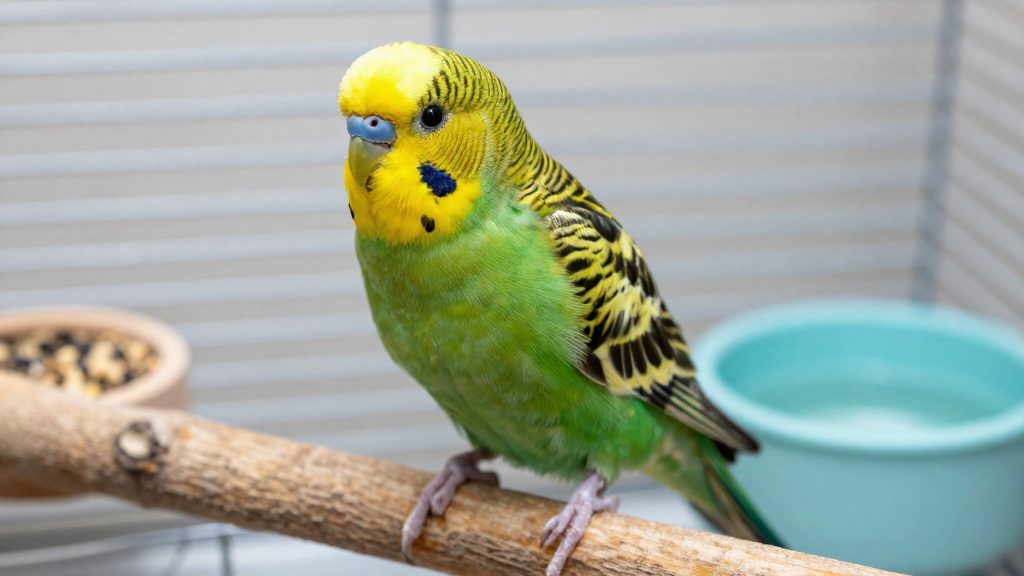
Budgies are flock birds, and VCA Animal Hospitals (2022-10-17) describes them as generally very social, gentle and affectionate. Before adopting, a first-time owner should confirm that the household can provide daily interaction, time out of the cage and a predictable routine. Space matters, and so does the time people can give the bird each day: budgies are social, so a household should be able to provide both.
What should first-time budgie owners know before adopting?
Flock-bird social needs and daily companionship
A flock bird is adapted to constant contact with others, so a budgie kept alone depends on its people for that contact. Short, occasional visits are unlikely to meet that need.
Age also affects how easily a bird adjusts. According to VCA Animal Hospitals (2022-10-17), young budgies are easier to tame, and early exposure to people, other pets, car trips and vet visits helps them adapt. When choosing a bird, ask the breeder or shelter how it was handled as a young bird and whether it has experienced these situations.
Single bird versus pair
- One budgie: all social contact comes from its owner, so daily attention is essential for its wellbeing.
- Two budgies: the birds have company, but you are responsible for two animals’ daily care, observation and interaction.
The official sources consulted do not specify how much daily time either option requires, so assess your own schedule honestly before deciding.
Noise, mess and long-term commitment
Because budgies fly and chew, expect feather debris, chewed material and droppings around the cage area. Budgies can be vocal and vocalise through the day, so consider how that sound will fit into a shared living space. The commitment is long-term: a budgie is a companion for its whole life, and the sources consulted do not give a lifespan figure to plan around.
Choosing a healthy budgie
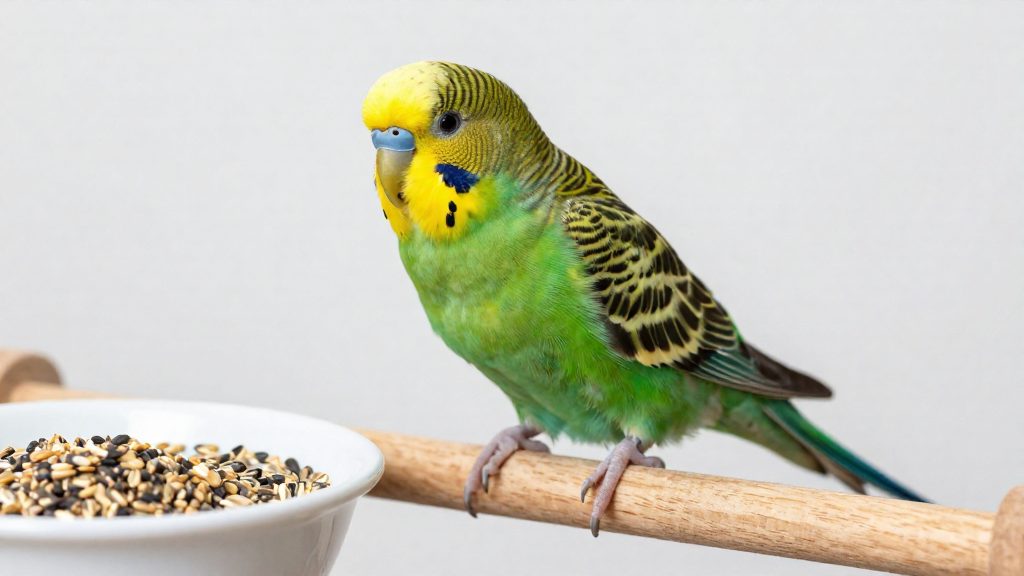
Judging a budgie’s health at the point of purchase combines two checks: observing the bird’s behaviour, and having it examined by an avian veterinarian. According to VCA Animal Hospitals (2022-10-17), a lively, alert bird that is not easily frightened is most likely healthy. Behaviour gives a first impression during the visit. The examination checks what observation cannot show.
Alertness and responsiveness as a health indicator
Alertness is the first thing to assess. A healthy budgie is lively and alert, and it is not easily frightened. Observe the bird from outside the cage, without handling it, for several minutes. Note whether it reacts to movement and sound in the room, whether it moves actively around the cage, and whether it stays calm when people approach. A bird that startles easily does not match the description of a healthy, alert bird, although stress can also explain it, so confirm with a veterinary examination.
A single observation is limited. A bird can look subdued because it is stressed by the sale environment, and a calm bird in a quiet room does not prove good health. Repeat the observation at a second visit if you can, and compare what you see with what the seller describes.
Examination of a new bird by an avian veterinarian
VCA states that a new bird should be examined by a veterinarian experienced with birds. The buyer’s role is to request the examination, not to perform it. Ask the seller whether the bird has already been seen by an avian vet. If it has not, arrange the examination before the sale is completed.
| Check | Carried out by | Purpose |
|---|---|---|
| Behavioural observation | Buyer, at the seller’s premises | First impression of alertness and responsiveness |
| Avian veterinary examination | Avian veterinarian | Assessment of a new bird by a vet experienced with birds |
Questions to ask sellers, breeders and shelters
Ask these questions before deciding, and compare the answers with your own observations:
- Has the bird been examined by a veterinarian experienced with birds? If yes, can you see the record?
- How has the bird been behaving recently, and is it alert when people approach?
- Will you allow an avian veterinary examination before payment?
- Can I observe the bird for several minutes, outside the cage, before deciding?
- Where have the birds been housed, and have any birds recently been unwell or died? A reluctance to answer is itself a point to weigh.
Setting up the cage and home
A budgie spends much of its day in its cage, so the setup should support flight, chewing and safety from the first day. According to VCA Animal Hospitals (2022-10-17), budgies enjoy flying, playing and chewing. Their enclosure and surroundings therefore need non-toxic, pet-safe toys, space to move, and protection from household hazards.
Cage size and layout
- Choose the largest cage the space allows, favouring horizontal length so the bird can fly short distances between perches.
- Keep bar spacing narrow enough that the bird cannot get its head or feet caught between the bars.
- Place perches at different heights and in different thicknesses so the bird can move between them and exercise its feet.
- Position perches so droppings do not fall directly into food or water dishes.
Toys for chewing and play
- Offer a rotating selection of toys made from materials labelled non-toxic and pet-safe.
- Check toys regularly for splinters, loose parts and pieces that could be pulled off and swallowed.
- Remove damaged toys promptly rather than leaving them in the cage.
- Include a mix of chewable and manipulable items, since budgies enjoy both chewing and playing.
Placement in the room
- Keep the cage away from draughts, open windows and air-conditioning outlets.
- Keep it away from heaters, which can cause sudden temperature swings around the cage.
- Avoid kitchens, where cooking steam and fumes can reach the bird.
- Choose a spot in a room where people spend time, so the bird can see activity, but with a quieter corner where it can retreat.
What do budgies eat?
A daily budgie diet is built from three components: a formulated base, fresh produce, and a limited amount of seed. The official sources consulted for this guide do not specify exact proportions, portion sizes, or a complete list of safe foods, so the practical approach is to set the base first and add variety on top of it. Ask an avian veterinarian to confirm the plan for your bird, especially in its first weeks at home.
Seed-only versus formulated pellet diets
A seed-only diet is easy to offer but gives the bird a narrow choice of nutrients, and budgies tend to pick the seeds they like and leave the rest. A formulated pellet diet is designed to supply a more consistent set of nutrients in every bite, so it is usually used as the main component, with seed and fresh food added around it. Switching from seed to pellets is a gradual process: offer pellets alongside the usual seed, then reduce the seed over time while watching whether the bird eats the new food.
| Component | Role in the daily diet | Practical handling |
|---|---|---|
| Formulated pellets | Main, consistent base | Keep a fresh supply in the bowl |
| Seed | Supplementary, palatable treat | Offer in limited, measured amounts |
| Fresh vegetables | Variety and moisture | Remove uneaten produce before it spoils |
| Fruit | Occasional addition | Keep portions small relative to the vegetables |
Fresh vegetables and fruit
Fresh vegetables are the simplest way to add variety. Wash them, serve them at room temperature, and remove leftovers before they wilt or spoil. Fruit can be offered, but it should be a smaller share of fresh food than vegetables, because sugary items can encourage the bird to fill up on them.
Foods to avoid
Do not share human food from the table without checking it first. The consulted sources do not give a full list of foods toxic to birds, so treat any food not confirmed as safe for birds as off-limits, and ask an avian veterinarian about specific items before offering them.
How do you settle in and tame a new budgie?
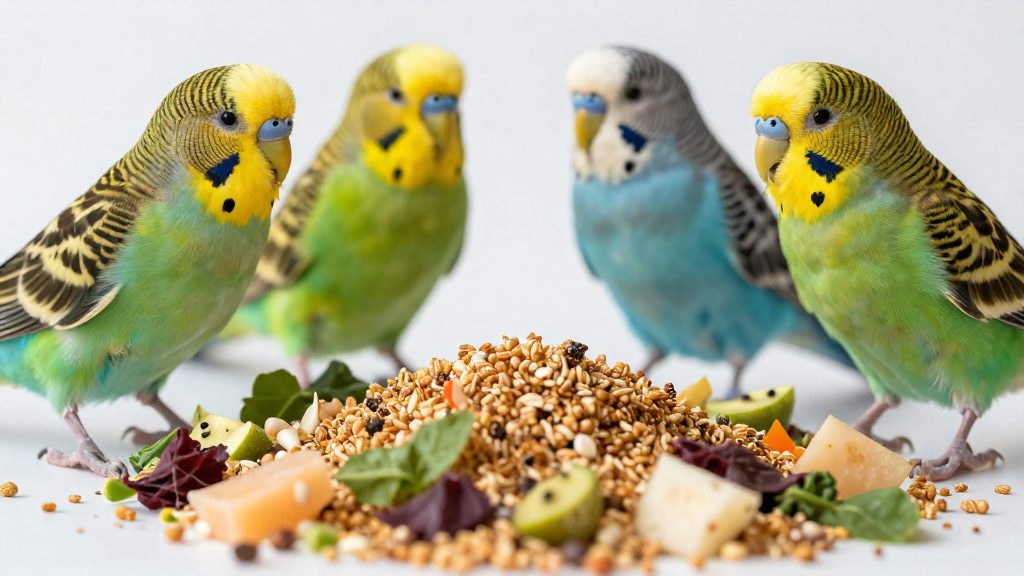
A new budgie needs a quiet settling period before anyone tries to handle it, followed by a short, repeated routine that builds trust one session at a time. The approach is patient rather than forceful: let the bird learn its surroundings and the people in them first, then introduce hands in brief, predictable sessions.
Give the bird a quiet settling period
Place the cage in a calm part of the home and keep the first days low-stress. Limit visitors, avoid sudden loud noise near the cage, and let the bird watch household activity from a distance. Use the early days to observe how the bird moves, feeds and responds to nearby activity. The official sources consulted do not specify a fixed number of days for this phase, so judge progress by the bird’s behaviour rather than by a calendar.
Hand-tame through short, consistent daily sessions
Hand-taming works through repetition rather than duration. Offer a finger or hand at perch level, use the same time of day and the same calm voice, and end each session before the bird shows fear. Ending on a neutral or positive note makes the next session easier. Move your hand toward the bird gradually instead of reaching quickly into the cage. Short daily sessions are more effective than occasional long ones, because the bird learns a predictable pattern.
Build early exposure to people, pets and car trips
Young budgies are easier to tame, and early exposure helps them adjust to new situations (VCA Animal Hospitals, 2022-10-17). Introduce household members one at a time, and keep other pets outside the cage and at a distance during introductions. For car trips, use a secure carrier and keep early journeys short and calm, so the bird associates travel with a stable routine rather than with stress. Vet visits also count as exposure to new environments, and the same calm, gradual approach applies.
Signs of illness: when to see a vet?
A budgie hides illness well, so the most reliable signal is a clear change from its normal behaviour, not a single dramatic symptom. Any change in alertness, posture, droppings, appetite or breathing warrants contacting an avian veterinarian promptly, and breathing difficulty is an emergency. The sooner a change is reported, the more useful the history the vet has to work with.
Fluffed posture, lethargy and withdrawal
Observe the bird from outside the cage for a few minutes each day so you know its baseline.
- Fluffed posture: Feathers held out and puffed up, especially when the bird is sitting still, can signal that it is trying to conserve body heat and feels unwell.
- Lethargy: Sitting on the floor of the cage, sleeping during normal active hours, or not responding to familiar sounds and voices.
- Withdrawal from the flock: A budgie that normally joins its companions and stops doing so, or stays apart from them, has changed its social behaviour.
Changes in droppings, appetite and breathing
| Area | What to observe | Why it matters |
|---|---|---|
| Droppings | Colour, consistency and volume compared with the bird’s usual pattern | Changes can indicate digestive or urinary problems |
| Appetite | Less food eaten, or no food taken over a period of the day | A budgie that stops eating can deteriorate quickly |
| Breathing | Open-beak breathing, tail movement with each breath, or a clicking or wheezing sound | Breathing effort is a sign of respiratory distress |
The official sources consulted do not specify numeric thresholds for these changes, so the comparison is always with the bird’s own normal routine.
Urgent versus same-day veterinary care
The official sources consulted do not provide a symptom-by-symptom triage list, so the following division reflects general veterinary practice rather than a verified scale.
| Care level | Typical signs | Action |
|---|---|---|
| Urgent | Visible breathing effort, collapse or inability to perch, a bird sitting on the cage floor, or a fluffed, lethargic bird that is not eating | Contact an avian veterinarian immediately |
| Same day (at the latest) | A clear change in droppings, or reduced appetite, with the bird otherwise alert | Contact an avian veterinarian today. If the bird is also fluffed, lethargic, withdrawn or has stopped eating, treat it as urgent and call immediately |
Vet checkups and avian vet care
Budgies need veterinary health checkups twice a year, about every six months, according to VCA Animal Hospitals (2022-10-17). These twice-yearly checkups are preventive. They are scheduled whether or not the bird seems unwell, so the vet can compare the bird against its normal condition over time. Waiting for obvious symptoms removes that comparison.
Locating an avian veterinarian
Experience with birds, rather than a general small-animal qualification alone, is the criterion to check. To find one:
- Ask each clinic directly whether it treats birds and which staff member sees them.
- Check whether the clinic’s veterinarian has specific avian experience, and ask how many birds they see.
- Identify an avian-capable clinic before any emergency, so you are not searching while the bird is unwell.
What a routine avian examination involves
The official sources consulted do not specify the full list of procedures in a routine avian examination, so this section does not describe them. Your role is to prepare the information the vet will need:
- Write down the bird’s diet, including any changes to seed, pellets, fresh food or water.
- Note any changes you have observed in eating, drinking or droppings since the last visit.
- Describe the housing, including cage size, perches and the toys in use.
- Transport the bird in a secure carrier, and bring the written notes to the appointment.
- Ask the vet to explain the findings and confirm the date of the next checkup.
Keeping the schedule
Record the date of each visit and set a reminder for six months later. Keeping a written log of visits makes it easier to spot gaps in care and gives the vet a consistent history.
Frequently asked questions
Do I need to find an avian veterinarian before buying a budgie?
Yes. According to VCA Animal Hospitals (2022-10-17), a new budgie should be examined by a veterinarian experienced with birds. Find an avian veterinarian before you need one, because budgies can decline quickly and an emergency visit leaves little time to search.
What should I do if my budgie seems unwell?
Contact an avian veterinarian promptly if the bird shows any change in alertness, posture, droppings, appetite or breathing. Visible breathing effort, collapse, an inability to perch or a bird sitting on the cage floor are emergencies that need immediate contact. The official sources consulted do not specify a triage scale, so a fluffed bird that is also lethargic or refusing food should be treated as urgent.
Can an adult budgie still learn to accept handling?
VCA Animal Hospitals (2022-10-17) states that young budgies are easier to tame, which suggests that older birds may need more time to adjust. The official sources consulted do not give a timeline for taming an adult bird, so progress will depend on the individual bird and its history.