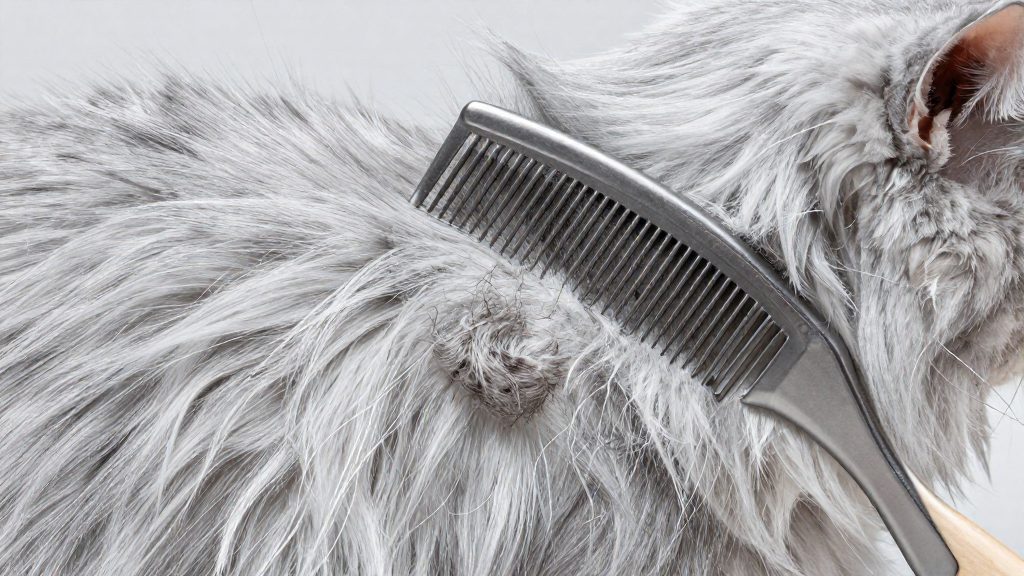
Long-haired cats need home grooming because their coats tangle and compact faster than the cat can undo them alone. According to PetMD (Dr. Jenny Alonge, 2026-09-30), mats can be caused by infrequent brushing, moisture, trapped undercoat, friction from collars, harnesses or bedding, and illness or pain that stops a cat from grooming itself. Several of these factors act at once, so a mat can form in one area even when the rest of the coat looks smooth. Owners who understand these causes can see where to check the coat and why waiting for visible knots is not enough.
Why do long-haired cats need grooming at home?
How trapped undercoat leads to felting
Many long-haired cats carry a dense undercoat beneath longer outer hairs. When loose undercoat stays in the coat, it catches on the outer hairs and on neighbouring strands. Over time these fibres press together and felting begins close to the skin, where the hair is most compacted. PetMD (2026-09-30) lists trapped undercoat as a direct cause of mats, which is why loose hair needs lifting out before it binds.
Friction from collars, harnesses and bedding
Anything that rubs the same patch of fur repeatedly accelerates tangling. PetMD (2026-09-30) names friction from collars, harnesses and bedding as a mat cause.
Moisture and loss of self-grooming
| Factor | Where mats tend to start | Source |
|---|---|---|
| Moisture | Not specified by location in the consulted source | PetMD (Dr. Jenny Alonge, 2026-09-30) |
| Trapped undercoat | Dense areas of the coat | PetMD (Dr. Jenny Alonge, 2026-09-30) |
| Friction from collars, harnesses or bedding | Mats often form under the legs, on the hindquarters, on the chest and around the collar (listed by VCA as common mat areas, not linked to a single cause) | PetMD (2026-09-30); VCA Animal Hospitals (2026) |
Moisture is listed by PetMD (Dr. Jenny Alonge, 2026-09-30) as one of the causes of mats. Illness is the other route. VCA Animal Hospitals (2026) notes that a cat that stops grooming itself may have a painful mouth condition, arthritis or obesity. When a cat’s self-grooming declines, the owner becomes the only source of coat maintenance. A drop in grooming is therefore a signal about the cat’s health as well as its coat.
Tools you actually need
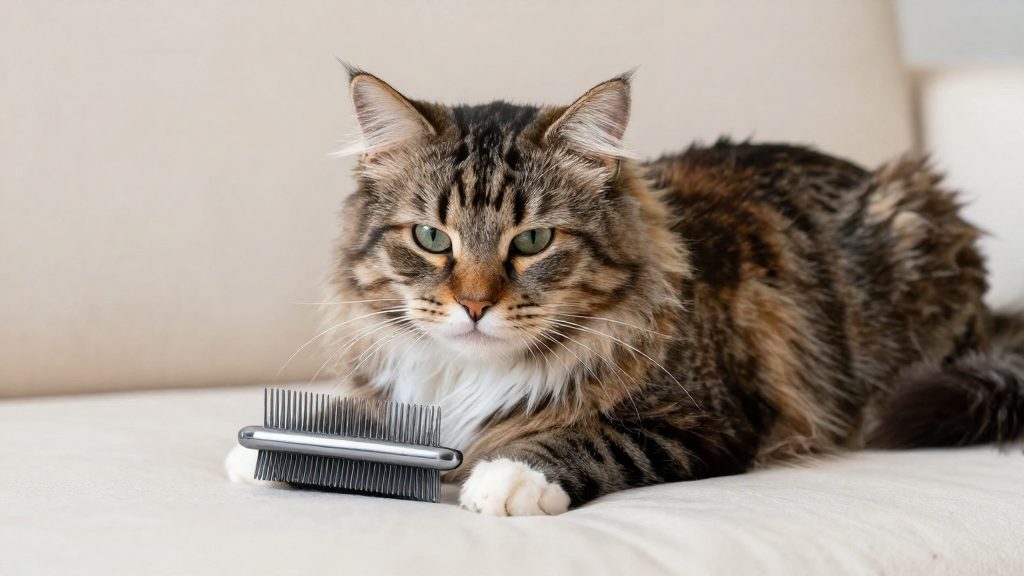
A home kit for a long-haired cat needs three tools: a wide-tooth comb, a slicker brush, and a mat breaker kept for small problems. The tools below are for a daily routine. None of them is meant for heavy removal work.
| Tool | Intended use | Limit stated by the sources |
|---|---|---|
| Wide-tooth comb | Used after loosening a small, loose tangle with the fingers | Only for a few small, loose tangles (PetMD, 2026-09-30) |
| Slicker brush | Used on small, loose tangles after loosening them with the fingers | Only for a few small, loose tangles (PetMD, 2026-09-30) |
| Mat breaker or dematting tool | Small mats | Suitable only for small mats (VCA Animal Hospitals, 2026) |
The wide-tooth comb is used after the tangle has been loosened with the fingers, on a few small, loose tangles (PetMD, 2026-09-30).
The slicker brush handles the surface coat. Use it on small, loose tangles after loosening them with your fingers, not on an established mat.
The mat breaker or dematting tool is designed for small mats only. VCA Animal Hospitals (2026) states that it can be used on small mats.
How often should you brush a long-haired cat?
Brush a long-haired cat daily as the baseline routine. VCA Animal Hospitals (2026) advises brushing or combing every day, with extra attention to the areas that mat. A daily pass removes loose hair before it tangles against the skin, so the coat stays easier to manage. The official sources consulted do not specify a set session length, so judge each session by coat condition rather than by a timer.
Daily brushing is the baseline. Each session should also check the areas where mats often form, as listed by VCA Animal Hospitals (2026):
| Zone | What to check during the daily pass |
|---|---|
| Legs | The areas under the front legs, where mats commonly form |
| Hindquarters | The back legs and rear flanks, where hair is prone to knotting |
| Chest | The fur on the front of the chest, below the chin |
| Collar | The neck area under and around the collar or harness line |
Work through each zone before moving on, so that a small tangle is not missed. Lift the coat with your hand and look at the skin beneath, not just the top layer of fur.
Brushing step by step
A full brushing session works best in a fixed order: a quiet setup, strokes that follow the coat, and a positive finish. Keep each session short enough that the cat stays comfortable.
Set up a calm, quiet spot
Choose a quiet room where the cat will not be disturbed. A towel under the cat can give it a more secure grip, whether on a table or on your lap. Have the brush within reach before the cat settles, so you do not have to move away mid-session. Speak softly and keep your movements slow.
Brush with the grain, layer by layer
Brush in the direction the hair grows, working from the head toward the tail. As general practice, lift the top layer of the coat with one hand and brush the layer beneath it. Work in small sections and finish one area before starting the next. Use short, gentle strokes and pause between sections. Keeping the same direction throughout makes each pass easier for the cat to tolerate.
Watch for signs to stop
Stop if the cat cries, snaps or resists handling. PetMD (Dr. Jenny Alonge, 2026-09-30) advises getting a groomer or vet to deal with the mat in that case, and also for any mat that is tight to the skin, large, or won’t loosen with gentle brushing.
End on a positive note
Finish while the cat is still calm, before it becomes tired or irritated. Offer a treat or a favourite toy, and let the cat leave the spot on its own terms. Ending with a reward links brushing to a pleasant experience, which makes the next session easier to begin.
How do you remove a small mat safely?
To remove a mat safely at home, you only work on a few small, loose tangles. According to PetMD (2026-09-30), the method is to loosen the tangle with your fingers first, then use a wide-tooth comb or slicker brush, working from the outer edge toward the skin with short, gentle strokes and breaks. If the tangle does not loosen with this gentle brushing, stop there rather than forcing it.
Loosen the tangle with your fingers
Before any tool touches the coat, separate the hair inside the tangle with your fingertips. Gently pull the fibres apart so the knot becomes a looser cluster. Hold the coat at the base of the mat with your other hand so the pulling force does not travel down to the skin. This step reduces the work the comb has to do and shows whether the tangle is loose enough for home removal.
Work from the outer edge toward the skin
Once the outer strands move, start at the free tip of the mat and comb or brush inward toward the skin. Do not begin at the skin and pull outward. Each pass releases hair from the open end, so the tangle shrinks rather than tightening against the body. Keep the teeth or bristles angled so they glide through the loosened hair instead of catching on the knot.
Use short strokes and take regular breaks
Make short, light strokes rather than long, forceful drags. Pause between sections so the cat can settle, and check the coat for progress before continuing. A calm, repeated process protects both the skin and the cat’s tolerance for grooming.
Why scissors are a bad idea
The risk comes from what sits under the mat, not from the blades alone. A mat is a dense, felted layer of hair, and the skin beneath it is hidden from view. When you cut, you cannot see exactly where the skin is, so a small slip can injure it. The problem is greatest with mats that lie tight against the body, because there is little space between the blade and the skin.
Electric shavers are restricted to experienced users. VCA Animal Hospitals (2026) advises that an electric shaver should only be used by someone experienced with one. A shaver removes the mat by running a blade close to the skin, so the same tissue that scissors threaten is still at risk. Shaving is therefore not a neutral fallback for an owner who has never clipped an animal. If you have not used an animal clipper on a cat before, the official guidance is to set the shaver aside rather than learn on a matted coat.
When to see a vet or groomer
A mat needs a vet or professional groomer once it is tight against the skin, large, widespread, or will not loosen with gentle brushing. Skin that is red, raw, moist or broken is an emergency. Past that threshold, the risk of injuring the skin outweighs the benefit of continuing at home. VCA Animal Hospitals (2026) advises seeing a vet or groomer if the cat will not tolerate mat removal at home, and notes that a vet can sedate the cat for pain-free removal.
Escalation triggers
- Mats tight against the skin.
- Large mats, or mats spread across the coat.
- Mats that do not loosen with gentle brushing.
- A cat that cries, snaps or resists handling during the work.
Sensitive areas
Mats near the eyes, ears, genitals or anus go to a vet or groomer under the same advice, according to PetMD (Dr. Jenny Alonge, 2026-09-30). These areas sit close to delicate structures, so the cat’s distress and the risk of injury are both higher.
Skin changes around a mat
| Sign at or near a mat | Action | Source |
|---|---|---|
| Redness, swelling, odour, moisture or discharge at or near a mat | See a vet. If the skin is red, raw, moist or broken, treat it as an emergency | PetMD (Dr. Jenny Alonge, 2026-09-30) |
| Skin that is red, raw, moist or broken | Treat as an emergency; sedation or anesthesia may be needed for safe removal | PetMD (Dr. Jenny Alonge, 2026-09-30) |
Mats as a symptom
A cat that stops grooming itself may have a painful mouth condition, arthritis or obesity, according to VCA Animal Hospitals (2026). In that case the mats may point to an underlying problem, so a vet examination is advisable alongside the coat work.
Frequently asked questions
Can I cut a mat out of my cat’s coat with scissors?
No. According to VCA Animal Hospitals (2026), cutting a mat out with scissors risks injuring the cat’s skin, which is easily damaged. A mat breaker or dematting tool is the safer option for small mats, and an electric shaver should only be used by someone experienced with one.
When should I stop trying at home and call a professional?
Call a groomer or vet if a mat is tight to the skin, large, or won’t loosen with gentle brushing. PetMD (Dr. Jenny Alonge, 2026-09-30) also advises professional help if the cat cries, snaps or resists handling, or if the mat sits near the eyes, ears, genitals or anus. Redness, swelling, odour or discharge also warrant a vet visit.
My cat has suddenly stopped grooming itself. Is that a problem?
It can be. VCA Animal Hospitals (2026) notes that a cat which stops grooming may have a painful mouth condition, arthritis or obesity. Because a loss of self-grooming can signal pain, book a vet check rather than relying on more brushing alone.