Most dogs need their nails trimmed about once a month, according to VCA Canada (2025). Dogs walked often on pavement or concrete may need trims less often, while inactive dogs may need them about every three weeks. The clearest sign that a trim is overdue is nails that touch the ground or click on hard floors.
How often should you trim a dog’s nails, and how do you spot overgrowth?
Typical trim interval
The schedule depends mainly on how much the dog walks on hard ground:
| Dog’s routine | Typical trim interval |
|---|---|
| Most dogs | About once a month |
| Walked often on pavement or concrete | Less often than monthly |
| Inactive | About every three weeks |
Frequent walking on pavement or concrete may reduce how often trims are needed, but it does not remove the need for checks. A dog’s routine can change over the year, so the nails should be inspected rather than trimmed only on a calendar date.
Warning signs that nails are already overgrown
Two signs show that overgrowth is already a problem:
- Nails touching the ground when the dog stands on a flat surface.
- Clicking on hard floors such as tile, wood or concrete as the dog walks across them.
When either sign appears, a trim is due now rather than at the next scheduled date.
When to seek help instead of trimming at home
If nails need trimming urgently and the dog cannot be calmed at home, go to a vet or groomer first. Attempting a forced trim on a distressed dog is not the recommended route, according to VCA Canada (2025).
What tools do you need for a home nail trim?
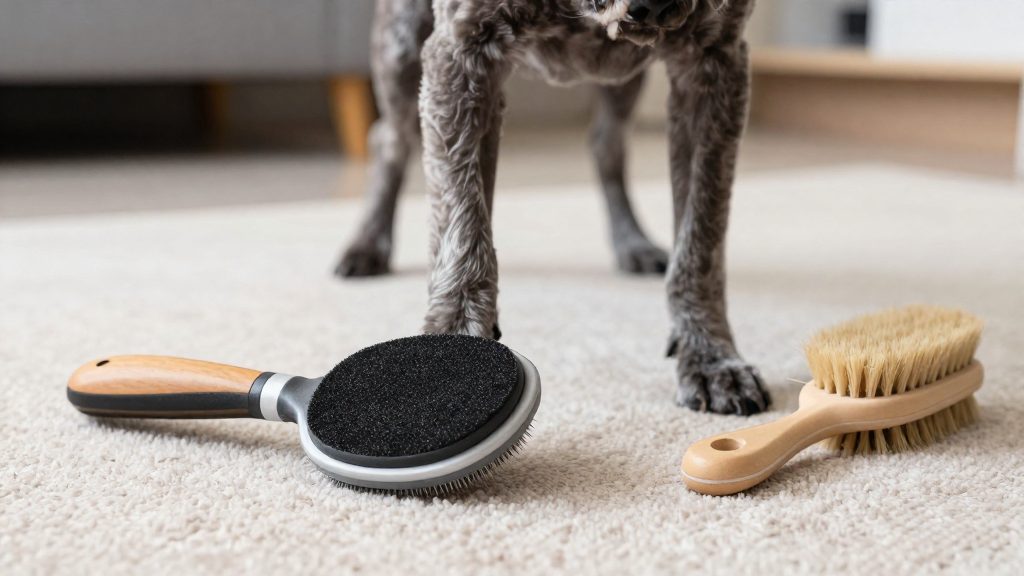
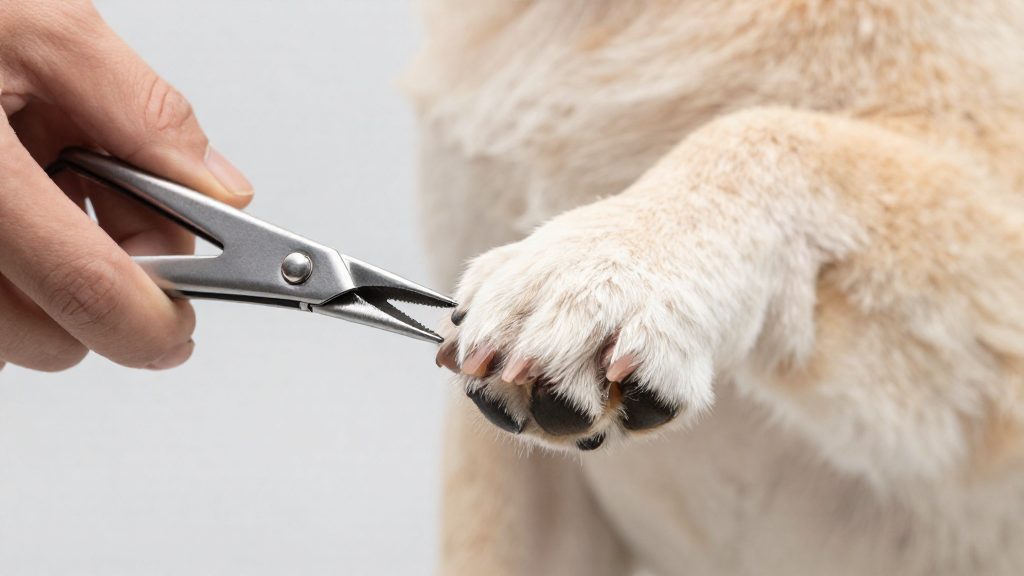
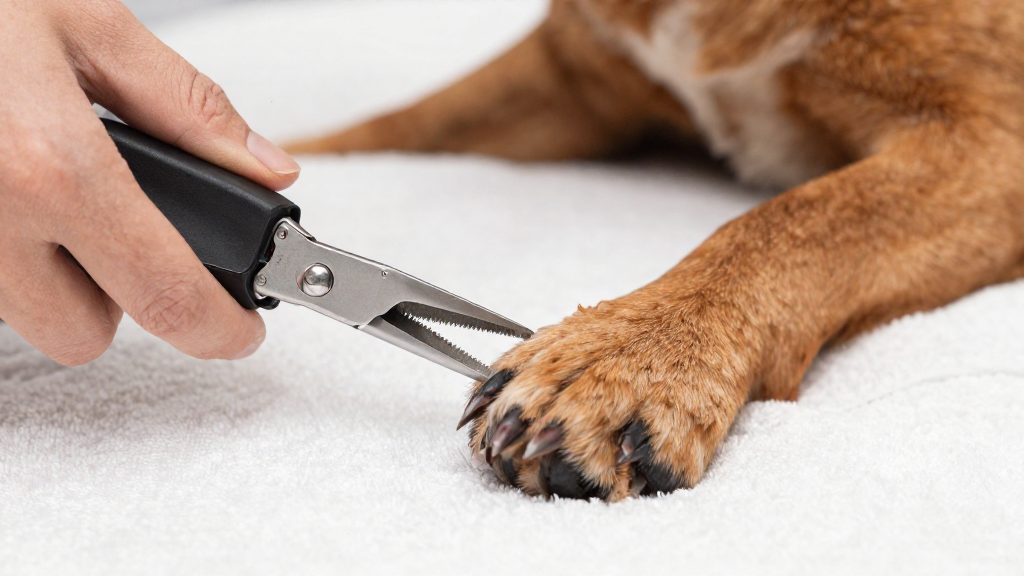
Home nail trims use either cutting tools or abrasive tools. According to VCA Canada (2025), guillotine-style clippers and scissor-style clippers both work for cutting. A handheld file or a grinder is an alternative that leaves a smooth edge. The choice depends on the dog’s nails and on which tool the owner can hold steadily.
Cutting tools
- Guillotine-style clippers have a loop that the nail passes through, closed by a single blade that slides across it.
- Scissor-style clippers use two blades that meet at a pivot, like small scissors.
VCA Canada (2025) lists both styles as working options. The official sources consulted do not specify a difference between them, so the choice comes down to which one the owner can position accurately.
Abrasive tools
- Handheld file: wears the nail down gradually instead of cutting it. VCA Canada (2025) notes that a file leaves a smooth edge.
- Grinder: a rotating abrasive head. VCA Canada (2025) notes that a grinder leaves a smooth edge, and that it can tangle in long hair and burn if it slips.
Matching the tool to the dog
For dogs with long hair around the paws, a grinder needs extra care, because the hair can tangle in the rotating head. The official sources consulted do not specify how to choose between the tools beyond these features, so pick the tool you can hold steadily and position accurately.
How do you find the quick on light and dark nails?
The quick is the pink blood supply inside each nail, and the cutting limit is set by how visible it is. On light nails, the quick shows as a pink area through the nail, so you can measure your cut from it. According to VCA Canada (2025), you should cut about 2–3 mm away from the quick on light nails. On dark nails, the quick cannot be seen through the nail, so you cannot measure from it. The same source advises trimming only the very tip of a dark nail.
| Nail colour | How the quick appears | Cutting limit (VCA Canada, 2025) |
|---|---|---|
| Light or clear | Visible as a pink area inside the nail | Cut about 2–3 mm away from the quick |
| Dark | Not visible through the nail | Trim only the very tip |
The source does not specify a visual cue for locating the quick in dark nails. For dark nails, trim only the very tip in small 1–2 mm cuts, and ask a vet or groomer to show you if you are unsure.
How to trim your dog’s nails step by step
Trimming works best as a short, repeated sequence: confirm the nail needs cutting, remove a small amount, check the result, then decide whether to continue.
| Step | Action | Check before moving on |
|---|---|---|
| 1 | Hold the paw and compare the nail’s length with the ground | Does the nail touch the ground or click on hard floors? |
| 2 | Take one cut of 1–2 mm | Is the cut face clean and free of any pink? |
| 3 | Stop and reassess | Is the nail now clear of the ground? |
| 4 | Repeat on the same nail only if still needed | Is the nail at the length you want? |
| 5 | Move to the next nail | Has every nail been checked? |
Keep each cut to 1–2 mm
Work in 1–2 mm increments. VCA Canada (2025) recommends small cuts rather than one large one, because each small cut shows you how close you are to the quick.
Include the dewclaws
The dewclaws sit higher on the leg and do not touch the ground, so they are easy to miss. VCA Canada (2025) notes that they can overgrow, so check them in every session, not only when the other nails look long.
Reassess after every cut
After each cut, pause and check the nail before continuing. Stop when the nail no longer touches the ground, and do not force a finished length in one session. Ending the session early is a valid choice, and the next trim can pick up where this one stopped.
What should you do if you cut the quick?
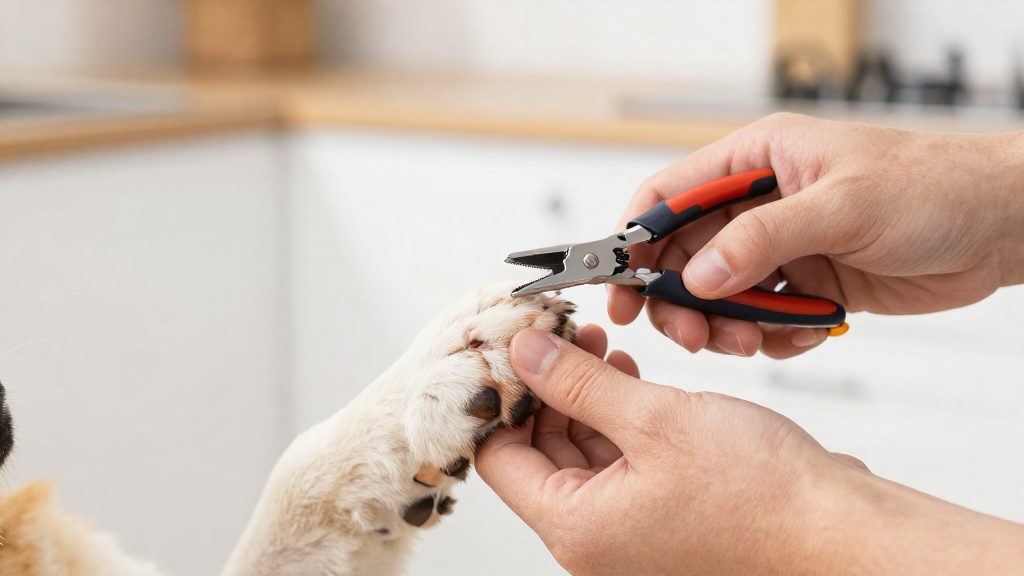
If you cut into the quick, the pink blood supply inside the nail, stop the bleeding first. According to VCA Canada (2025), the standard response is to apply styptic powder directly to the bleeding nail. Keep the dog still, hold the paw steady, and press the powder onto the cut surface. Hold the paw steady until the bleeding slows. If the bleeding does not stop, contact a vet.
Styptic powder is the product designed for this purpose, so keep a tin of it near the clippers before you start any trim. Do not wait until the nail is already bleeding to look for it.
When styptic powder is not available
VCA Canada (2025) states that flour or cornstarch can be used as a substitute if styptic powder is not on hand. Apply it the same way: press a small amount onto the bleeding nail and hold the paw still until the bleeding slows. Household flour and cornstarch are not designed for wound care, so they are a stopgap, not a replacement for styptic powder. Buy a tin before the next trim so the substitute does not become the routine.
Immediate steps at a glance
| Step | Action | Source |
|---|---|---|
| 1 | Keep the dog still and steady the paw | General handling practice |
| 2 | Apply styptic powder directly to the bleeding nail | VCA Canada (2025) |
| 3 | If no styptic powder, apply flour or cornstarch | VCA Canada (2025) |
| 4 | Keep the paw still until the bleeding slows | General handling practice |
Do not trim the same nail again
Once the bleeding has stopped, leave that nail alone for the rest of the session. Cutting the same nail again reopens the wound and restarts the bleeding. Finish the remaining nails on the paw or in the session only after the bleeding has stopped and the dog has settled.
How can you help an anxious dog accept nail trims?
An anxious dog learns to accept nail trims through gradual desensitization: short, repeated sessions in which the dog is handled in small steps and rewarded at each one. According to VCA Canada (2025), reducing stress depends on using treats and praise and training gradually. The source recommends training gradually rather than starting with a full trim. Each session should instead make paw handling predictable, so the dog starts to link it with something positive.
Progress one step at a time
Move to the next stage only when the dog stays relaxed at the current one.
| Stage | What to do | Reward |
|---|---|---|
| 1. Paw handling | Touch the paws without trimming | Treat and praise |
| 2. First nail | Trim one nail, then reward the dog | Treat and praise right after the cut |
| 3. Remaining nails | Trim the remaining nails one at a time, only while the dog stays relaxed | Treat and praise at each nail |
Keep the reward tied to the specific action. Give the treat and praise during each step, not only at the end of the session, so the dog connects the reward with the handling.
Use a helper and a distraction
A helper can hold the dog gently while the handler works on the paw. If the dog becomes distressed, stop rather than restrain it harder. Smearing peanut butter on a wall or door gives the dog something to lick during the process, which occupies its attention while the paw is handled.
When should you see a vet or groomer?
Home trimming is the usual approach, but it stops being the right option when a nail needs urgent attention and the dog cannot be calmed enough to be trimmed safely at home. According to VCA Canada (2025-03-20), in that situation the dog should go to a vet or a groomer first. The official sources consulted do not specify how many failed attempts or how much time to allow before switching, so the dog’s response is the practical guide: if it cannot be settled, stop and book a professional.
A mild sedative is one option a vet can offer for dogs that are very upset by nail trims. Sedation is a clinical decision for the individual dog, so the owner should not give any sedative at home without veterinary instruction.
A groomer is the other professional named for this situation. VCA Canada (2025-03-20) lists a groomer alongside a vet as the place to go when a trim is urgent and home calming has not worked. The source does not describe how a groomer handles a distressed dog, so ask the groomer about their approach before the appointment.
| Situation | Who to contact | What they can offer |
|---|---|---|
| Urgent trim, dog cannot be calmed at home | Veterinarian | Mild sedative for very upset dogs |
| Urgent trim, home calming has failed | Groomer | Professional trim as an alternative to home trimming |
Frequently asked questions
What should I do if I cut the quick and it bleeds?
Apply styptic powder to the nail, as VCA Canada (2025-03-20) advises. If you have none, flour or cornstarch can be used instead. If the bleeding does not stop, contact a vet.
How do I avoid cutting the quick on dark nails?
VCA Canada (2025-03-20) advises trimming only the very tip of dark nails, in cuts of about 1–2 mm at a time. Include the dewclaws, which do not touch the ground and can overgrow.
My dog gets very anxious during nail trims. What should I do?
Work up gradually, starting with touching the paws and then trimming one nail at a time, using treats and praise throughout, according to VCA Canada (2025-03-20). If the dog becomes distressed, stop the session. If the nails need urgent trimming and the dog cannot be calmed, a vet or groomer should do it, and a vet can offer a mild sedative for dogs that are very upset by trims.