Indoor cats get bored when their home does not give them enough to do for an animal built to hunt, climb, explore and scratch. The BC SPCA says cats are not low-maintenance and need a stimulating indoor environment to avoid boredom and frustration (BC SPCA, 2026). Under-stimulation can develop when a cat has few outlets for hunting drive and a bounded territory with little sensory variety. Long sleep is the normal baseline for a cat, not a cause.
Why do indoor cats get bored?
Boredom in an indoor cat is a mismatch between instinct and environment. The first two points below are unmet needs. The third is the normal sleep baseline that gives context for judging them.
Hunting drive with few outlets indoors
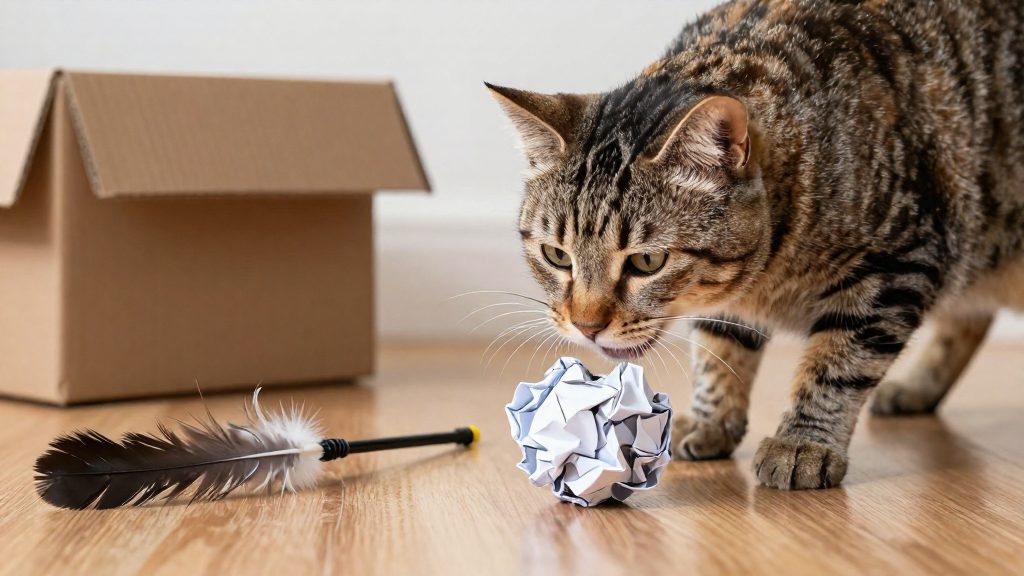
Cats are predators, and the hunt sequence of stalking, chasing, catching and eating has no full equivalent inside a home. A filled food bowl removes the catch, and a toy left in one place removes the chase. Best Friends Animal Society (2026) reports that cats often prefer low-cost items such as cardboard boxes, paper balls and ping-pong balls over expensive toys. This points to movement and unpredictability mattering more than the object’s price.
Limited territory and reduced sensory input
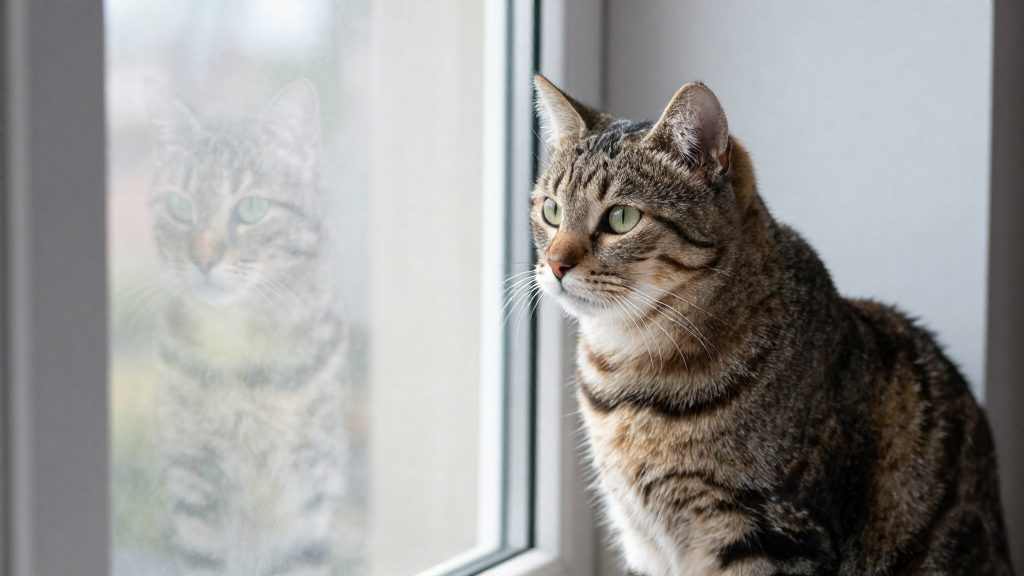
An outdoor cat meets changing smells, sounds, animals and terrain. An indoor cat’s territory is set by walls, so the same rooms, sights and smells repeat every day. The BC SPCA’s enrichment list addresses this gap through vertical space and views (BC SPCA, 2026). Best Friends Animal Society (2026) also recommends window bird-watching as a sensory input.
Typical 12–16 hour sleep baseline
PetMD (Jenny Alonge, DVM, 2026-09-30) states that cats sleep about 12–16 hours a day. Long sleep is therefore the normal baseline for a cat. Boredom comes from what happens during the waking hours that remain, when a cat has no interesting activity to switch to.
| Factor | Indoor limitation | Documented context |
|---|---|---|
| Hunting drive | Few outlets for stalking, chasing and catching | Cats need stimulation for body and brain (BC SPCA, 2026) |
| Territory and senses | Fixed rooms with repeated sights and smells | Enrichment list: BC SPCA (2026) |
| Sleep | Baseline of about 12–16 hours a day | Normal daily rest range (PetMD, 2026-09-30) |
Signs your cat needs more stimulation
Behaviour is often the first visible sign that an indoor cat is under-stimulated. Four patterns are especially useful to recognise: aggression, excessive vocalizing, destructive scratching and overgrooming (PetMD, 2026-09-30), plus restlessness at night, which the BC SPCA addresses with an evening play session or timed feeder. Each one can also have a medical cause, so the pattern matters as much as the behaviour itself.
Aggression and excessive vocalizing
Aggression and excessive vocalizing are stress signals that can appear when a cat has too little to do. PetMD (Jenny Alonge, DVM, 2026-09-30) lists both among the signs of an under-stimulated cat. Watch for:
- Attacks on hands or feet during ordinary household activity, especially when the cat has been inactive for long periods.
- Redirected aggression, where the cat lashes out at another pet or person after seeing something it cannot reach.
- Repeated yowling or meowing that has no clear trigger, such as food, a closed door, or a visitor.
Destructive scratching as a frustration outlet
Scratching furniture, curtains or door frames can be a frustration outlet when a cat has energy but no appropriate way to use it. PetMD (2026-09-30) names destructive scratching as a sign of under-stimulation. The clue is the pattern: scratching that increases during periods of boredom, or that targets items the cat cannot otherwise reach or use for play, may suggest unmet needs, but normal claw maintenance or a medical cause is also possible.
Night restlessness and early-morning activity
A cat that is active at night or at dawn, pacing, running through the home or waking its owner, may be showing under-stimulation. The BC SPCA suggests an evening play session or timed feeder for night restlessness.
| Sign | Common pattern | Next step |
|---|---|---|
| Aggression | Attacks on hands or feet, redirected aggression | Review daily play and enrichment |
| Excessive vocalizing | Frequent yowling without a clear trigger | Check for medical causes if the change is sudden |
| Destructive scratching | Damage that increases during boredom | Offer legitimate outlets for energy |
| Night restlessness | Pacing, waking the household, early-morning activity | Note when the cat is most active |
When behaviour change is a medical question
PetMD (2026-09-30) advises that sudden or significant behaviour changes warrant a call to the vet, because these signs can also be medical. If the change appears abruptly, or if the cat seems lethargic, gains weight, or sleeps more than usual, consult a veterinarian before assuming the cause is boredom.
Vertical space, perches and window views
For an indoor cat, usable territory is mostly floor space unless vertical space is added. The BC SPCA lists high perches, window perches and several scratching posts among its enrichment ideas (BC SPCA, 2026). Each one gives the cat a route upward, a new vantage point or a place to work its body, which widens the area it actively uses.
| Feature | Purpose listed by the BC SPCA (2026) | Placement approach |
|---|---|---|
| High perches | Vertical space and climbing | Several heights, near rooms where the cat spends time |
| Window perches | Visual stimulation, view of the outdoors | Where the cat can see outside without leaving the home |
| Scratching posts | Body engagement and scratching outlet | Several, spread across the home |
High perches and shelving
Place perches at different heights so the cat can move between levels rather than making one large jump. Put them in rooms with regular household activity, since a perch the cat never visits adds nothing to its territory. Check that each perch is stable before the cat uses it. The official sources consulted do not specify exact height intervals.
Window perches with outdoor views
A window perch lets a cat watch outdoor movement while staying inside. Best Friends Animal Society (2026) also recommends window bird-watching.
Multiple scratching posts and their placement
Spreading scratching posts across the home means the cat does not need to cross a room to use one. Placing a post beside a high perch links two enrichment features in one area. The official sources consulted do not specify how many posts a home needs or what post heights suit a given cat.
Puzzle feeders and foraging games
Turning meals and treats into foraging tasks gives a cat a job to finish before it eats. The BC SPCA (2026) lists puzzle feeders and hidden treats among its indoor enrichment ideas, and Best Friends Animal Society (2026) recommends food puzzles and scatter feeding. Both methods make the cat search, manipulate or work out how to reach food, which resembles the hunting sequence of searching, stalking and capturing prey.
Puzzle feeders and difficulty progression
A puzzle feeder hides kibble in compartments or behind parts the cat must move or open. Start with the simplest version the cat can solve without giving up, then make it harder only after the cat solves the current level reliably. If the cat stops trying or leaves the feeder, the step was probably too large. Use part of the cat’s normal daily food in the puzzle rather than adding extra food, and ask a vet how much food suits the individual cat.
Hidden treats around the home
Scatter feeding means placing small portions in several spots across different rooms, at different heights and on different surfaces. Begin with spots in plain view, then move to less obvious locations such as inside a cardboard box or under a rug as the cat becomes skilled at searching. Cardboard boxes and paper bags are among the BC SPCA’s listed enrichment items. Keep hiding spots clear of cords, medicines and cleaning products, and check that each spot is easy for the cat to reach without climbing into unsafe areas.
Food-reward trick training sessions
The BC SPCA (2026) lists food-reward trick training as an enrichment method, and Best Friends Animal Society (2026) recommends clicker training. In both, the cat earns a small piece of food for performing a set action, such as sitting or touching a target. Keep each session short. Use only a small amount of food per reward, and subtract it from the day’s meal total.
| Method | Source | Main mental task |
|---|---|---|
| Puzzle feeder | BC SPCA (2026) | Solving a mechanism to reach food |
| Scatter feeding | Best Friends Animal Society (2026) | Searching across rooms |
| Hidden treats | BC SPCA (2026) | Locating scattered food |
| Clicker or food-reward training | Best Friends Animal Society (2026); BC SPCA (2026) | Linking an action to a reward |
How much playtime does a cat need?
For most indoor cats, the working target is two to three play sessions a day, each lasting 10 to 15 minutes, according to PetMD (Jenny Alonge, DVM, 2026-09-30). That totals roughly 20 to 45 minutes of active play. Short, focused sessions work better than one long one.
Play should move the body as well as the mind. The BC SPCA (2026) recommends daily play with a wand toy, which lets you control the movement and stop before the cat loses interest. Pair it with rotating prey-like toys, which the BC SPCA lists as a core enrichment item. Swapping the toy in and out every few days keeps it novel without buying more.
Timing matters for night-time activity. The BC SPCA (2026) suggests an evening play session or timed feeder to address night restlessness. An evening session that ends with the cat eating or settling tends to reduce the energy that would otherwise surface at 3 a.m. Use the timed feeder only as a supplement to play, not a replacement.
| Element | Guidance | Source |
|---|---|---|
| Daily total | Two to three sessions of 10 to 15 minutes | PetMD (Jenny Alonge, DVM), 2026-09-30 |
| Core tool | Daily play with a wand toy | BC SPCA, 2026 |
| Prey-like toys | Rotate regularly to maintain interest | BC SPCA, 2026 |
| Night restlessness | Evening play session or timed feeder | BC SPCA, 2026 |
Cheap DIY enrichment from around the house
Household materials can supply much of the stimulation a cat needs at little or no cost. The BC SPCA (2026) lists cardboard boxes, paper bags and cat grass among its enrichment ideas. Each material has its own safety limit, and those limits decide whether a homemade setup is suitable.
Cardboard boxes and paper bag hideouts
Boxes and bags give a cat a concealed space to observe from. To set them up safely:
- Cut a simple entrance into a box rather than leaving it sealed, so the cat can come and go freely.
- Place the box where the cat already moves through the home, such as near a window.
- Remove the handles from paper bags before offering them. Best Friends Animal Society (2026) identifies handles as the hazard to eliminate.
Cat grass and catnip
Cat grass is a low-cost option the BC SPCA (2026) includes in its list. To grow it, sow seed in a shallow container of soil and keep the container indoors where the cat can reach it. The official sources consulted do not specify germination or growing times, so follow the timing printed on the seed packet.
Catnip needs more caution than cat grass. The BC SPCA (2026) notes that catnip can make some cats aggressive or hyperactive. Offer it sparingly at first and observe how the individual cat responds before making it a regular part of its environment.
String and laser pointers
Strings and cords are a supervised-only item. Best Friends Animal Society (2026) advises supervising any toy with a long string, so keep such toys out of reach when play ends.
Eye safety governs laser pointers. Best Friends Animal Society (2026) advises keeping the beam out of the cat’s eyes.
Are catios and harness walks safe for Canadian cats?
The BC SPCA (2026) names catios and leash or harness training as options for cats that stay frustrated despite indoor enrichment, alongside supervised outdoor time. The same guidance strongly recommends keeping cats indoors. Neither option is risk-free. Safety depends on how the enclosure is built and checked, how well the harness fits, and whether a person is present. The BC SPCA is a British Columbia organization, so its guidance is the reference here. The official sources consulted do not set national Canadian rules for outdoor access, and they do not give predator-specific risk figures, so the comparison below covers escape and supervision.
Catio enclosure design and escape prevention
A catio is an enclosure attached to or placed near the home that gives a cat fresh air and outdoor sights without open access to the outside. Escape is the main risk. Best Friends Animal Society (2026) advises checking catios regularly, so inspect the mesh, panels, latches and frame on a fixed schedule rather than assuming they are secure. Pay particular attention to the join between the catio and the home, such as a window or door opening, because that is where a cat can slip through.
Leash and harness training before outdoor walks
Harness walks depend on training done indoors first. The BC SPCA (2026) lists food-reward training among its enrichment ideas, and the same method can be used to introduce a harness: let the cat sniff and wear it for short periods, pair it with treats, and extend wear time only when the cat stays calm. Best Friends Animal Society (2026) stresses fitting harnesses properly, so check the harness fit before every walk. A loose harness can slip off, and an overly tight one can cause discomfort, so re-check after the cat has moved around.
Supervised outdoor time versus unsupervised roaming
Supervised outdoor time means a person is present for the whole session. The BC SPCA (2026) suggests it for cats that stay frustrated, but it does not give a set duration.
| Option | BC SPCA position (2026) | Main safeguard named in sources |
|---|---|---|
| Catio | Suggested for frustrated cats | Regular enclosure checks (Best Friends Animal Society, 2026) |
| Harness walk | Leash training suggested | Proper harness fit (Best Friends Animal Society, 2026) |
| Supervised outdoor time | Suggested for frustrated cats | Person present throughout the session |
| Unsupervised roaming | Not listed; the BC SPCA strongly recommends keeping cats indoors | No safeguard specified in the sources consulted |
When boredom might be a health problem
Boredom and medical illness can produce similar behaviour in indoor cats, so enrichment should not be the first assumption when a pattern changes. PetMD (2026-09-30) notes that under-stimulated cats may overgroom, scratch destructively or vocalize excessively, but the same signs can also have a medical cause.
| Observation | Vet threshold, per PetMD (2026-09-30) |
|---|---|
| Overgrooming that causes bald patches or skin irritation | Contact a vet |
| Lethargy or extra sleep, especially with weight gain | Contact a vet |
Overgrooming and skin changes
Overgrooming is a behaviour, but its physical results are what a vet needs to see. Check the coat during regular handling for thinning fur, bare patches, redness or areas the cat returns to repeatedly. Note where the hair loss is, how large it is and whether the skin looks irritated. A vet can examine the skin and determine whether the cause is behavioural, medical or both. Enrichment changes should not delay that visit.
Lethargy, extra sleep and weight gain
Lethargy or extra sleep is a reason to contact a vet, especially when it comes with weight gain. Contact a vet without waiting for enrichment to work. Keep notes to share at the visit: approximate hours asleep, interest in play and food, and body weight if you weigh the cat. Reduced interest in activities the cat previously enjoyed, alongside more sleep, is a pattern to report to a vet.
Sudden or significant behaviour changes
Sudden or significant behaviour changes warrant a call to the vet, because these signs can also be medical (PetMD, 2026-09-30). Do not assume boredom first. To help the vet, note the cat’s usual eating, grooming, sleeping, litter habits and activity level, when the change started, and whether anything in the home changed at the same time.
Frequently asked questions
What is the cheapest way to start enriching my cat’s day?
Start with cardboard boxes, paper balls or ping-pong balls, which Best Friends Animal Society (2026) notes many cats prefer to pricier toys. Movement and unpredictability matter more to most cats than the object’s price, so moving the toy is more useful than buying something new.
How long should I play with my cat each day?
PetMD (Jenny Alonge, DVM, 2026-09-30) states that most cats do well with two to three play sessions of 10 to 15 minutes each. Spreading these across the day suits a cat’s natural hunt-rest rhythm better than one long session.
When should I stop adjusting enrichment and call the vet?
Contact a vet if your cat develops overgrooming that causes bald patches or skin irritation, or if it becomes lethargic or sleeps more than usual, especially with weight gain (PetMD, Jenny Alonge, DVM, 2026-09-30). Sudden behaviour changes also warrant a call, because they can have a medical cause rather than a boredom cause.