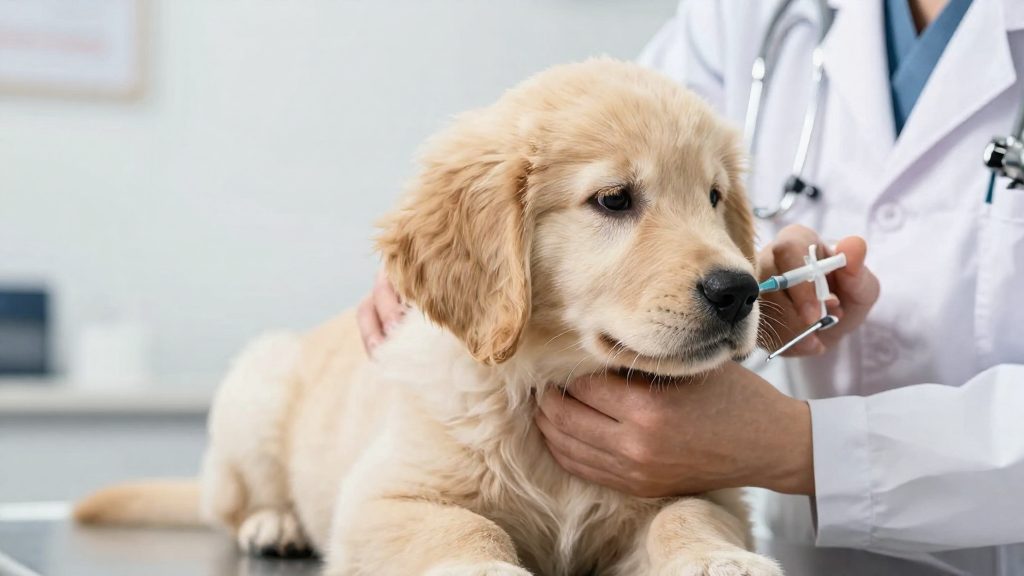
A single vaccine dose does not reliably protect most puppies, for two biological reasons. Antibodies received from the mother can neutralise vaccine antigens before the puppy’s own immune system responds, and the young immune system takes time to mature and build lasting memory. A series of doses given at intervals addresses both problems. The WSAVA guidelines, published in 2017 and cited via VIN, describe this staged approach for core vaccines. The official sources consulted do not specify an exact age at which maternal antibodies stop interfering in every puppy.
Why do puppies need a vaccination series?
Maternal antibody interference and its waning period
Puppies receive maternal antibodies through colostrum, the first milk, and these antibodies protect against infection in the early weeks. They also bind to vaccine antigens, which can block the response the vaccine is meant to trigger. The level of these antibodies declines gradually and varies between litters and between individual puppies, so age alone cannot predict the moment a vaccine will take effect.
A dose given while maternal antibodies are still high may produce little or no lasting immunity. This is why a series is used rather than a single injection timed to one age.
| Factor | Effect on vaccination | Consequence for the series |
|---|---|---|
| High maternal antibody level | Neutralises vaccine antigen before it stimulates the immune system | An early dose may not immunise the puppy |
| Declining maternal antibody level | Interference weakens unevenly across the litter | The window in which a dose works opens at variable times |
| Immature immune system | Produces a weaker and slower response | Later doses are needed to complete the response |
Immune system maturation and why doses repeat
The immune maturation process is what allows a puppy to build its own, lasting protection. Exposure to vaccine antigens primes the immune system, and a subsequent dose strengthens that response. A first dose often does not produce the full response a mature adult would, because the immune system is still developing.
Each later dose therefore acts as a booster, reinforcing the response established by the earlier dose. Repeating doses is the method used to complete immunity in an immature immune system, rather than a sign that the first dose failed.
Why doses are spaced rather than given together
Spacing gives maternal antibody levels time to fall between doses, so each dose meets an immune system that is less likely to be blocked. The WSAVA guidelines (2017, via VIN) place core doses 3–4 weeks apart. Giving the doses together would expose all of them to the same level of maternal interference, which reduces the chance that the later doses will work.
Core vaccines for puppies in Canada
Core vaccines are the canine vaccines recommended for every puppy, whatever its lifestyle, because the diseases they target are widespread and can be serious. The official sources consulted do not specify Canadian incidence or severity figures for these diseases, so the descriptions below stay qualitative.
The three core disease targets
- Distemper: caused by the canine distemper virus, a viral disease that can affect the respiratory, digestive and nervous systems.
- Parvovirus: caused by canine parvovirus 2, a viral infection that mainly affects the digestive tract and can lead to rapid dehydration.
- Adenovirus: infectious canine hepatitis is caused by canine adenovirus type 1 and affects the liver and other organs. Vaccines use the related type 2, which also protects against it.
Each disease is caused by a different virus, so protection against one does not replace protection against the others. A puppy that has received one component is not protected against the remaining diseases.
Combination formats and what they contain
Most puppy products combine several antigens in one injectable dose rather than giving each component separately. The distemper, parvovirus and adenovirus components are usually included together in the core set. Some products also add parainfluenza, a respiratory component. The official sources consulted do not specify which Canadian-licensed formats contain parainfluenza, so the product label and the vet’s record are the reliable references.
Puppy vaccination schedule: week by week
The core puppy series follows the WSAVA guideline, which sets the first core vaccine dose at 8 to 9 weeks of age, a second dose 3 to 4 weeks later, and a third dose at 16 weeks or older (WSAVA via VIN, 2017). The official sources consulted do not specify a Canada-specific calendar, so the dates your veterinarian sets for your puppy take precedence over any generic timeline.
Dose sequence
| Dose | Puppy’s age | Timing rule |
|---|---|---|
| Dose 1 (core) | 8 to 9 weeks | Starts the core series |
| Dose 2 (core) | 3 to 4 weeks after dose 1 | Counted from the date of dose 1 |
| Dose 3 (core) | 16 weeks or older | Minimum age for the final puppy dose |
| Further core dose | About 26 weeks | Ideally given around this age (WSAVA via VIN, 2017) |
Working out the dates
Because the intervals are counted from each previous dose, the calendar shifts with the first appointment:
- First dose at 8 weeks: dose 2 falls between 11 and 12 weeks; dose 3 is due at 16 weeks or older.
- First dose at 9 weeks: dose 2 falls between 12 and 13 weeks; dose 3 is still due at 16 weeks or older.
- Dose 3 is set by age, not by the interval, so it can fall more than 3 to 4 weeks after dose 2.
Further core dose and neutering
WSAVA states that the further core dose at about 26 weeks can be combined with neutering (WSAVA via VIN, 2017). This lets owners schedule one clinic visit instead of two. The sources consulted do not specify adult revaccination intervals beyond this point.
Is the rabies vaccine mandatory in Canada?
The official sources consulted for this article do not specify whether rabies vaccination is legally required for dogs or cats across Canada as a whole, so no national rule can be stated here. Pet requirements can be set at more than one level of government, so the practical answer depends on where the animal lives. Check the provincial and municipal rules before assuming a vaccine is optional or required.
Provincial and municipal differences
Local requirements are the first thing to confirm. Use this method to find them:
| Level | What to check | Where to look |
|---|---|---|
| Provincial | Whether provincial animal health rules mention rabies vaccination | The provincial government’s animal health or agriculture pages |
| Municipal | Whether the city or regional district has an animal bylaw that requires vaccination or licensing | The municipal bylaw or animal control office |
| Veterinary clinic | Local vaccination practice and what certificate the clinic issues | The veterinarian’s office |
Rabies dose age and booster interval
The only dosing figures available to this article come from the World Small Animal Veterinary Association (WSAVA) guidelines, published via the Veterinary Information Network (VIN) in 2017. They apply where rabies is endemic and do not establish Canadian requirements.
| Situation (WSAVA, 2017, via VIN) | Guidance |
|---|---|
| Where rabies is endemic, first dose | At 12 weeks of age or older |
| Where rabies is endemic, second dose | 2 to 4 weeks after the first, in high-risk areas only |
The official sources consulted do not specify the booster interval recommended for dogs or cats in Canada.
Proof of vaccination and certificate requirements
The official sources consulted do not specify the certificate format or documentation that Canadian authorities accept. In practice, owners should confirm with the municipality which document it will accept, especially for licensing or travel.
Non-core vaccines: does your puppy need them?
Non-core vaccines protect against diseases that are not universal risks for every dog. Whether a puppy needs one depends on its exposure, not on a fixed rule. In WSAVA’s puppy vaccination guidance, leptospirosis is the example given of a non-core vaccine. When it is used, WSAVA describes two doses given alongside the core vaccines, at 8 and 12 weeks of age (WSAVA via VIN, 2017).
| Vaccine | Status in WSAVA guidance | Timing described |
|---|---|---|
| Leptospira | Non-core; used when risk is judged to apply | Two doses, at 8 and 12 weeks (WSAVA via VIN, 2017) |
The official sources consulted do not give a standard timing for Bordetella or Lyme vaccination in puppies, so those decisions rest on the individual animal and the vet’s assessment.
Assessing exposure risk
Vets weigh the following lifestyle factors when deciding on optional vaccines:
- Contact with other dogs: frequent visits to dog parks, puppy classes, daycare, or boarding kennels raise exposure to airborne and close-contact respiratory pathogens, the setting in which Bordetella is most often discussed.
- Grooming and shared facilities: regular use of groomers or shared kennels adds contact with other animals.
- Environment: rural areas, woodland, and tick-prone regions increase exposure to tick-borne disease, which is the basis for Lyme vaccination discussions.
- Water and wildlife contact: puppies that swim in ponds, streams, or lakes, or that roam where wildlife urine may be present, have higher leptospirosis exposure.
- Travel: trips that involve boarding, shared transport, or visits to areas with different disease patterns change the risk profile.
Working through the decision
- List the puppy’s real activities for the next 12 months, not only the current month.
- Note the local tick and wildlife situation, which your vet can describe for your area.
- Ask your vet whether each optional vaccine fits the list, and why.
- Record the decision and review it at each annual visit, since lifestyle changes.
When can a puppy go outside or meet other dogs?
The official sources consulted do not give a single date for when a puppy in Canada may first go outdoors or meet other dogs. They do describe the core vaccination series, which WSAVA (2017) sets out as starting at 8–9 weeks and finishing with a dose at 16 weeks or older. Public contact should therefore be planned with your veterinarian, who can judge a puppy’s vaccination status, health and local risk. Early socialisation is important, so the question is how to balance it against infection risk, not whether to avoid it entirely.
Socialisation and early exposure
Early exposure to people, sounds, surfaces and calm dogs supports later behaviour. The consulted sources do not specify an exact socialisation window in weeks, so use the following method instead:
- Start with low-traffic settings such as a friend’s home, a quiet street or a car ride, where the puppy can see and hear new things without close contact with unknown dogs.
- Introduce one new stimulus at a time and stop if the puppy shows persistent fear, such as hiding, trembling or refusing food.
- Carry the puppy in areas where many dogs have passed.
Parvovirus risk in public areas
Public spaces, including parks, pet shops and sidewalks where dogs defecate, are where a puppy can meet infectious material. The consulted sources do not quantify this risk for Canada or state how long the virus persists on surfaces, so treat it as a precaution rather than a measured figure.
Puppy classes and dog park criteria
Puppy classes and dog parks may differ in risk, because some classes require proof of vaccination from participants. Before enrolling a puppy, check the following:
| Criterion | What to confirm |
|---|---|
| Vaccination proof | Written record from your veterinarian, held by the organiser |
| Group size and supervision | Small class with an instructor present |
| Cleaning routine | Clear policy for cleaning shared floors and equipment |
The consulted sources do not set a national rule for these venues.
Possible side effects and when to call a vet
Some reactions after vaccination are expected, others call for prompt contact with your veterinarian, and signs of anaphylaxis need emergency veterinary care immediately. The sources consulted for this section do not give a reliable frequency or timeframe for post-vaccine reactions, so the guidance below describes what to observe and what to act on, not how often each reaction occurs.
Mild, expected reactions are usually short-lived. Owners commonly see:
- Sleepiness or lower energy for a day or so
- A reduced appetite for one meal or so
- A mild, temporary fever
- A small, firm, slightly tender lump at the injection site
Keep the puppy calm, make fresh water available, and avoid strenuous play until they are back to their normal self.
Injection site swelling is a reaction owners may notice. A small firm bump that gradually softens is generally expected. Monitor the area at least daily and call your vet if the swelling grows, feels hot, becomes very painful, opens, or drains. Lumps that persist beyond the period your vet mentions should also be checked.
Anaphylaxis is an emergency. It is a severe allergic reaction that can progress quickly. Signs include:
- Difficulty breathing, rapid or noisy breathing, or blue or pale gums
- Facial, muzzle, or eyelid swelling
- Collapse, weakness, or inability to stand
- Repeated vomiting or diarrhea
- Hives or widespread itching
Seek emergency veterinary care immediately if any of these appear, even if you are not sure the vaccine is the cause. Do not wait to see whether symptoms settle.
Questions to ask your veterinarian
Your puppy’s vaccination plan is only useful if your records are complete, the schedule fits your puppy’s daily life and location, and every appointment is booked and tracked. Bring these questions to the first visit so the plan is confirmed in writing rather than left to memory.
Record keeping and certificate details
Ask how each vaccine will be recorded, and whether you will receive a copy of the entry at every visit. The official sources consulted do not specify a single Canadian format for vaccine certificates, so ask the clinic what it issues and what it includes. Useful points to confirm:
- Whether the certificate lists the product name, the date given and the veterinarian’s name.
- Whether the clinic keeps an electronic record and can send you a copy on request.
- Which document you should keep for kennels, daycare, or other providers who may ask for proof.
Tailoring the plan to lifestyle and location
Ask whether rabies is a concern in your area, since WSAVA guidance ties some rabies decisions to endemicity, and whether any planned travel changes what documents you will need.
Clinic scheduling and reminders
Ask which appointment dates should be booked in advance, and what the clinic recommends if a visit is missed. Confirm how reminders are sent (by phone, text or email), who to contact to reschedule, and how far in advance bookings are usually made. Write the agreed dates in your calendar before you leave the clinic.
| Area | Question to ask | Purpose |
|---|---|---|
| Records | Will I receive a copy of each entry? | One reference for future visits |
| Certificate | Does it list the product name and administration date? | Proof for providers who request it |
| Location | Is rabies a concern in this area? | Confirms whether the plan needs adjusting |
| Travel | Which documents does the destination require? | Avoids last-minute gaps |
| Scheduling | Which dates should be booked now? | Keeps the plan on track |
| Reminders | How are reminders sent, and who handles rescheduling? | Prevents missed appointments |
Frequently asked questions
When does a puppy in Canada receive its first vaccine?
According to WSAVA guidelines (2017, via VIN), the core series starts at 8 to 9 weeks of age, with a second dose 3 to 4 weeks later and a third dose at 16 weeks or older. The official sources consulted do not specify Canadian provincial timing, so confirm the local schedule with your veterinarian.
Is rabies part of the same puppy series?
The WSAVA guidelines (2017, via VIN) list rabies separately: where rabies is endemic, one dose is given at 12 weeks or older. The official sources consulted do not specify Canadian rabies requirements for puppies, so ask your veterinarian or local public health authority which rules apply where you live.
What should I do if my puppy reacts after a vaccine?
Mild reactions are expected after vaccination, but some signs call for prompt contact with your veterinarian. Signs of anaphylaxis, such as collapse or breathing difficulty, need emergency veterinary care immediately.