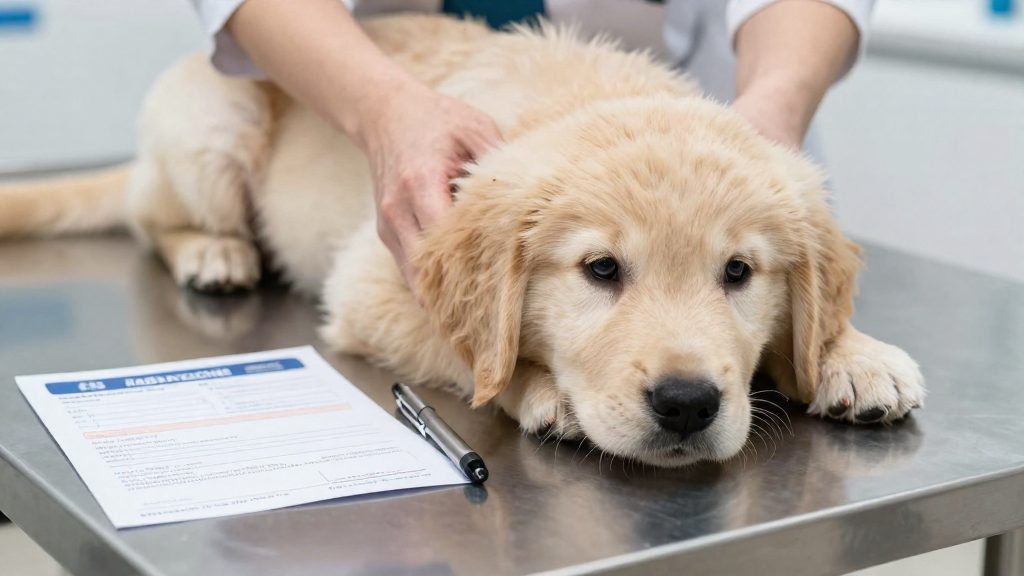
Canada’s federal rabies import rules apply to dogs aged 8 months and older, and also to dogs under 8 months that travel with their owner, except pet dogs under 3 months old, which need neither a rabies vaccination nor a rabies-free-country certification (commercial dogs under 8 months follow separate CFIA rules), according to the Canadian Food Inspection Agency (CFIA, 2025-10-08). These rules govern entry into Canada. The official sources consulted do not specify whether rabies vaccination is mandatory for dogs already living in Canada. Pet dogs imported into Canada are not subject to post-import quarantine.
Which dogs do the federal rabies import rules cover?
Age threshold and travel status
The import rules cover three groups of dogs, distinguished by age and whether they travel with their owner:
| Dog profile | Rabies import rules | Source |
|---|---|---|
| Aged 8 months or older | Apply | CFIA (2025-10-08) |
| Under 3 months (pet dogs only; commercial dogs follow separate rules) | Exempt: no rabies vaccination and no rabies-free-country certification | CFIA (2025-10-08) |
| 3 months to under 8 months, travelling with owner | Apply | CFIA (2025-10-08) |
| Under 8 months, for breeding, resale or adoption | Separate CFIA rules: vaccination not before 3 months of age (since 15 May 2021), dog at least 16 weeks old at export, 28-day wait after vaccination | CFIA |
Age alone does not remove a dog from scope when it is accompanied by its owner. Commercial dogs under 8 months follow their own rules, which are outside the pet-travel framework.
Scope of the federal requirements
The rules also distinguish dogs from a rabies-free country from dogs from other countries, which changes which documents are accepted. The CFIA treats only dogs, cats and ferrets as pets for these purposes (CFIA, 2026-08-14).
Post-import status and enforcement
Pet dogs are exempt from post-import quarantine, so an accepted pet dog does not face a quarantine period after arrival (CFIA, 2025-10-08).

Why rabies vaccination matters for dogs
Rabies is a viral disease that affects dogs, people and wildlife, and it is the reason vaccination is built into the rules for dogs travelling to Canada. Its public-health weight comes from how the virus acts: it attacks the nervous system and can pass from one species to another, so an infection in one dog is a risk for the people and animals around it. The official sources consulted for this article do not give dated figures on rabies incidence, transmission rates or case fatality, so this section describes the risk qualitatively.
How the virus reaches people
- Saliva is the carrier. Rabies spreads when infected saliva reaches a wound or mucous membrane, most often through a bite.
- Dogs can be a link. An infected dog can transmit the virus to people and other animals, which is why vaccinating the individual dog also protects the household.
- Wildlife can be the source. An infected wild animal can bite a pet, and that pet can then become a route to people.
Outcome once clinical signs appear
The official sources consulted do not specify survival or fatality figures for dogs once clinical signs develop, so this article does not estimate them. What matters for owners is the timing: prevention is the only stage at which the risk can be controlled through vaccination, and it is not a substitute for veterinary assessment after any suspected exposure.
Role of vaccination in public health
- It protects the animal that can transmit the virus. Vaccinating the dog reduces one of the main links in the chain.
- It works at population level. The more dogs in a community that are vaccinated, the fewer opportunities the virus has to spread among them.
- Records support oversight. Documented vaccination is what authorities check, and the official sources consulted do not quantify how much this reduces disease in any given region.
Rabies vaccine rules for dogs entering Canada
For dogs aged 8 months and older, the Canadian Food Inspection Agency (CFIA, 2025-10-08) sets different entry pathways depending on whether the dog comes from a rabies-free country. A dog from a non-rabies-free origin must show a valid, current rabies vaccination certificate. The CFIA allows an alternative: a rabies neutralising antibody titre test (RNATT) result of at least 0.5 IU/ml, with the lab report travelling with the dog.
A dog from a rabies-free country has three options, and any one of them is sufficient:
| Pathway | Document required | Condition |
|---|---|---|
| Rabies-free origin, residence route | Veterinarian’s certificate of 6 months’ residence in a country with no rabies | Certificate must attest to 6 months’ residence in a country with no rabies |
| Rabies-free origin, vaccination route | Valid vaccination certificate | Certificate must be current |
| Rabies-free origin, titre route | Titre test result | At least 0.5 IU/ml |
| Non-rabies-free origin | Vaccination certificate or RNATT result | Certificate from a licensed vet in the origin country; titre at least 0.5 IU/ml |
The official sources consulted do not list which countries are classified as rabies-free within this section, so confirm your origin country’s status before booking.
If a dog does not meet the requirements on arrival, an inspector-ordered vaccination applies. The inspector sets a deadline for the importer to have the dog vaccinated, and the owner pays for it (CFIA, 2025-10-08). This is a corrective measure, not a substitute for meeting the requirements in advance.
What proof of vaccination do you need?
A dog from a country that is not rabies-free must carry a valid, current rabies vaccination certificate. According to the Canadian Food Inspection Agency (CFIA, 2025-10-08), the certificate must be issued by a licensed veterinarian in the country of origin and written in English or French. The official sources consulted do not say whether a certificate in another language is accepted, so a certificate in any other language should not be assumed to meet the requirement.
If the dog has no valid vaccination certificate, the alternative is a rabies neutralising antibody titre test (RNATT). The lab report must travel with the dog.
What about puppies under 3 months?
Dogs under 3 months old at import are exempt from the rabies requirements. The Canadian Food Inspection Agency (CFIA, 2025-10-08) states that these puppies need neither a rabies vaccination nor a certificate showing the dog comes from a rabies-free country. The age is counted at the time of import, so a puppy that is 2 months old on the day it enters Canada falls under the exemption, whatever its vaccination status.
The exemption ends at 3 months. The age bands therefore work as follows:
| Dog’s age at import | Rabies requirements (CFIA, 2025-10-08) |
|---|---|
| Under 3 months (pet dogs; commercial dogs follow separate rules, including a 16-week minimum age at export) | None: no vaccination and no rabies-free certificate |
| 3 months to under 8 months, travelling with owner | Rabies rules apply |
| 8 months and older | Rabies rules apply |
The exemption depends on age alone. It does not depend on the dog’s country of origin, so a young puppy from a country with rabies does not need a vaccination certificate to enter Canada. The exemption applies only to dogs under 3 months of age at import.

Commercial and adopted puppies: stricter rules
Dogs under 8 months old are handled differently depending on why they are moving. A separate, stricter set of conditions applies to commercial dogs under 8 months old, meaning dogs moved for breeding or resale. The CFIA states that this category includes dogs transferred for adoption.
The CFIA sets three timing requirements for these dogs:
| Requirement | Commercial dog under 8 months |
|---|---|
| Earliest rabies vaccination | Not before 3 months of age, a rule in force since 15 May 2021 |
| Minimum age at export | 16 weeks |
| Waiting period after vaccination | 28 days |
These conditions work together. A dog vaccinated at the earliest permitted age still needs to reach 16 weeks before export, and the 28-day wait must also be completed before the dog travels.
How the rules apply to adopted puppies
An adopted puppy is treated under the commercial category when the transfer is part of a sale, breeding or adoption arrangement involving a dog under 8 months. The official sources consulted do not specify how adoption paperwork differs from sale paperwork.
Because the timing rules are fixed, the planning order matters. The vaccination date, the 16-week minimum age and the 28-day wait all need to be checked against the planned travel date.
How do you prepare your dog before travel?
Preparing a dog for entry to Canada comes down to three checks made early: whether the rabies rules apply to your dog’s age at arrival, which entry route matches the country you are leaving, and whether the paperwork can be produced at the border. The Canadian Food Inspection Agency (CFIA) advises owners to contact their veterinarian as soon as travel details are known, because missed deadlines can lead to the pet being refused entry (CFIA, 2026-08-14).
Step 1: Confirm whether the rabies rules apply
- Dogs under 3 months old at import need neither a rabies vaccination nor a rabies-free-country certification (CFIA, 2025-10-08).
- The official sources consulted do not address dogs aged 3 to 8 months arriving without their owner, so confirm that case with the CFIA before booking.
Step 2: Match the veterinary visit to your entry route
The route depends on whether your departure country is a rabies-free country (CFIA, 2025-10-08).
Book the appointment once your travel dates are fixed, and ask the vet to record every date on the certificate. The official sources consulted do not specify the minimum interval between a vaccination and departure, so confirm this with your veterinarian and the CFIA.
Step 3: Plan the titre test around departure
The titre test is a blood test and is accepted for dogs from both rabies-free and non-rabies-free countries. The official sources consulted do not specify how long before departure the sample must be taken or how long a result stays valid. Ask the veterinary clinic for the laboratory’s turnaround time, then schedule the sample so the result is in hand before you travel.
Step 4: Organise documents for border inspection
- Keep the original certificate or lab report in your hand luggage, with copies stored separately.
When should you call your vet?
Call your veterinarian promptly, without waiting for a routine appointment, in three situations: a bite or scratch from a wild or unknown animal, neurological changes in your dog, and an unusual reaction after a vaccination. The official sources consulted do not specify symptom timelines, clinical thresholds or a standard reporting procedure, so the steps below describe what to do rather than what a test will show.
Exposure events
Contact your veterinarian immediately, the same day, after any bite or scratch from, and ask the veterinarian whether the CFIA must be notified:
- a wild animal
- an animal whose owner or vaccination status is unknown
- an animal that behaved unusually before or during the contact
Keep your dog separated from the animal involved. Wash the wound with soap and water, and wear gloves when handling a dog that may have come into contact with saliva. Tell the veterinarian which animal was involved and whether its vaccination status is known.
Neurological signs
Report any change in your dog’s nervous system to your veterinarian without delay. Relevant signs include:
- Behaviour change, such as unusual aggression, withdrawal, confusion or restlessness
- Paralysis, weakness or difficulty walking
- Excessive drooling or difficulty swallowing
Note when the signs started and whether they are getting worse, as this helps the veterinarian assess the case.
Reactions after vaccination
The official sources consulted do not list specific post-vaccination reactions. As a general precaution, treat the following as requiring urgent attention and contact a veterinarian straight away: sudden swelling of the face or muzzle, collapse, laboured breathing, or repeated vomiting after a vaccine dose.
Frequently asked questions
Does a puppy under 3 months old need a rabies vaccination to enter Canada?
No. According to the Canadian Food Inspection Agency (CFIA, 2025-10-08), a pet dog under 3 months old needs neither a rabies vaccination nor a rabies-free-country certificate. Commercial dogs under 8 months, such as those for breeding, resale or adoption, follow separate CFIA rules.
What proof do I need for a dog coming from a country that is not rabies-free?
The dog needs a valid, current rabies vaccination certificate issued by a licensed veterinarian in the country of origin, written in English or French. Alternatively, it can have a RNATT (rabies neutralising antibody titre test) result of at least 0.5 IU/ml, with the lab report travelling with the dog (CFIA, 2025-10-08).
What can happen if my dog does not meet the rabies requirements on arrival?
An inspector may order you to have the dog vaccinated within a set time, and you would pay for it (CFIA, 2025-10-08). Pet dogs are not held in post-import quarantine, but missed deadlines can result in the dog being refused entry, so contact your veterinarian as soon as your travel dates are known (CFIA, 2026-08-14).