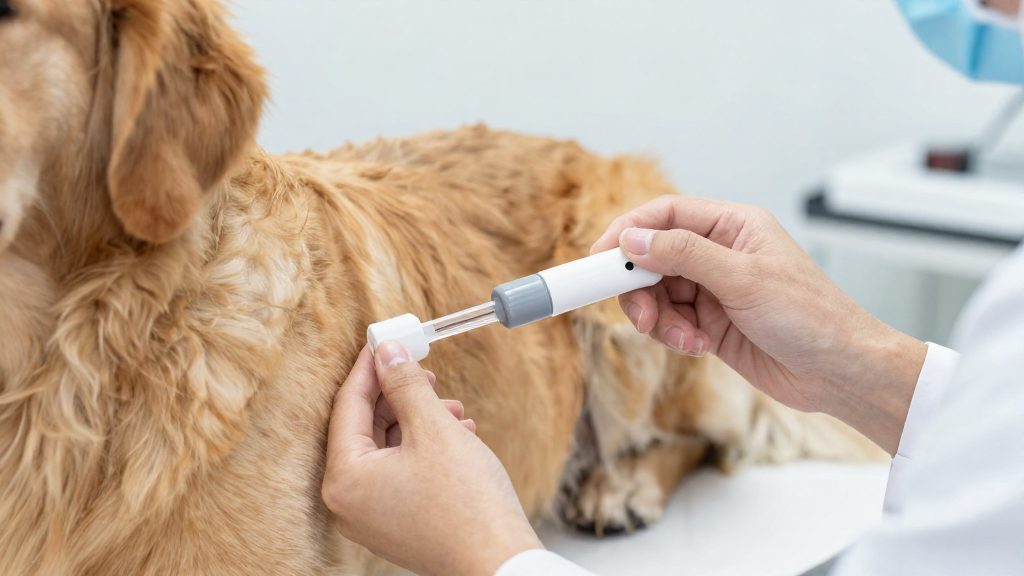
Heartworm is uncommon across Canada as a whole, but that national average does not show whether an individual dog is at risk, because exposure depends on where the dog lives, how much time it spends outdoors, and whether it travels.
Is heartworm a risk for dogs in Canada?
Nationally, the risk is low. According to the University of Saskatchewan, Western College of Veterinary Medicine (2021), Canadian national surveys found heartworm in under 1% of dogs. A national study in the same source reported a seroprevalence of 0.42% across 115,636 samples.
| Measure | Reported figure |
|---|---|
| Dogs with heartworm in Canadian national surveys | Under 1% |
| National seroprevalence | 0.42% |
| Samples in the national study | 115,636 |
Seroprevalence is the proportion of samples that show evidence of exposure to the parasite. It describes how often exposure is detected in the sampled population, not how often a given dog will be diagnosed.
Why low prevalence does not remove individual risk
National averages combine areas with very different exposure. According to the University of Saskatchewan, Western College of Veterinary Medicine (2021), transmission in Canada is seasonal, and a national average can understate the risk for a dog that lives in or travels to regions where the parasite is endemic. A dog in one of those regions can be at risk even though the national figure is low.
Individual risk is therefore a local question. The factors that matter most are:
- Local endemic status: whether the dog’s home area has seasonal transmission.
- Mosquito exposure: how much time the dog spends outdoors during mosquito season.
- Travel history: whether the dog has been to or through endemic areas.

Where is heartworm found in Canada?
Heartworm (Dirofilaria immitis) is not spread evenly across Canada. According to the University of Saskatchewan’s Companion Animal Parasite Education Program (CPEP), seasonal endemic transmission occurs in five areas: southern British Columbia, Manitoba, Ontario, Quebec and New Brunswick. Transmission in these areas generally runs from about May to October, the period when the mosquitoes that carry the parasite are active. Outside these regions, infection is uncommon, and a dog found infected there most likely picked it up during travel.
The five seasonal endemic regions
| Region | Classification | Transmission window |
|---|---|---|
| Southern British Columbia | Seasonal endemic | About May to October |
| Manitoba | Seasonal endemic | About May to October |
| Ontario | Seasonal endemic | About May to October |
| Quebec | Seasonal endemic | About May to October |
| New Brunswick | Seasonal endemic | About May to October |
The official sources consulted do not specify whether the transmission window differs between the northern and southern parts of each province, so the table should be read as a general seasonal guide, not a local forecast.
Why non-endemic provinces are classed differently
Classification reflects where transmission is established, not where a dog happens to live. Provinces and territories outside the five listed regions are not treated as seasonal endemic, so the testing logic changes.
The reason for the distinction is practical:
- Low prevalence: Where local transmission is rare, a positive result is more likely to be a false positive than a true infection.
A dog living in a non-listed province that passed through an endemic region is therefore assessed under the travel rule, not treated as a resident of an endemic area.
How does the heartworm antigen test work?
The antigen test detects a protein released by adult female worms (University of Saskatchewan, CPEP). It does not look for the worms themselves or for their larval stage. Because of this, the test can only register an infection once adult females are present in the dog. The official sources consulted describe this as a delay of about 6–7 months after exposure before the test becomes positive (University of Saskatchewan, CPEP).
This delay is the main reason the test can miss an infection. A dog exposed to mosquito-borne heartworm can be infected and still test negative if the test is run before that window has passed. The same applies when a dog carries only male worms, since the antigen the test detects comes from females.
CPEP identifies testing too early and male-only infections as causes of false negatives, and Pets.ca adds that a negative result does not rule out young or few worms. Taken together, the sources indicate that the test measures an established infection with adult female worms rather than any exposure at all.
| Situation | Likely test result | Reason given by sources |
|---|---|---|
| Adult female worms present, about 6–7 months after exposure | Positive | Antigen from adult females is detectable |
| Test run before the 6–7 month window | Negative, even if infected | Adult females have not yet produced detectable antigen |
| Infection with male worms only | Negative | Detected antigen comes from adult females |
| Young or low-number infection | May be negative | A negative result does not rule out young or few worms |
When should my dog be tested?
Timing depends on whether a dog lives in or travels to an endemic area, and on when its last possible mosquito exposure occurred.
The spring antigen window
The University of Saskatchewan (CPEP) identifies spring, April to May, as the ideal time for antigen testing in Canada. The University of Saskatchewan, Western College of Veterinary Medicine (2021-03-21) states that May is the best month. This window falls roughly six to seven months after the end of the typical transmission season, which is why it is the most reliable point in the year to test.
Endemic dogs: before and after prevention
For dogs in endemic areas, the schedule is anchored to preventive treatment:
| Testing point | Timing |
|---|---|
| Before preventives are started | Before the first dose of monthly prevention |
| Follow-up test | 6–7 months after the last possible mosquito exposure |
| Last possible exposure in Canada | Generally October |
| Best month for the follow-up test | May |
The Western College of Veterinary Medicine (2021-03-21) advises that antigen testing be performed at least six months after the last possible mosquito exposure and that dogs be tested before starting monthly prevention.
The official sources consulted do not specify a seasonal calendar for dogs living outside the endemic provinces listed above.
How often should dogs be tested?
Heartworm testing in Canada does not follow one fixed calendar for every dog. The University of Saskatchewan’s Companion Animal Parasite Education Program (CPEP) advises that veterinarians assess risk each year and decide on testing case by case. Frequency therefore depends on where a dog lives and travels, not on the date alone.
Annual risk review by the veterinarian
Each year, the veterinarian reviews the dog’s exposure risk, including home region and travel history, and then decides whether to test. Two dogs of the same age can therefore follow different schedules. CPEP advises that the decision be made case by case.
Where annual testing is advised
CPEP states that annual testing is often advised in highly endemic areas. The official sources consulted do not specify which municipalities or districts qualify as highly endemic, so owners should ask their veterinarian.
| Area type | Testing approach | Source |
|---|---|---|
| Endemic: southern BC, Manitoba, Ontario, Quebec, New Brunswick | Veterinarian reassesses risk yearly; annual testing often advised in highly endemic areas | CPEP |
| Non-endemic areas | Test only dogs that travelled to or through endemic areas more than seven months earlier | CPEP |
Dogs on preventives still need the review
Preventive medication does not remove the need for the annual review. CPEP advises that annual testing is often recommended in highly endemic areas even for dogs already on preventives. Owners should not treat a preventive as a replacement for the veterinarian’s yearly risk assessment.
What owners can prepare
- Bring the home postcode to each annual visit.
- Ask the veterinarian to state in writing whether the dog’s risk category changed that year.

What does a positive or negative result mean?
A positive heartworm antigen result indicates that adult female heartworms are probably present, but it is not a standalone diagnosis. According to Pets.ca, a positive can reflect a true current infection, a past infection that the dog’s immune system has cleared, or a false positive caused by another disease. A negative result is also not automatically conclusive, because testing too early or an infection with male worms only can produce a false negative. Interpretation therefore depends on the dog’s microfilariae status, travel history and local risk.
Antigen-positive with no microfilariae
A dog that is antigen-positive but has no microfilariae and no suggestive history should be retested in six months, according to the University of Saskatchewan (CPEP). The retest allows the veterinarian to check whether the result is confirmed before any further decisions are made.
Positive results in non-endemic areas
Heartworm prevalence is low across Canada. Because of this low background rate, a large share of positive results in non-endemic areas may be false positives, according to the University of Saskatchewan (CPEP).
| Result pattern | Context | Interpretation |
|---|---|---|
| Antigen-positive, no microfilariae, no suggestive history | Per CPEP guidance | Retest in six months (CPEP) |
| Antigen-positive | Non-endemic area, no recent endemic travel | Possible false positive; a second test and chest X-rays follow (Pets.ca) |
| Antigen-negative | Dog tested too early after exposure | May be a false negative (CPEP) |
Why a negative result may not be final
A negative result does not rule out young or low numbers of worms, according to Pets.ca.
Interpreting the result with a veterinarian
The veterinarian combines the test result with the dog’s exposure history, the local risk level, and whether preventives have been used. The official sources consulted do not provide a single decision rule for all cases, so the final interpretation is made individually.
Does travelling change testing needs?
Yes. For a dog that lives outside endemic areas, the travel history decides whether testing is considered at all. The University of Saskatchewan (CPEP) advises testing only dogs that travelled to or through endemic areas more than seven months earlier. This seven-month rule exists because the antigen test detects adult female worms.
Travel to or through an endemic area counts as exposure
Heartworm is transmitted by mosquitoes. Under the sources, travel through an endemic area carries the same weight as travel to one. A dog that crossed an endemic region on a road trip falls under the same rule as a dog that stayed there.
Most non-endemic cases likely come from travel
Most cases found outside endemic areas are likely acquired through travel. Because the background rate is low, travel history is the main factor that separates a non-endemic dog that needs testing from one that does not.
Applying the rule
| Dog’s situation | Guidance from the sources |
|---|---|
| Non-endemic home, endemic travel within the last seven months | Testing now may give a false negative; ask your veterinarian when to test and report any symptoms promptly |
| Non-endemic home, endemic travel more than seven months earlier | Test, as the sources recommend for this group |
| Non-endemic home, no endemic travel | Outside the travel-based rule; the sources limit non-endemic testing to dogs with such travel |
The official sources consulted do not specify whether the seven-month count starts on the day of return or on the last possible exposure, so ask your veterinarian to confirm the reference date for your dog.
When to see your vet
A scheduled antigen test is a planned check, not a way to assess a dog that is already showing symptoms. If a dog develops new signs, the owner should contact a veterinarian promptly, whatever the testing calendar says. Coughing and other signs can have many causes, so the vet decides whether heartworm is involved.
Respiratory signs are the first category to report. Difficulty breathing, collapse or fainting is an emergency: contact a veterinarian or an emergency veterinary clinic immediately, not a routine appointment. A persistent cough, meaning one that keeps returning rather than settling, especially after walks or play, should be examined in person rather than monitored at home.
| Situation | Action | Reason |
|---|---|---|
| Persistent cough, particularly with exercise | Book a veterinary examination now | Respiratory signs need assessment independent of any testing schedule |
| New symptoms after recent travel to or through an endemic area | Contact the vet and report the travel dates and destination | Symptoms in a dog with an exposure history are assessed on their own merits |
| Reduced stamina or unexplained lethargy | Arrange a visit and note when the signs started | The vet can decide on testing based on the clinical picture |
Owners should give the vet a complete picture: the period of possible mosquito exposure, and whether monthly prevention was given and when it started. This history helps the vet decide which tests to run and how to interpret them.
Frequently asked questions
When should a dog in Canada be tested for heartworm?
In areas where heartworm is endemic, the University of Saskatchewan’s Companion Animal Parasite Education Program (CPEP, undated) advises testing a dog before preventives are started and again six to seven months after its last possible mosquito exposure. The antigen test detects adult female worms and becomes positive about six to seven months after exposure, so your veterinarian sets the timing case by case.
My dog travelled to an endemic area. Does it need a test?
CPEP (undated) advises testing a dog from a non-endemic home only if it travelled to or through an endemic area more than seven months earlier, because testing sooner can produce a false negative. Your veterinarian decides the timing, and any symptoms should be reported promptly in the meantime.
How reliable is a positive heartworm test?
A positive antigen test can reflect a current infection, an earlier infection the immune system has cleared, or a false positive caused by another disease. Pets.ca (undated) notes that a positive result is followed by a second test and chest X-rays. A negative result does not rule out infections with few or young worms.