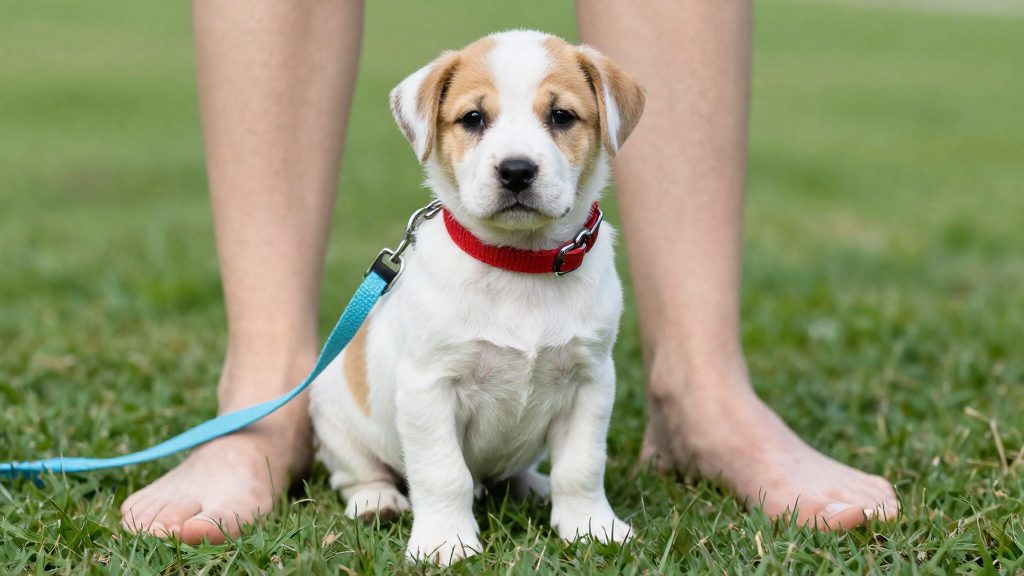
Why does leash training matter for your puppy?
Leash training matters because a puppy that walks calmly on a lead is easier to control near traffic, in parks and around other dogs, and early practice helps set the walking habits the puppy carries forward. The lead is the main point of control outdoors, so the way a puppy learns to accept it, and the expectations it forms during the first weeks, carry forward. Starting early means the puppy learns the lead as a normal part of life rather than something to resist. The points below explain the safety, socialisation and habit reasons for early leash work before any technique begins.
Road safety and reliable control on lead
A puppy that has not learned to tolerate lead tension may pull or react strongly when startled. The Ontario SPCA and Humane Society (2023-11-20) advises conditioning puppies early to the gear and to leash tension. The lead is often the only physical control a young dog has near roads, bicycles or unfamiliar people. Teaching the puppy to stay near you on a slack lead, and to respond to its name and a simple cue, reduces how often you need to rely on the lead alone. The official sources consulted do not specify road rules or distances, so check the traffic and dog-walking regulations that apply where you live.
Outdoor exposure during the socialisation period
The Ontario SPCA and Humane Society (2023-11-20) suggests skipping leash walks for the first few weeks after a puppy arrives, because new surroundings can be overwhelming. Use that time for indoor conditioning to the collar, harness and leash. The official sources consulted do not give an exact socialisation age range in weeks, so this article does not state one. The official sources consulted do not give an exact socialisation age range in weeks, so this article does not state one.
Habits formed early that persist into adulthood
Early sessions set the expectations a dog carries into adult walks. Short, successful sessions teach the puppy that the lead predicts a pleasant activity, not a struggle. Habits such as walking beside you and staying calm when stopped are worth building early, while the puppy is small and easy to manage.
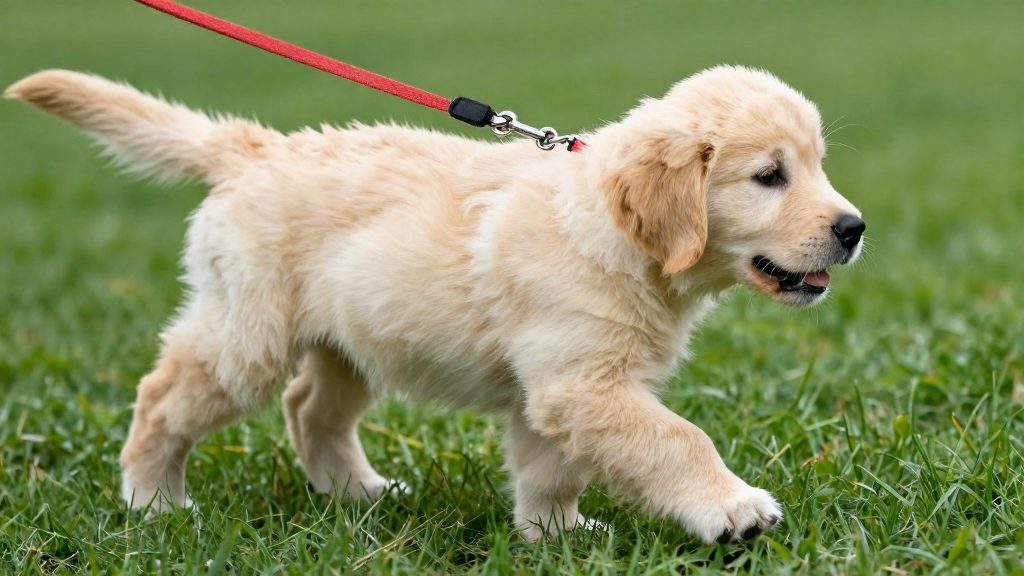
Gear to get before the first walk
Early leash training needs only three core items, plus an optional walking tool for difficult days. According to the Ontario SPCA and Humane Society (2022-04-26), the basic kit is a leash long enough to stay slack, small tasty treats, and a marker, which is either a word or a clicker. The leash length matters because the method depends on a loose line: the handler waits for the puppy to step forward with the leash hanging, rather than holding it taut.
Small, tasty treats
Choose treats small enough to swallow quickly, so the puppy does not stop walking to chew. The Ontario SPCA and Humane Society (2023-11-20) identifies high-value rewards as the most effective method of positive reinforcement, so use something the puppy wants more than its regular meals. Keep the treats in a pouch or pocket at knee height so each one can be delivered at the moment of the step.
The marker: a word or a clicker
A marker tells the puppy exactly which behaviour earned the treat. The source gives “Yes!” or a click as examples. Pick one and use it consistently, and avoid using the same word in ordinary conversation, so the puppy learns that it signals a reward. Practise the marker with the treat before the first walk so that the timing is already familiar.
Head halter or harness for rushed days
The Ontario SPCA and Humane Society (2022-04-26) states that a humane walking tool, such as a head halter or harness, can help on rushed or overwhelming days so that training does not regress. Its purpose is to protect progress on hard days. The source does not present it as a substitute for the loose-leash method itself.
Getting your puppy used to the collar or harness
Puppies are not born accepting collars, harnesses or leashes, so the goal is to make the gear feel neutral before any walk starts. According to the Ontario SPCA and Humane Society (2023), puppies need to be conditioned early to both the gear and leash tension. Each stage is paired with a treat, and you move on only when the puppy reacts happily or neutrally. Introducing gear this way lets the puppy learn that the harness predicts something good.
Stepwise harness introduction
The Ontario SPCA and Humane Society (2023) describes a sequence in which each step is treated before the next one begins.
| Stage | What you do | Move on when |
|---|---|---|
| 1. Show | Hold the harness where the puppy can see and sniff it, then give a treat | The puppy approaches the harness |
| 2. Approach | Bring the harness closer to the puppy and treat again | The puppy stays relaxed as it gets closer |
| 3. Head pass | Pass the harness over the puppy’s head, then treat | The puppy accepts the head pass |
| 4. Loose fit | Fasten the harness loosely and leave it on for a few minutes, treating throughout | The puppy stays happy or neutral |
If the puppy reacts badly at any stage, return to the previous step instead of pushing forward.
Passing the harness over the head before fastening
The head pass is a separate skill from fastening. Let the puppy put its head through the opening on its own terms, then reward it immediately. Fasten the buckles only once the puppy moves into the harness without hesitation. Fasten the harness only when the puppy is happy or neutral, as the source advises moving on only at that point.
Tolerating collar and leash tension early
Introduce the collar and leash indoors, in a quiet room, before any outing. Attach the leash, let the puppy move around, and treat it while the leash is in use. Leash tension should feel like an ordinary part of the environment, not a signal to stop or struggle.
How do you teach loose-leash walking step by step?
Loose-leash walking is taught as a repeatable loop: the puppy hears a cue, walks forward on a slack line, is marked at the moment it steps forward, and receives a treat at your knee. According to the Ontario SPCA and Humane Society (2022), the method needs a leash long enough to stay slack and small, tasty treats. Each repetition follows the same sequence, and rewards are reduced only once the puppy walks reliably beside you.
Step 1: Keep the leash slack and give a cue
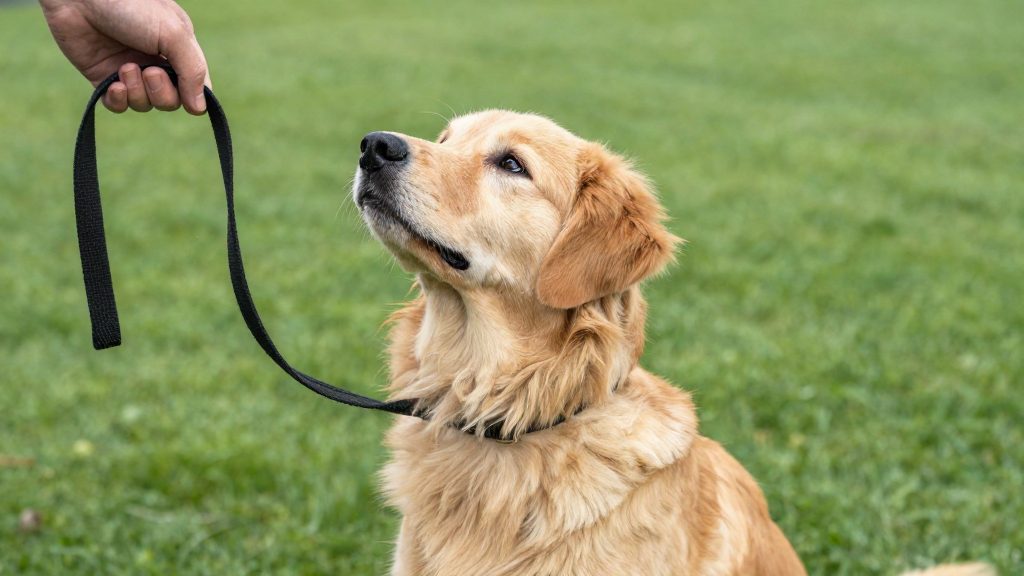
Hold the leash with a slack line from the first step. Say a consistent cue such as “Let’s go!” and start walking. The cue tells the puppy that a walk has begun, so the behaviour is tied to a specific word and to your movement together.
Step 2: Mark each forward step and treat at the knee
When the puppy steps forward with you, mark that exact moment with your chosen marker, then give a small treat at your knee. Delivering the treat at your side keeps the puppy’s attention close to you. At this stage, reward almost every step, so the puppy learns quickly that walking with you pays off.
Step 3: Thin the rewards at random intervals
Once the puppy keeps the leash slack across several steps, reward less often and at random intervals. Because the puppy cannot predict which step will earn a treat, the walking habit is maintained with fewer treats. Continue to pair the cue, the walking and the marker, so the pattern stays the same while the reward schedule changes.
What should you do when your puppy pulls?
When a puppy pulls, the Ontario SPCA and Humane Society (2022-04-26) lists four techniques, each with a clear action or cue. The aim is to make the leash go slack again and then give the puppy a defined reward, so the pulling stops paying off.
| Technique | How to apply it |
|---|---|
| Stop and wait (“be a tree”) | Stand still until the leash slackens, then reward. |
| U-turn | Change direction before the puppy reaches the end of the leash. |
| Lure past a distraction | Hold a treat at the puppy’s nose and guide it past the distraction. |
| “Go sniff” release cue | Say the cue to give the puppy permission to investigate. |
Stopping and turning
Stopping is the first response to tension. Stand still, remain quiet, and wait until the leash slackens. Reward the moment it does. The U-turn works in a similar way but happens earlier: change direction before the puppy reaches the end of the leash, then walk on in the new direction. Because you turn before the leash is fully taut, the puppy has to keep track of you to stay on your route.
Luring past distractions
When a passing dog, a person or a strong smell pulls the puppy toward it, hold a small, tasty treat at the puppy’s nose and guide it past the distraction. Use a treat small enough that the puppy can eat it quickly and keep moving.
Giving permission to sniff
Sniffing is a natural activity for a puppy, so the Ontario SPCA and Humane Society (2022-04-26) suggests building it into the walk as a reward. Use a release cue such as “Go sniff” to give permission to investigate. The puppy then has a defined moment to explore, which is easier to manage than letting it pull toward every smell on its own.
Keeping sessions short and rewarding
Leash training works best in brief sessions. The Ontario SPCA and Humane Society (2022) recommends keeping each training session to about 5 to 15 minutes and ending while things are going well. A puppy has a short attention span, so a session that runs too long usually ends in fatigue or frustration rather than learning. Setting a timer before you start helps you keep to the limit.
Choosing the session length
Practise a single skill per session, such as a few steps of walking with a slack leash, instead of combining several routes, distractions and exercises. A narrow goal makes it easier to see whether the puppy is progressing and to stop before it tires.
Ending while the puppy is still engaged
The aim is to stop at a good moment, not when the puppy has lost interest. Finish right after a successful repetition, while the puppy is still watching you and moving with you. If the puppy starts to pull hard, sniff persistently or ignore its treats, end the session calmly instead of pushing through.
Spacing short sessions across the day
Spread the short sessions across the day, with other activities in between, so the puppy does not face a continuous stream of training. The official sources consulted do not specify how many sessions a day are appropriate or how much time should separate them, so adjust the number to the puppy’s energy level and to what you can maintain consistently.
When to ask a trainer or your vet for help?
Most leash problems in puppies respond to consistent home practice, but some signs point to a medical cause or to fear that needs a professional. Stop the walk and contact a vet the same day when a puppy shows signs of pain or discomfort, such as limping, yelping or refusing to move. Sudden severe pain or an inability to walk is an emergency: go to a veterinary clinic or emergency animal hospital immediately, and phone ahead. Get help from a qualified trainer when a behaviour problem persists despite steady, short training sessions.
Physical signs that need a vet check
Pain can look like a behaviour problem. A puppy that refuses to walk or pulls back from the leash may be hurting, not stubborn. Watch for:
- Limping or favouring a leg during or after a walk
- Reluctance to start walking, sitting down repeatedly, or stopping without a clear reason
- Flinching, yelping, or pulling away when the collar is touched or tightened
- Scratching or chewing at the neck, or visible redness or soreness under the collar
Do not keep walking a puppy to see whether it “gets used to” the discomfort. Remove the collar, check the neck and legs for injury, and book a veterinary appointment. Tell the vet exactly when the signs appear, such as only on the leash or only after exercise.
Fear, reactivity and aggression on the leash
Once walks begin, some fear is normal. Seek help if the reaction does not ease with time and calm exposure.
Call a qualified professional if the puppy shows:
- Reactivity: lunging, barking, or growling at people, dogs or noises, with the reaction growing stronger over time
- Freezing, hiding, or trying to escape the leash, rather than settling after a short period
- Snapping, stiffening, or biting when handled on the leash
- Fear that spreads to new locations or to walks it previously accepted
Aggression is a safety issue for the puppy, other people and other animals. Do not punish a growl, since it is a warning that the puppy is uncomfortable. Use distance, avoid triggers, and ask a professional for a plan.
Choosing a qualified trainer
When a problem persists, look for a trainer who uses positive reinforcement, which the Ontario SPCA and Humane Society (2023-11-20) presents as the most effective method. Before booking, check that the trainer:
- Describes their methods and explains what a session with your puppy will involve
- Does not rely on force, intimidation, or physical corrections
-
- Can explain their training background and methods, so you can judge whether they suit your puppy
- Is willing to observe a session or speak with you before work begins
Ask your vet for referrals if the puppy also shows any physical signs above, since a behaviour problem may have a medical component that a trainer cannot assess.
Frequently asked questions
When can I start walking my new puppy on lead?
The Ontario SPCA and Humane Society (2023-11-20) suggests skipping lead walks for the first few weeks after a puppy arrives and using that time for indoor conditioning to the collar, harness and lead. The official sources consulted do not give a week count, so ask your vet or breeder when outdoor walks suit your individual puppy.
What equipment do I need to start leash training?
The Ontario SPCA and Humane Society (2022-04-26) lists a lead long enough to stay slack, small tasty treats and a marker, such as a word or a clicker. It adds that a humane walking tool, such as a head halter or a harness, can help on rushed or overwhelming days so that training does not regress.
My puppy limps or refuses to walk on lead. Should I wait and see?
Stop the walk and contact a vet the same day if your puppy shows signs of pain, such as limping, yelping or refusing to move. Sudden severe pain or an inability to walk is an emergency: go to a veterinary clinic or emergency animal hospital immediately and phone ahead. This is general guidance rather than a sourced threshold.